
License Plate Recognition for a Gated Texas Estate: Why One Camera Is Never Enough
A camera that records your gate is not the same as a camera that reads plates. Here is what license plate recognition needs to work on a gated Texas estate, and why the reliable setup uses two cameras, not one.
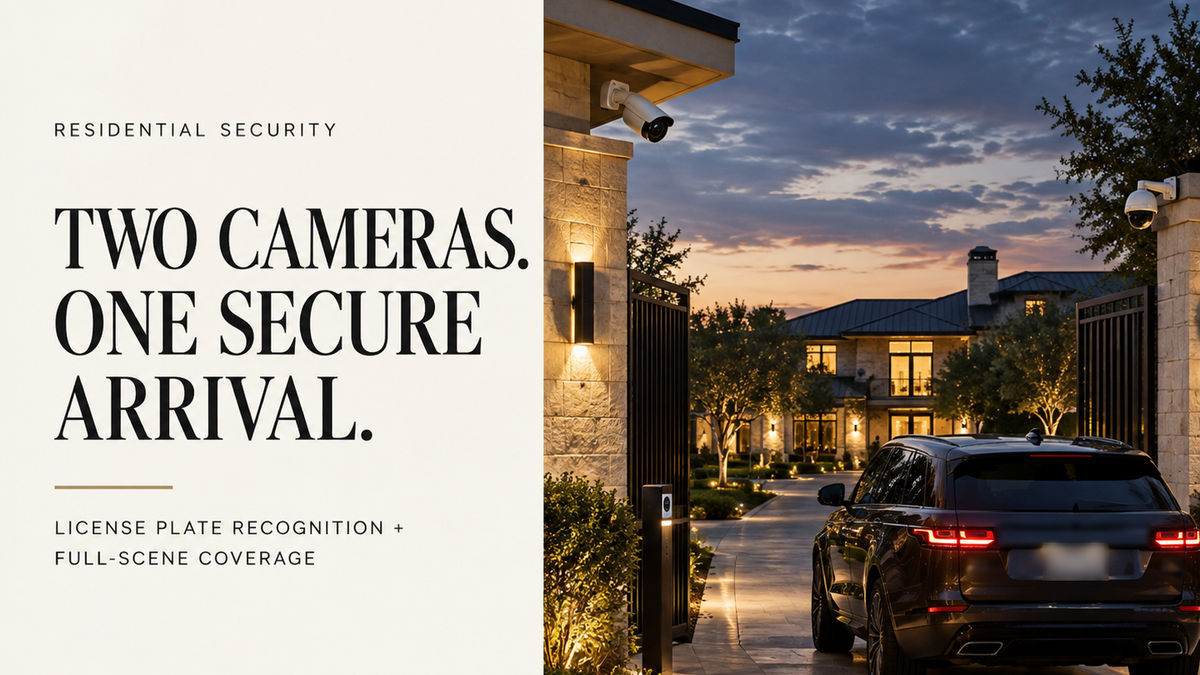
A dark SUV rolls up to your gate at 6:40 on a November evening. The camera recorded it. Play the clip back, and the plate is a glowing white rectangle with nothing readable inside it.
That is the usual way license plate recognition lets a homeowner down. The hardware worked. The setup did not. Plates are coated to bounce light straight back, so a camera firing its own night light photographs the glare, not the characters.
A license plate recognition camera for home use can do far more than record, if it is placed and tuned for its one job. At a gated estate, it reads each plate, checks it against your list, and decides what happens next.
SEIITS lists license plate recognition for driveway monitoring, along with gate access integration, among the capabilities on its residential security service page.
What is license plate recognition, and how is it different from a security camera?
License plate recognition is software that converts the plate in a video frame into text and compares that text with a stored list, while an ordinary security camera only records footage a person has to read afterward. That difference decides whether your gate can act on a plate or merely remember it.
A research overview submitted to the U.S. Department of Justice describes automated plate recognition as a high-speed camera with infrared capture, plus optical character recognition (OCR) software that turns letters in an image into searchable text. A camera that lets a person read a plate on playback is a capture camera. Add software that writes a searchable, time-stamped entry, and you have LPR.
Why does a gated estate need two cameras at the gate?
A gated estate needs two cameras at the gate because a camera tuned to read plates at night sees almost nothing else. Plate-reading guidance commonly calls for shutter speeds of about 1/1000 of a second or faster, which freezes the characters but leaves most of the frame nearly black after dark.
That trade is right for reading and useless for knowing who was driving or whether someone stepped out. The overview camera answers those questions. Even the Justice Department report above describes a typical plate record as a black-and-white plate image stored with a separate color context image.
|
|
Plate camera |
Overview camera |
|
Its
one job |
Read
the plate as text |
Show
the vehicle, driver and scene |
|
Field
of view |
Narrow,
aimed at the plate zone |
Wide,
covers the gate and approach |
|
Night
settings |
Fast
shutter, its own infrared light |
Standard
night vision |
|
What
you see after dark |
Plate
characters and headlights |
The
vehicle, people and movement |
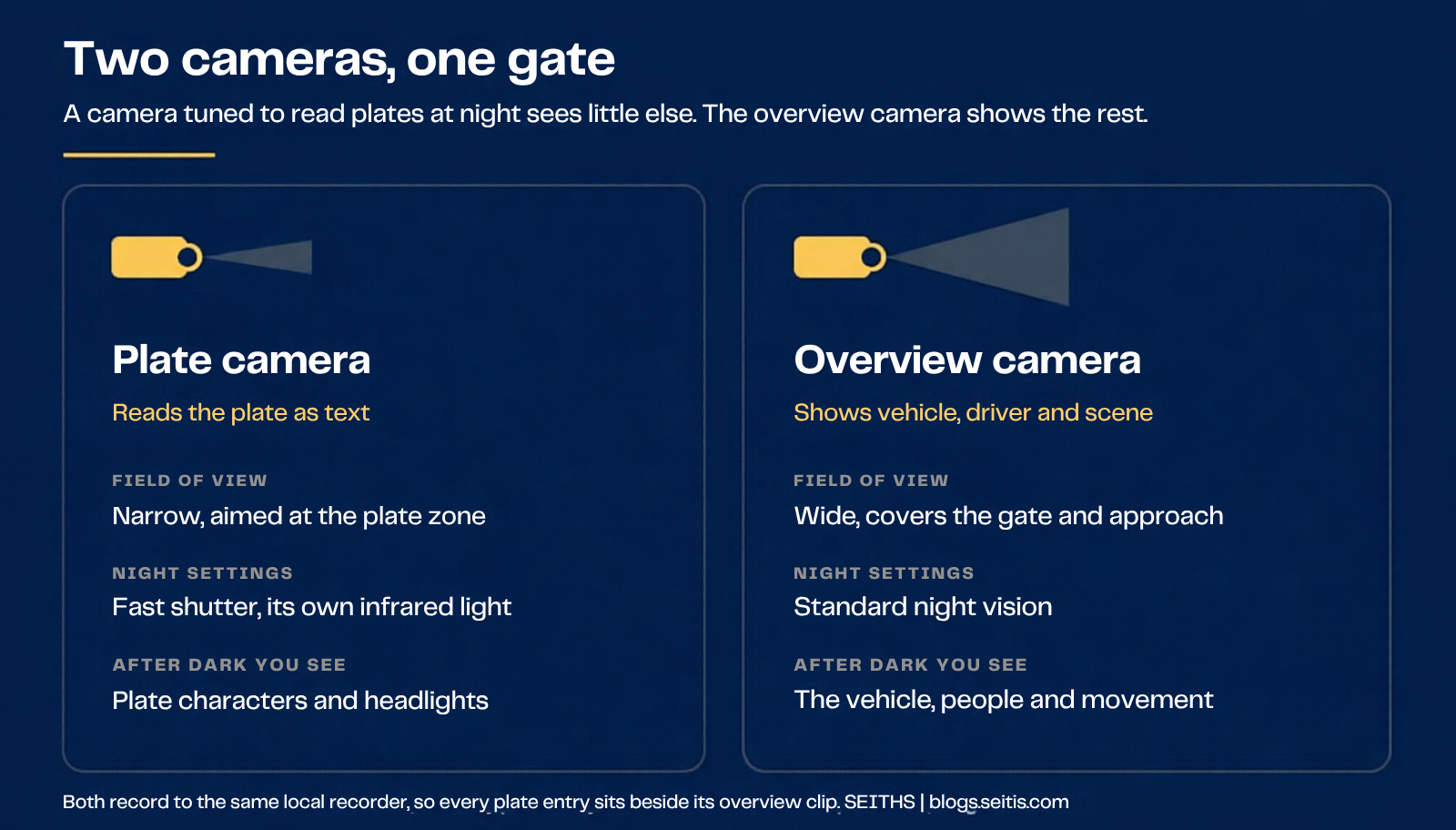
Record both to one recorder and every plate entry sits beside its overview clip. For how gate cameras fit the wider system, see what professional camera coverage costs on a Texas estate.
Where should a plate camera go on a driveway or motor court?
A plate camera belongs where vehicles slow or stop, facing them as straight on as the site allows, with its own light and a hardwired connection. Placement matters more than resolution.
1. Pick the slow point. The gate apron or motor court entry, where a car brakes, gives the camera a still target.
2. Keep the angle shallow. Mount near plate height, aimed down the approaching lane; steep angles stretch the characters.
3. Give it its own infrared light. Leaning on a built-in night light at close range is the classic cause of the white-rectangle plate.
4. Hardwire power and data. Power over Ethernet (PoE) carries both on one cable, so the camera never depends on WiFi or a battery. The smart gate access control guide covers options for a distant gate.
5. Keep the logs at home. Plate entries belong on your local recorder, on a camera network kept apart from family devices by a VLAN (virtual local area network), as the home WiFi security guide explains.
Still building? Run conduit to the gate before the driveway is poured, as the new construction technology planning guide explains. The gate link shares the wired backbone that feeds your ceiling access points.
What Texas factor changes the setup?
Texas law requires most passenger vehicles to carry both a front and a rear plate, which in theory makes a camera facing arriving traffic ideal. In practice, not every car that reaches your gate will have a front plate mounted.
A Texas House committee analysis of a 2025 bill noted that state statute requires two plates, and that some modern vehicles are built with no front bumper spot to mount one. A camera facing incoming traffic gets nothing from those cars.
The fix is design, not a better camera. A missing front plate should route the visitor to the intercom and overview camera, never to a silent failure or an open gate. Where the exit lane allows, a rear-plate read on the way out completes the record.
What should happen after the camera reads a plate?
A plate read should start the arrival sequence, not just add a line to a log. On a recognized plate, a connected system can open the gate, turn on driveway and path lights, and notify the household, with the entry time-stamped.
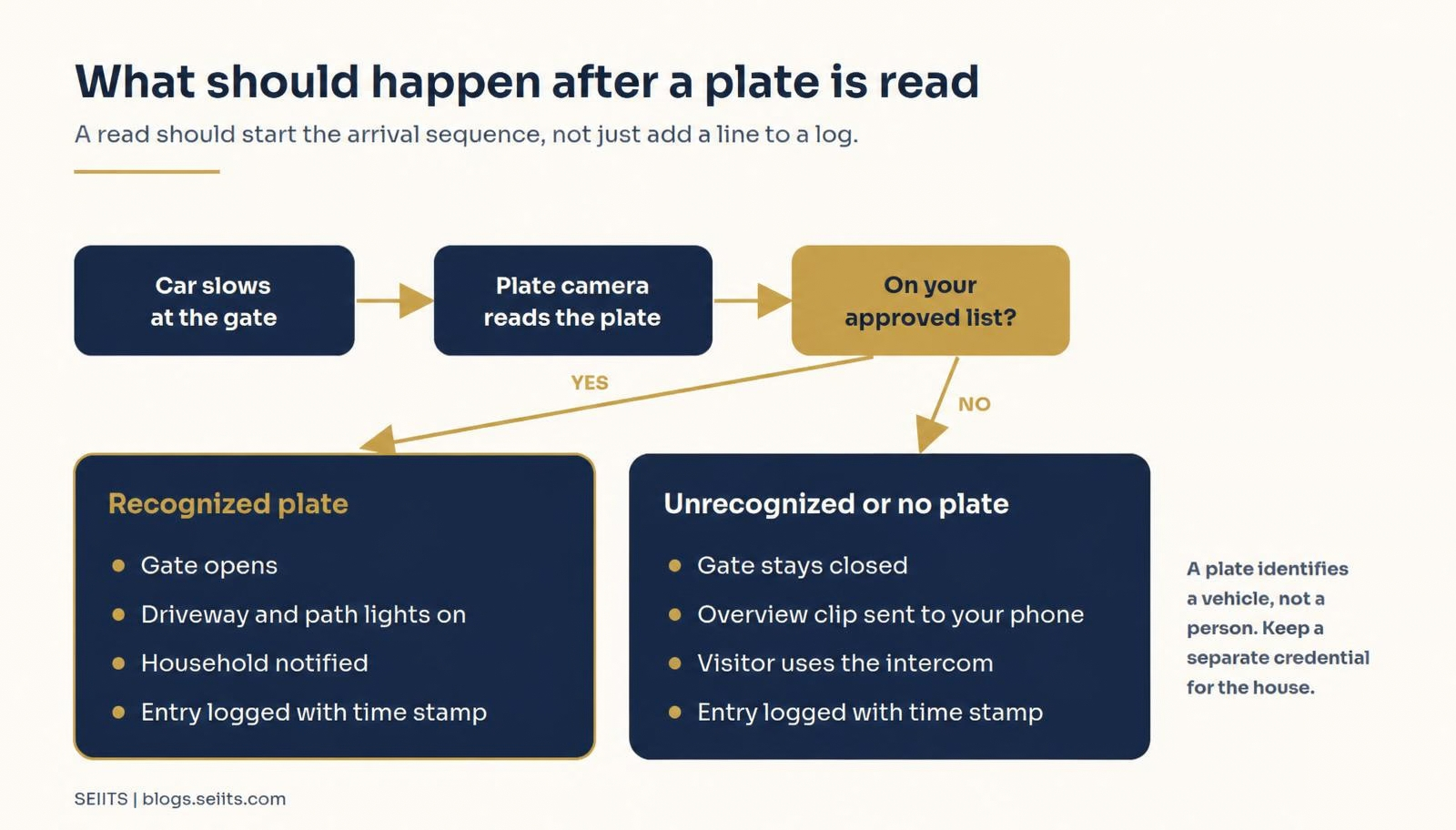
On an unrecognized plate, the gate stays closed, the overview clip goes to your phone, and the visitor uses the intercom. Housekeepers and regular contractors get scheduled windows, not permanent access, the logic behind professional access control. Gate-triggered smart lighting belongs to the same whole-home automation design.
One caution most sellers skip. A plate identifies a vehicle, not a person. Anyone driving a recognized car inherits its access, and plates can be copied. Use plate recognition for convenience at the gate and a record of every arrival, and keep a separate credential for the house itself. It all runs over the managed estate network, so SEIITS treats the gate as part of one system, not a gadget.
How can you test whether your gate camera can read plates?
You can test your current gate camera tonight, using footage it has already recorded, in about fifteen minutes. The five checks below show whether the problem is glare, speed, angle or a missing second camera, which tells you what a fix actually involves.
1. Pull an after-dark arrival. Pause on the frame where the car is closest. If the plate is a white rectangle, the camera's own night light is washing it out.
2. Compare a daytime arrival. A plate that reads by day but not at night points to lighting and night settings, not resolution.
3. Check a car at normal speed. Smeared characters mean the shutter is too slow or the camera is watching a spot where cars do not slow down.
4. Look at the same moment for context. If you can read the plate but not see the vehicle or driver, or the reverse, one camera is doing half the job.
5. Find where the clip lives. If you cannot pull it up while the internet is down, your footage is not being kept on the property.
Frequently asked questions
Can a regular security camera read license plates?
A regular security camera can capture a plate clearly enough for a person to read on playback, if it is close, well lit and aimed at a slow-moving car. It cannot read the plate automatically. Turning a plate into searchable text, and acting on it at a gate, requires recognition software.
Do I need a dedicated license plate recognition camera for my home?
You need dedicated plate recognition only if you want the system to act on plates automatically, or to search every arrival by plate. For a gated estate with staff, contractors and deliveries, that searchable log is the point. For reviewing the occasional incident, a well-placed standard camera can be enough.
Can license plate recognition open my gate automatically?
It can, if the gate is connected to the system. When a plate matches your approved list, the software can send the gate an open command. Whether you should allow that depends on the gate and your comfort level, because a plate identifies a car, not a driver, and plates can be copied.
Does license plate recognition work at night?
It works at night when the plate camera has its own infrared light, a fast shutter and fixed focus. Plates are made to reflect light, so a camera relying on its built-in night light at close range often records a glowing blank. Tuning the night settings on site matters more than resolution.
Does Texas require a front license plate?
Yes. Texas Transportation Code Section 504.943 requires most passenger vehicles to display a front and a rear plate. Many cars still arrive without a front plate mounted, so an estate gate should never depend on a front-plate read alone. A missing plate should send the visitor to the intercom instead.


Comments ()