
Smart Lighting Installation in Texas: The 2026 Homeowner's Guide to Costs, Brands, and Real Savings
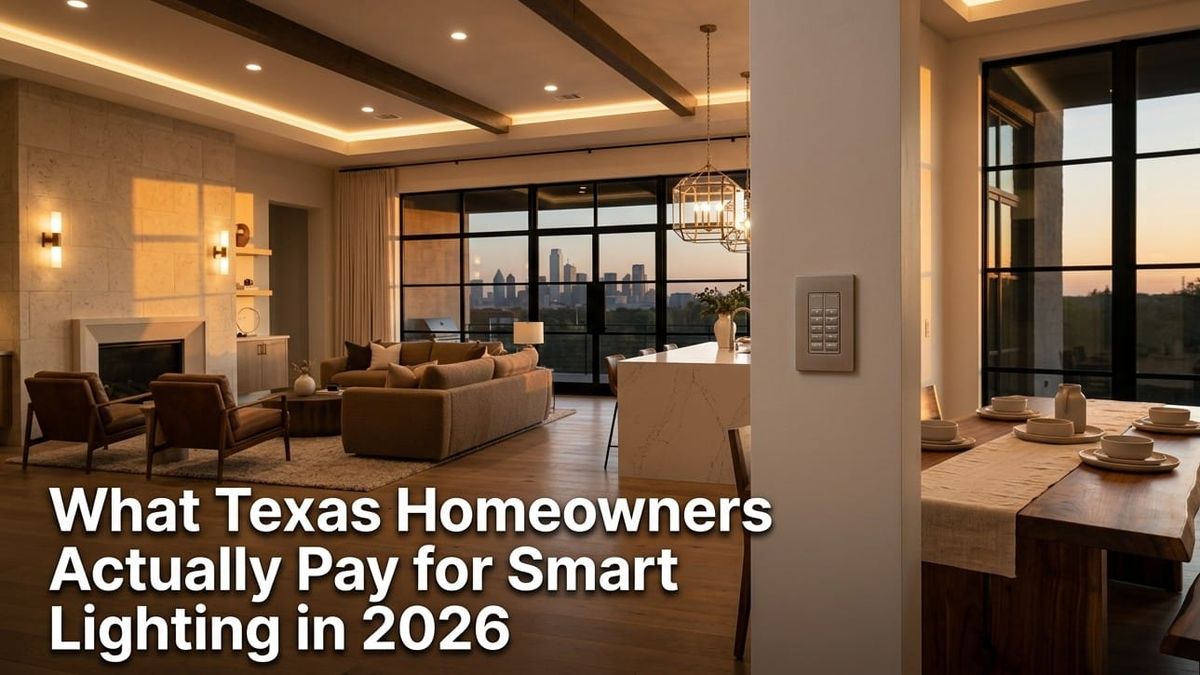
Smart lighting installation in Texas typically costs between $300 and $8,500, depending on home size and how deep you want to go. A basic DIY upgrade in a single room runs under $200. A full luxury installation across a 4,000-square-foot Dallas home with Control4 or Lutron integration can exceed $15,000.
That's the honest range. Most competitor sites won't tell you this upfront because it scares buyers. But if you're in Texas and thinking about smart lighting, you deserve numbers that actually help you plan.
I've spent the last 7 years installing and integrating smart lighting systems for Texas homeowners in Dallas, Austin, Houston, San Antonio, and Plano. This guide walks you through what smart lighting installation actually involves in Texas, which brands work best for our climate and electrical code, how much you'll pay, and how to avoid the three most common mistakes homeowners make.
By the end, you'll know whether to DIY, hire a local electrician, or bring in a luxury home technology integrator. You'll also have real numbers for budgeting against your 2026 ERCOT bill.
Why Smart Lighting Installation Matters More in Texas
Every state benefits from smart lighting. But Texas has three specific factors that change the math.
1. High Electricity Rates and ERCOT Grid Volatility
Texas runs its own independent grid through ERCOT. When demand spikes during July and August heatwaves, wholesale prices swing wildly. Most homeowners are insulated from the spikes by fixed-rate plans, but the underlying cost pressure pushes retail rates steadily upward. The average Texas residential rate climbed from 14.67 cents per kWh in January 2025 to around 16.18 cents per kWh in April 2026, per U.S. Energy Information Administration data.
That's a 10 percent jump in 15 months. Every kWh your smart lighting saves is worth more each year.
2. Extreme Summer Heat and Cooling Load
Smart lighting indirectly cuts AC costs. LED bulbs (the foundation of every smart system) release roughly 90 percent less heat than the incandescents they replace. In a Dallas or Houston summer, every watt of heat your lights don't produce is a watt your AC doesn't have to fight. Across a whole home, that's a meaningful secondary saving you won't see in most product spec sheets.
3. Large Square Footage and Luxury Construction
The median Texas home is larger than the national average. In Dallas luxury markets (Highland Park, Preston Hollow, Southlake) and Austin enclaves (Westlake, Barton Creek), 5,000 to 12,000 square foot homes are common. More lights, more fixtures, more waste when managed manually. Proper smart lighting design in these homes isn't a luxury. It's the only reasonable way to manage that much lighting.
What Smart Lighting Installation Actually Includes
Smart lighting installation is not just screwing in a smart bulb. A proper installation in a Texas home typically includes some or all of the following components.
Hardware Components
- Smart bulbs (Philips Hue, LIFX, TP-Link Kasa, Wyze) for lamps and simple fixtures
- Smart switches and dimmers (Lutron Caseta, Leviton Decora Smart) to replace standard wall switches
- Motion and occupancy sensors for halls, bathrooms, closets, garages
- Daylight sensors for exterior and sunroom spaces
- Smart plugs to automate lamps without replacing the bulbs
- Lighting control hubs (Lutron Smart Bridge, Philips Hue Bridge, Control4 controller, Savant Host)
- Keypads and touchscreens for scene control in luxury homes
Software and Integration
- Primary control app configuration (per brand)
- Voice assistant setup (Amazon Alexa, Google Home, Apple HomeKit, Siri)
- Scene programming (Morning, Dinner, Movie, Goodnight, Away, Vacation)
- Schedule and automation rules based on sunrise/sunset, occupancy, geofencing
- Integration with HVAC, shades, security, and AV systems
Labor and Setup
- Electrical assessment and circuit check for load compatibility
- Neutral wire verification (required for many smart switches, often missing in older Texas homes)
- Physical installation of switches, sensors, and hubs
- Wi-Fi network audit (most consumer routers can't handle 40+ smart devices reliably)
- System programming, testing, and user training
- Documentation and handover
Reality check: A DIY homeowner usually skips the last five items. That's fine for 2 to 4 bulbs in one room. It falls apart fast in a 20+ device install.
Cost of Smart Lighting Installation in Texas (2026 Pricing)
Most sites in the Texas SERP dodge real numbers. Here are the actual ranges you'll see quoted in Dallas, Austin, Houston, and San Antonio as of April 2026.
Per-Device Installation Costs
Whole-Home Installation Budgets by Home Size
What drives cost up: Homes without neutral wires in existing switch boxes (common in pre-1985 Texas homes). Integration with existing Control4 or Savant systems. Outdoor landscape lighting. High ceilings that require lift rental. Luxury keypad engraving and finish upgrades.
What keeps cost down: Starting with smart bulbs instead of switches. Sticking to one brand ecosystem. Pre-wire during new construction or remodel. Choosing no-hub brands like LIFX if you're DIY.
DIY vs Professional Installation: Which Is Right for You?
This is the single question most Texas homeowners get wrong. The answer depends on four factors.
Choose DIY If...
- You're replacing 1 to 10 smart bulbs in existing fixtures (no wiring involved)
- You're installing smart plugs for lamps
- You live in a home built after 2000 with standard wiring and neutral wires at every switch
- You're comfortable with Wi-Fi setup, app configuration, and troubleshooting
- Your total project budget is under $500
- You're fine with a single-brand system (all Hue or all Kasa)
Choose a Licensed Electrician If...
- You're replacing hardwired switches, dimmers, or fan controls
- Your home was built before 2000 and may lack neutral wires at every switch
- You want motion sensors hardwired into specific circuits
- You need new dedicated circuits or electrical panel upgrades
- You plan to cover more than 15 fixtures
- Your Texas city requires permits for electrical work (most do)
Choose a Luxury Home Technology Integrator (like SEIITS) If...
- You own a 3,500+ square foot home and want whole-home automation
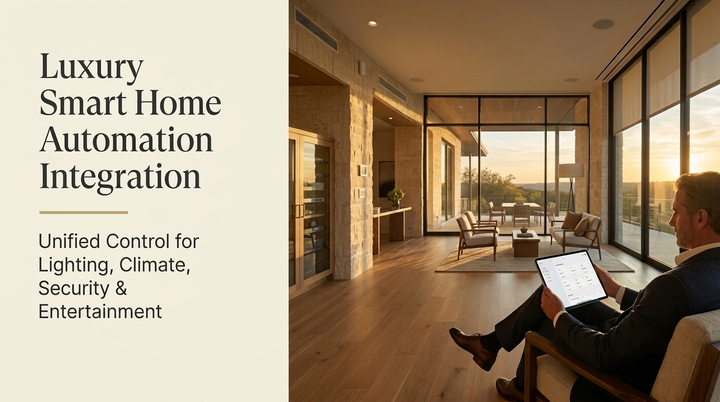
- You want lighting integrated with AV, security, HVAC, shades, and wireless networking
- You use (or plan to use) Control4, Lutron HomeWorks, Savant, Josh.ai, or Crestron
- You want keypads and scene control instead of just app-based control
- You want ongoing support, firmware updates, and remote troubleshooting
- You're building new construction or doing a major remodel in a luxury Texas market
The biggest mistake we see: homeowners who start DIY with 10 bulbs, then try to scale to 50 without a hub, and end up with a broken system and a $900 sunk cost. If you're heading toward whole-home, start right. Book a free SEIITS assessment and we'll audit your existing setup before you spend another dollar.
Best Smart Lighting Brands for Texas Homes in 2026
After 7 years of installations across Dallas, Austin, Houston, and San Antonio, here's how the major brands actually perform in Texas conditions.
Luxury Tier
Best for 3,500+ square foot homes, whole-home automation, and homeowners who value reliability over DIY flexibility.
Mid-Tier (Prosumer)
Best for 1,500 to 3,500 square foot homes, DIY-capable homeowners who want pro-grade performance.
Budget Tier
Best for renters, bedrooms, closets, and homeowners testing smart lighting before committing.
SEIITS recommendation: For Texas homes under 2,500 sq ft, Lutron Caseta (switches) plus Philips Hue (lamps and accent) is the sweet spot. Reliable, expandable, HomeKit-compatible, and survives firmware updates without breaking.
Step-by-Step Installation Process
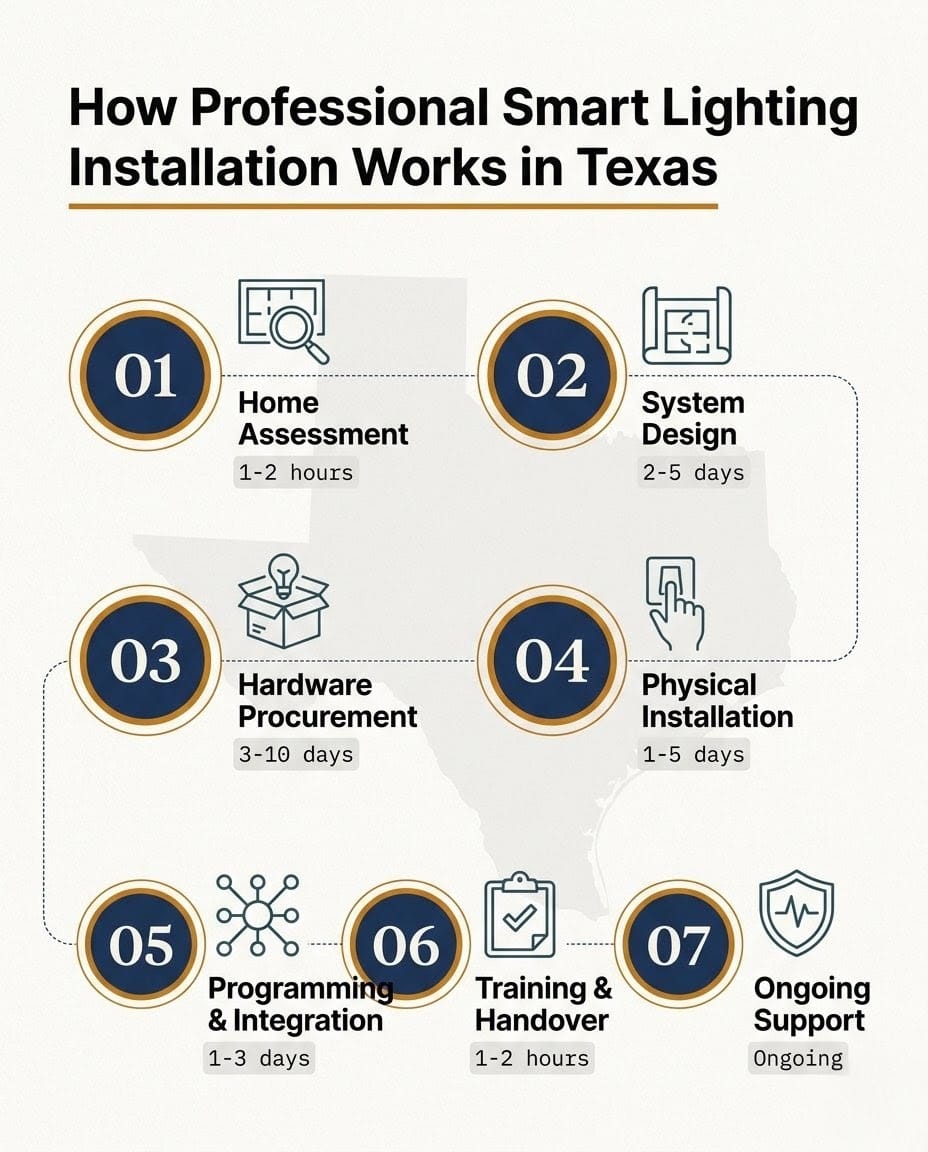
Here's what actually happens during a professional smart lighting installation in Texas, step by step.
Step 1: Home Assessment (1 to 2 hours)
A technician walks through your home and documents every light fixture, switch location, and existing electrical condition. We check neutral wires, circuit loads, Wi-Fi coverage, and note any spots that need dedicated circuits or sensor placement.
Step 2: System Design (2 to 5 days)
Based on the walk-through, we design the system. This includes brand selection, fixture map, sensor locations, scene programming logic, hub placement, and integration with any existing smart home gear. You approve the plan before any hardware is ordered.
Step 3: Hardware Procurement (3 to 10 days)
We order through professional dealer channels. This matters because luxury brands like Lutron HomeWorks, Control4, and Savant aren't sold direct to consumers. Turnaround ranges from same-week for stock items to 2 to 3 weeks for custom keypad engraving.
Step 4: Physical Installation (1 to 5 days)
For a 2,500 sq ft home: roughly 1 to 2 days. For a 6,000 sq ft home: 3 to 5 days. This includes removing old switches, installing smart switches with proper neutral connections, mounting sensors, placing hubs, running any additional low-voltage cabling, and verifying every fixture works under load.
Step 5: Programming and Integration (1 to 3 days)
This is where most DIY setups fall apart. We program every scene, schedule, voice command, geofence rule, and integration. For luxury installs, we also integrate lighting with HVAC (so unused rooms go dark and AC adjusts), security (arm/away triggers vacation mode), and AV (movie scenes dim automatically).
Step 6: Training and Handover (1 to 2 hours)
We walk you and your family through the system. Everyone learns: main control app, voice commands, keypads (if installed), and how to override automations manually. We leave documentation you can actually read.
Step 7: Ongoing Support
SEIITS Membership clients get proactive system health monitoring. When firmware updates break something (they do, roughly 3 to 4 times per year across major brands), we know about it before you do and resolve it remotely. Non-members can book service calls as needed.
Texas Electrical Code and Permit Requirements
Smart lighting installation in Texas is regulated under the National Electrical Code (NEC) as adopted by the Texas Department of Licensing and Regulation, plus local city amendments. Here's what matters for homeowners.
When a Licensed Electrician Is Required
- Any installation that modifies hardwired devices (switches, dimmers, fixtures)
- Adding or moving circuits, junction boxes, or outlets
- Installing new dedicated circuits for heavy loads (outdoor landscape lighting, large chandeliers)
- Any work in a new construction home during the rough-in phase
- Most permitted electrical work in Dallas, Austin, Houston, San Antonio, and Fort Worth
When Permits Are Typically Required
Rules vary by city, but the general pattern across major Texas markets:
- Dallas: permits required for any hardwired switch/fixture replacement in occupied residential structures
- Austin: permits required for new circuits, optional for in-kind replacements
- Houston: permits required for most electrical work; homeowner permits available for owner-occupied properties
- San Antonio: similar to Houston
Skipping permits is risky. Uninspected electrical work can void homeowners insurance and create complications when selling the home. A proper SEIITS or licensed electrician installation includes pulling the correct permits.
Safety Essentials
- Neutral wire verification at every smart switch location (older Texas homes often lack this)
- AFCI and GFCI compliance on newer circuits
- Surge protection for hubs and controllers (Texas lightning storms are brutal)
- Proper grounding of all low-voltage equipment
Real Energy Savings: The ERCOT Math
Most articles throw out a "save 20 to 40 percent" number without showing the work. Here's the actual math for a Texas household.
Baseline Assumptions
- Average Texas home: 1,100 to 1,146 kWh per month (EIA data, April 2026)
- Average rate: 16.18 cents per kWh (EIA Texas residential, April 2026)
- Average monthly bill: $178 to $180
- Annual bill: approximately $2,136
- Lighting as percentage of total home electricity use: 10 to 15 percent
- Annual lighting spend per Texas household: approximately $213 to $320
Expected Savings by Installation Tier
The full integration tier is where luxury systems pay for themselves. A $15,000 whole-home Control4 installation saving $500 per year on electricity breaks even on energy alone at year 30. That's not the point. The point is the 5 percent bump in resale value, the $300 you save per month combined with security and comfort gains, and the 15 years of use you get out of a properly installed system.
Three Common Texas Installation Mistakes (and How to Avoid Them)
Mistake 1: Buying Smart Bulbs for Switches That Already Have Dimmers
Pairing a smart bulb with an existing analog wall dimmer causes flicker, buzz, and premature failure. The correct fix is to either replace the dimmer with a smart dimmer (and use regular LEDs) or replace the switch with a standard on/off and use smart bulbs. Mixing doesn't work.
Mistake 2: Using Consumer Wi-Fi for a 40+ Device Install
Most consumer routers start struggling at 30 to 40 connected devices. A whole-home smart lighting system can easily add 50 to 100 devices. Without a proper mesh network or Wi-Fi 7 upgrade, you'll see random dropouts, slow responses, and bulbs showing "Not Responding" in the app. In larger Texas homes, this is our #1 cause of service calls. Plan your network before your lighting.
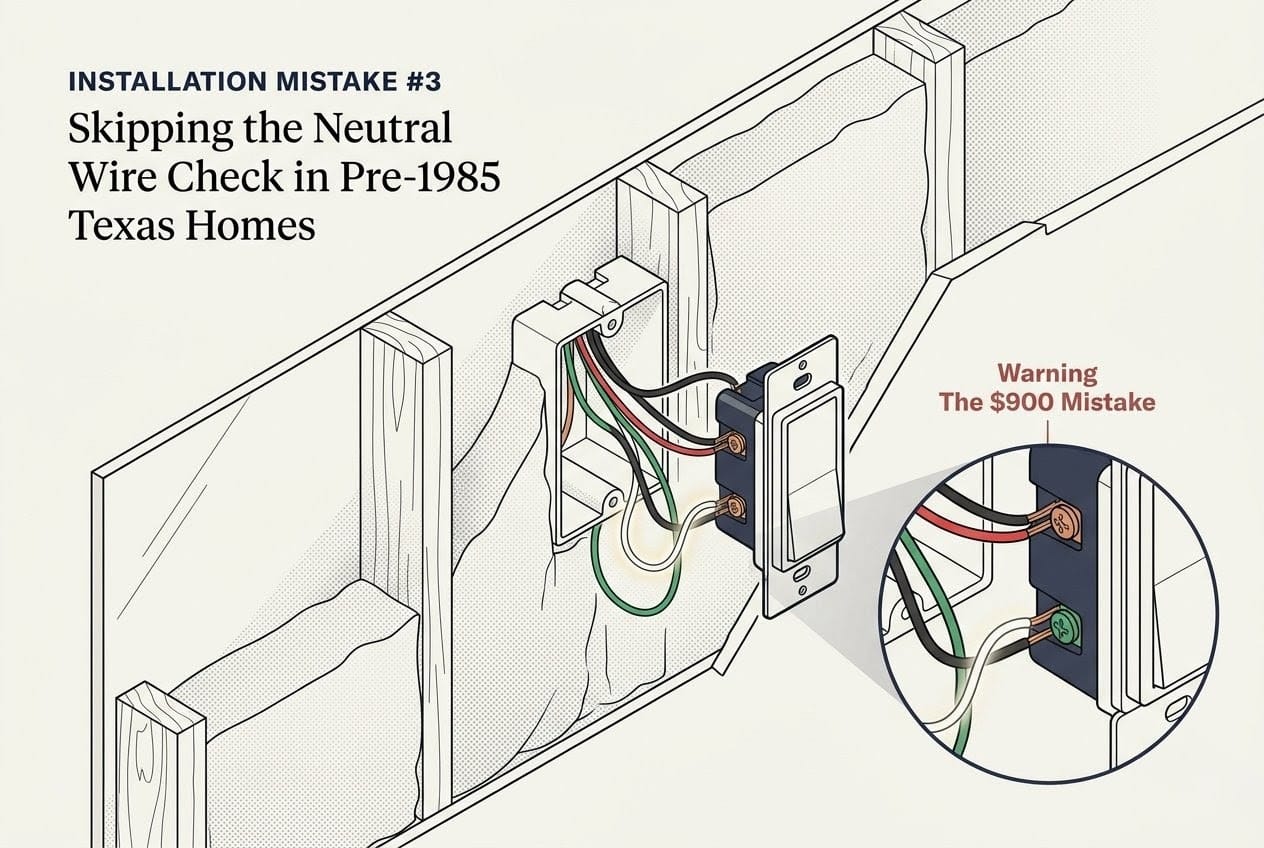
Mistake 3: Skipping Neutral Wire Verification in Older Homes
Many Texas homes built before 1985 don't have neutral wires at every switch box. Most smart switches require a neutral to power themselves. Homeowners buy switches, open the box, and discover the issue mid-install. Fixes range from using battery-powered Lutron Caseta (works without neutral) to running new wire (expensive). Verify before you buy.
When to Hire a Luxury Integrator vs a Regular Electrician
Both are licensed. Both can install smart switches. The difference is what happens after installation.
If you live in a Highland Park, Southlake, Westlake, River Oaks, Memorial Villages, or any other affluent Texas neighborhood and you're planning new construction or a major remodel, a luxury integrator will save you money in the long run. Not because we're cheaper per hour. Because we prevent the $5,000 rip-and-replace that happens when a regular electrician installs Hue bulbs in every fixture and later discovers you need a Lutron HomeWorks system to tie lighting into your Crestron AV rack.
Where SEIITS Installs Smart Lighting in Texas
SEIITS provides smart lighting installation and integration across Texas luxury markets. Our primary service areas:
Dallas-Fort Worth Metroplex
Dallas, Highland Park, University Park, Preston Hollow, Southlake, Westlake, Colleyville, Plano, Frisco, McKinney, Prosper, Flower Mound, Coppell, Las Colinas, Lakewood, Lake Highlands, Fort Worth, Arlington, Grapevine
Austin Metro
Austin, Westlake, Lakeway, Rollingwood, Barton Creek, West Lake Hills, Tarrytown, Bee Cave, Cedar Park, Round Rock, Georgetown, Dripping Springs
Houston Metro
Houston, Memorial, River Oaks, Tanglewood, West University, Bellaire, The Woodlands, Sugar Land, Katy, Cypress
San Antonio Metro
San Antonio, Alamo Heights, Terrell Hills, Olmos Park, Shavano Park, Hill Country Village, Stone Oak, Boerne
Outside these markets? We still take on select projects across Texas for the right fit. Reach out and we'll let you know.
Frequently Asked Questions About Smart Lighting Installation in Texas
How much does smart lighting installation cost in Dallas, Texas?
Smart lighting installation in Dallas typically ranges from $300 for a basic DIY setup in a single room to $15,000+ for a full luxury whole-home system with Control4 or Lutron HomeWorks. Per-switch professional installation costs $75 to $150, and per-bulb costs $25 to $40 installed. A mid-tier Dallas installation (2,500 sq ft home with smart switches in main rooms and a hub) typically runs $4,000 to $8,000.
Do I need a permit for smart lighting installation in Texas?
Yes, in most cases. Dallas, Houston, Austin, and Fort Worth all require electrical permits for hardwired switch and fixture replacements. Swapping smart bulbs in existing fixtures does not require a permit. Any licensed electrician or luxury integrator handles permitting as part of the installation.
Can I install smart lighting myself in an older Texas home?
For smart bulbs and smart plugs, yes. For smart switches, only if you confirm your switch boxes have a neutral wire. Many Texas homes built before 1985 don't, and attempting installation without one either fails or creates a code violation. Lutron Caseta is one brand that works without a neutral wire and is a safer DIY pick for older homes.
Which smart lighting brand is best for large Texas homes?
For homes over 3,500 square feet, Lutron HomeWorks or Control4 (paired with Lutron Caseta Pro on switches) is the most reliable choice. Consumer-grade Wi-Fi brands like Philips Hue work well for under 40 bulbs but can become unstable at scale. Luxury-grade systems use dedicated wireless protocols (like ClearConnect on Lutron) that don't congest your home Wi-Fi.
How long does professional smart lighting installation take?
For a typical 2,500 square foot Texas home: 1 to 2 days including programming. For a 6,000 square foot home with full integration: 3 to 5 days. New construction installations can take 2 to 4 weeks spread across the build timeline, coordinating with the framing and drywall phases.
Can smart lighting really reduce my electricity bill in Texas?
Yes. A well-configured system saves 15 to 35 percent on lighting costs. For a typical Texas household spending roughly $213 to $320 per year on lighting at 16 cents per kWh, that's $32 to $112 in direct annual savings. When integrated with HVAC and motorized shades, whole-home savings reach $300 to $600 per year in larger homes.
Does smart lighting work during Texas power outages?
Smart lights themselves don't work without power (no light can). However, Zigbee and Z-Wave based systems (like Philips Hue and Lutron Caseta) retain their programming and resume normal operation when power returns. Wi-Fi-only systems may take a few minutes to reconnect. For outage resilience, pair your smart lighting with a UPS backup for the hub and router.
Will smart lighting work with ERCOT time-of-use electricity plans?
Yes, and this is one of the biggest underused savings opportunities in Texas. Smart lighting with scheduling automatically dims during peak pricing hours (typically 2 to 7 PM in summer on TOU plans). Combined with shade automation and smart thermostats, you can shift significant load off peak pricing windows.
Do smart switches work with ceiling fans?
Only specific models. Standard smart switches aren't rated for fan motor loads. For ceiling fans, use fan-specific smart controls like Lutron Caseta Fan Control, Bond Bridge (retrofit for existing fan remotes), or fans with built-in smart control (Hunter HomeKit, Minka Aire AireControl).
What happens if my Wi-Fi goes down?
Depends on the system. Lutron and Philips Hue continue to work locally through their hubs with schedules and button presses intact. Wi-Fi-only brands like LIFX and WiZ lose remote and voice control until Wi-Fi returns, but manual switch control and existing schedules typically continue.
Can smart lighting integrate with my existing home security system?
Yes, through most major security platforms including Ring, ADT, Alarm.com, and Control4 security. When the security system arms "away," lights can auto-dim or trigger vacation simulation. When motion is detected at night outside, exterior lights can flood on. SEIITS handles this integration as part of our whole-home technology installations.
Is smart lighting worth it for a rental property in Texas?
For short-term rentals (Airbnb, VRBO) in Austin or Dallas: absolutely. Self-check-in codes, pre-arrival lighting scenes, and remote control during guest stays are huge. For long-term rentals, usually not worth the investment unless you're targeting premium tenants in luxury markets.
How do I choose between Alexa, Google Home, and Apple HomeKit for my lighting?
Pick the ecosystem your household already uses. If everyone has iPhones, HomeKit is smoother. If you're already deep in Google (Android, Google Calendar, Google Nest), Google Home. If you have Echo devices already, Alexa. Most modern smart bulbs support all three, so this is about personal preference, not limitation.
Do I need motion sensors in every room?
No. Motion sensors work best in transitional spaces: hallways, stairs, bathrooms, closets, garages, utility rooms. They don't work well in living rooms, offices, or bedrooms where people sit still for long periods. For those rooms, use schedules or manual control.
What's the warranty on professionally installed smart lighting in Texas?
Hardware warranty varies by brand (Lutron offers 5 to 15 years depending on product line, Philips Hue offers 2 years, Control4 offers 2 years). Installation labor warranty from SEIITS: 1 year on workmanship for all one-time installations, unlimited duration for SEIITS Membership clients.
Book Your Smart Lighting Installation with SEIITS
SEIITS is a Texas-based luxury home technology integrator serving Dallas, Austin, Houston, San Antonio, and surrounding luxury markets. We install, integrate, and maintain smart lighting systems for affluent homes alongside AV, wireless networking, security, and preventative technology maintenance.
Three ways to work with us:
1. One-Time Service Call: $498 flat-rate installations, repairs, and configuration for single-issue projects. Book here.
2. Service Call Bundles: Prepaid packages with concierge support and parts coverage. Save up to $500 vs pay-per-visit. Explore bundles.
3. Full SEIITS Membership: All-inclusive home technology stewardship covering wireless, AV, lighting, security, and maintenance. Apply for membership.
Not sure which path is right? Book a free home technology assessment. We'll walk your home (virtually or in person), evaluate your existing systems, and recommend a smart lighting plan sized to your space, lifestyle, and budget.
Related Reading on the SEIITS Blog
- Lutron vs Control4: Best Smart System for Lighting and Shades in Luxury Homes (2026 Guide)
- Home Automation Company Near Me: The Complete Guide for Dallas, Austin, and Houston Homeowners (2026)
- Installing a Smart Thermostat in Texas: What You Must Know Before Getting Started
- Wi-Fi 7 Installation Services in Texas: Why Consumer Routers Fail in Luxury Homes and Large Properties
- Why Texas Luxury Developers Are Integrating Smart Home Technology (2026)
Comments ()