
Motorized Shades Cost in Texas: What Luxury Estates Pay for Lutron and Hunter Douglas (2026)
Every Texas motorized shade quote comes back different. One dealer says $600 per window. Another says $2,400. Both are right — they are quoting completely different products. This guide breaks down what Lutron and Hunter Douglas actually cost in Texas in 2026.
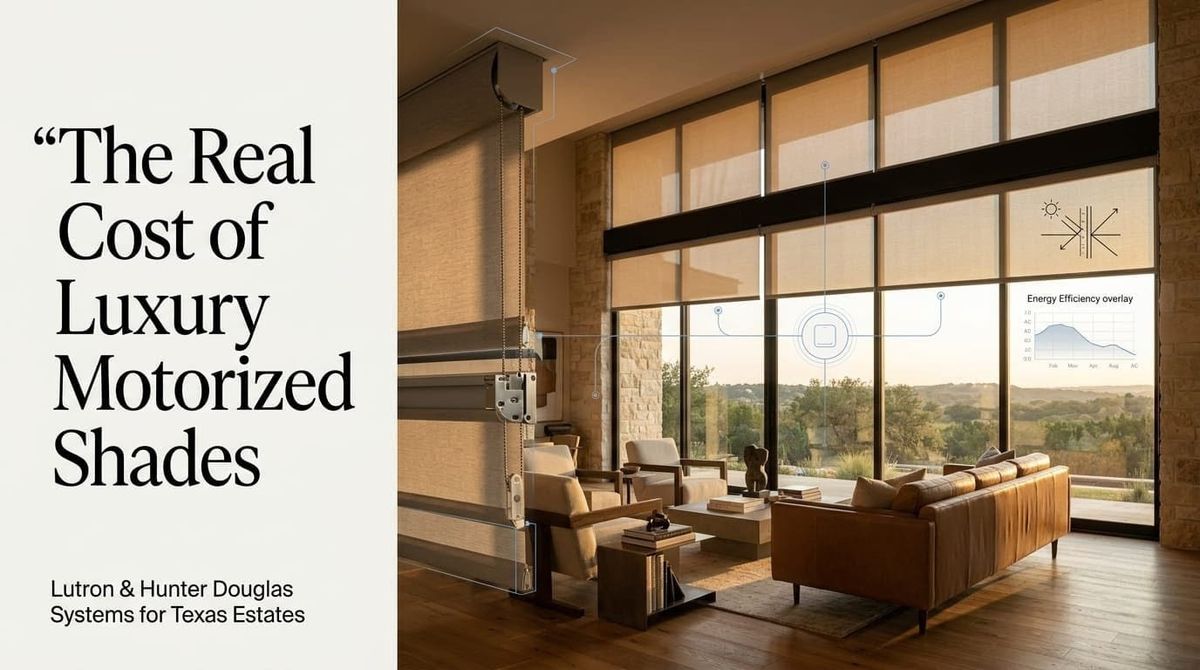
Three quotes for the same Southlake estate. The first came in at $14,000 for 22 windows. The second was $31,000. The third was $52,000.
The homeowner thought two of the dealers were lying. They were not. The $14,000 quote used battery-powered rollers from a mid-market brand. The $31,000 quote used Hunter Douglas PowerView hardwired with Gen 3 motors. The $52,000 quote used Lutron Sivoia QS hardwired with Control4 integration and a professional commissioning day. Same window count. Three completely different products.
This is the motorized shade market in Texas. The price difference between entry and reference tier is not a markup. It is a completely different buying decision.
SEIITS is a Texas luxury home technology concierge that specifies and installs motorized shade systems integrated with Control4 and Savant for estates across DFW, Austin, and Houston. Visit seiits.com/lightingservices for the full SEIITS lighting and shading service.
What Motorized Shades Actually Cost in Texas: The Honest Breakdown
Motorized roller shades cost $400-$900 per window for professional-grade battery systems in Texas. That is the honest starting point for a quality installation, not a cheap retrofit. Everything below $400 per window is a consumer product that will not hold up to Texas summer heat, will not integrate with Control4 or Savant, and will need replacement within three to five years.
But the number that actually matters for a Texas luxury estate is the whole-home number. Per-window pricing in isolation is like quoting a home theater per speaker. The scope, the integration, and the commissioning are where the real cost lives.
Lutron vs Hunter Douglas: The Real Difference for Texas Luxury Estates
This is not a brand war. Both are professional-grade products that will perform reliably for ten to fifteen years when properly installed. The right choice depends on what else is in your home.
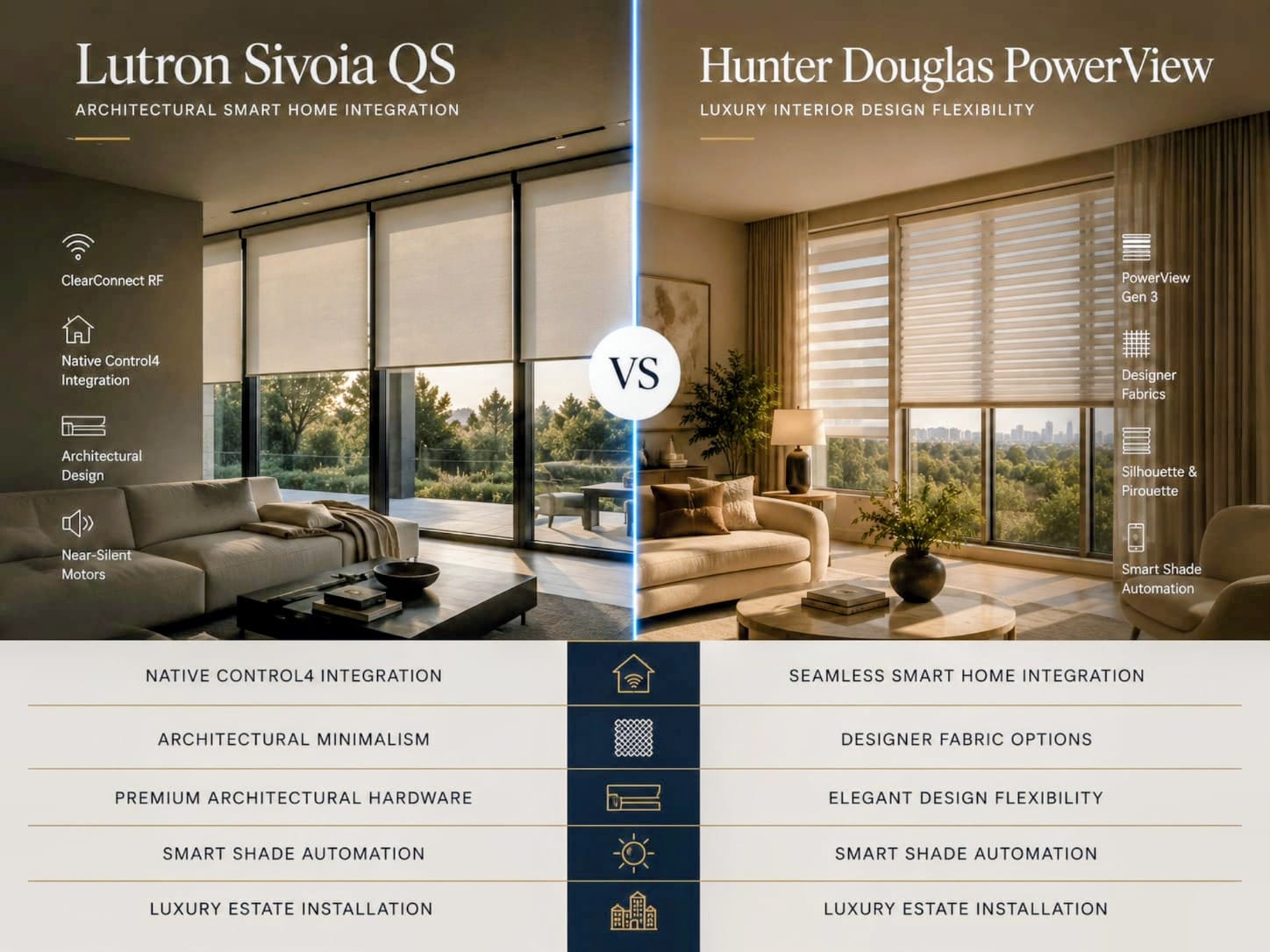
If your estate runs Lutron lighting already, Lutron shades are almost always the correct answer. The reason is integration depth. Lutron's ClearConnect RF protocol handles both lighting and shading on the same radio frequency, which means your 'Movie' scene dims the lights and drops the shades simultaneously without any third-party bridge or translation layer. It simply works every time.
Hunter Douglas PowerView Gen 3 is the correct choice when you want the widest selection of shade styles and fabric options. Hunter Douglas manufactures shade designs that do not exist anywhere else: the Silhouette, the Pirouette, the Luminette. If the design of the shade itself is the priority, not just the automation, PowerView gives you options Lutron cannot match.
Outdoor Motorized Shades: The Texas Patio Opportunity Most Dealers Miss
Texas has the largest outdoor living culture of any luxury home market in the country. A Southlake estate with a 1,200 square foot covered patio, an outdoor kitchen, and a pool area generates as much outdoor shade demand as the interior of the home generates indoor shade demand. Most dealers treat this as an afterthought. SEIITS treats it as half the project.
Outdoor motorized shades fall into two categories. Drop shades without side tracks provide solar and privacy coverage but allow wind and insects under the sides. Motorized shades with side tracks create a fully sealed outdoor room by running the shade fabric into aluminum channels on both sides of the opening. The difference in Texas is significant.
Motorized Outdoor Shades with Side Tracks
Side track systems seal the shade fabric into extruded aluminum channels, eliminating the gap on either side. This matters in Texas for three reasons: it keeps the wind from catching the shade fabric during the spring thunderstorm season, it prevents insects from entering the patio enclosure, and it allows the shade to actually block solar heat gain rather than just filtering it.
The U.S. Department of Energy confirms that properly fitted window coverings with minimal edge gaps provide significantly better thermal performance than loosely hung shades. For Texas patios, this translates directly to HVAC savings when the patio space is adjacent to conditioned interior space.
Texas-Specific Outdoor Shade Requirements
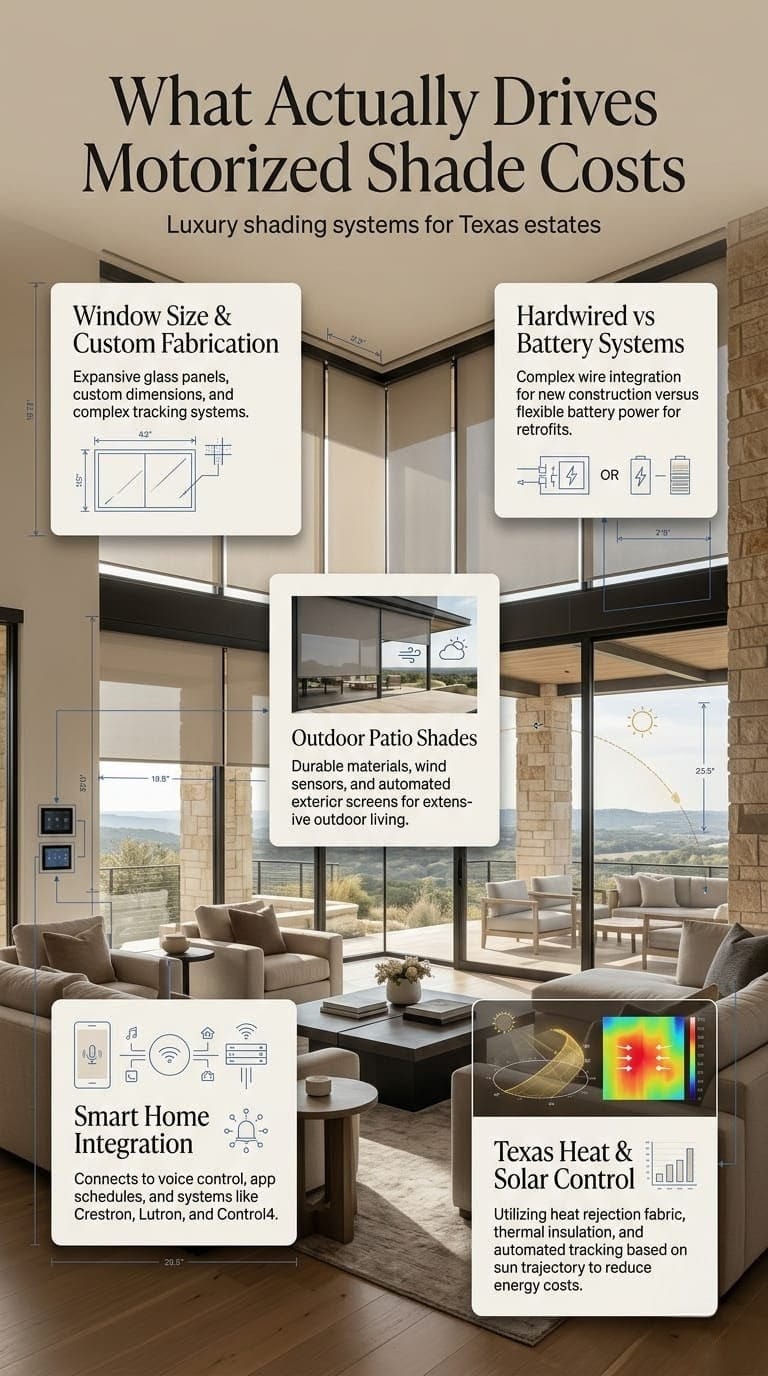
Standard outdoor shades sold nationally are rated for moderate climates. Texas needs more. Here is what SEIITS specifies on every outdoor shade installation.
- Fabric rated for UV exposure index 10+ (Texas summer UV averages 9-10 from May to September). Cheaper fabrics degrade, fade, and lose structural integrity within two to three seasons.
- Motor operating temperature minimum 140 degrees Fahrenheit. Enclosed headrail boxes on south-facing Texas pergolas can reach 130 degrees Fahrenheit in direct summer sun.
- Stainless steel or powder-coated aluminum hardware on all mounting brackets and tracks. Standard zinc or untreated steel hardware corrodes in Houston humidity and shows rust staining within 18 months.
- Control4 or Savant integration so outdoor shades deploy with interior scenes. 'Leaving Home' scene closes outdoor shades before you drive away. 'Afternoon Sun' scene deploys south-facing patio shades at 2 PM automatically.
For the full outdoor AV and entertainment setup that pairs with outdoor shades in Texas luxury estates, see the SEIITS AV installation guide.
The Texas Heat Argument for Motorized Shades: Real Numbers
In most parts of the country, energy savings from motorized shades is a nice-to-have benefit. In Texas, it is the primary financial justification for the investment.
Texas ranks among the highest states for residential cooling costs. DFW and Houston homeowners run air conditioning from April through October. A 5,000 square foot estate with floor-to-ceiling west and south-facing glass can see $800-$1,500 per month in cooling costs during peak summer. Automated cellular or solar shades that deploy at solar noon and retract at sunset reduce solar heat gain through those windows by 60-80%.
For a 4,500 square foot Westlake estate with 8 west-facing windows and 6 south-facing windows, properly automated cellular shades produce an estimated $2,800-$4,800 in annual cooling savings. At a total installed cost of $22,000-$35,000 for those 14 windows, payback runs 6-10 years on the energy savings alone. The daily convenience, the protection of art and furnishings from UV fading, and the resale value add to that calculation considerably.
Cost by Texas Market: DFW, Austin, and Houston
Three things differ materially across Texas luxury markets for motorized shade installations: window count per typical estate, construction factors that affect installation difficulty, and outdoor shade requirements driven by climate.
DFW: Frisco, Southlake, Westlake, Highland Park, Plano
DFW is the most competitive motorized shade market in Texas, which works in your favor. More certified Lutron and Hunter Douglas dealers means more competitive programming rates. Frisco and Southlake new construction estates with 25-35 windows are the most common project profile, typically landing between $22,000-$45,000 installed for interior shades. Highland Park and Preston Hollow retrofit projects on larger 1990s-2000s estates with 35-50 windows run $35,000-$70,000 due to brick veneer wall complexity on exterior-adjacent window locations.
The outdoor shade opportunity in DFW is significant. Southlake and Westlake estates with covered back patios averaging 800-1,200 square feet generate $8,000-$18,000 in outdoor shade scope on top of the interior project.
Austin: West Lake Hills, Barton Creek, Bee Cave, Tarrytown
Austin adds a limestone retrofit premium. West Lake Hills and Barton Creek estates frequently have 1990s-2010s Hill Country construction with irregular window frames, stone sills, and non-standard window sizes that increase both measurement complexity and installation time. The same 25-window interior shade project costs 15-25% more in Austin than in DFW for that reason.
Austin estates also have more skylights per property than any other Texas luxury market, particularly in homes with passive solar design from the 2000s build era. Skylight shades are the highest-ROI shade investment in Texas given cooling costs, and Austin has the highest concentration of this opportunity.
Houston: River Oaks, Memorial, The Woodlands, Tanglewood
Houston adds the humidity factor. All outdoor shade motors, tracks, and hardware must be specified for coastal humidity conditions. Stainless steel or marine-grade aluminum hardware is non-negotiable. River Oaks and Memorial estates are the largest project profiles in Texas, with 40-60 interior windows plus significant covered outdoor living spaces regularly producing $55,000-$100,000+ total shade projects.
Houston also has the highest concentration of floor-to-ceiling glazing in Texas luxury construction, particularly in River Oaks custom builds from 2005-2015. These large glass panels require oversized shade motors and specialized headrail engineering that pushes per-window cost toward the top of the ranges above.
Control4 and Savant Integration: What It Actually Costs
This is where most dealers go quiet. The shade hardware cost is one line item. The programming cost to make those shades respond to your Control4 or Savant scenes is another line item entirely, and it varies dramatically between dealers.
Basic integration connects your shades to your existing Control4 or Savant system so you can raise and lower them from the app or touchpad. That costs $1,500-$3,500 in programming labor depending on shade count. Advanced integration creates custom scenes: shades lower 60% when you press 'Movie,' close fully when 'Away from Home' activates, open to 40% at sunrise via an astronomical schedule, and close the south-facing patio shades when the outdoor temperature exceeds 95 degrees Fahrenheit. That costs $3,500-$8,000 in programming labor.
The programming cost is where you get what you pay for. A shade system that requires you to open an app and manually move each shade is a $22,000 convenience product. A shade system that operates exactly right every morning, responds to your lifestyle, and coordinates with your lighting and HVAC is a genuine quality-of-life investment. SEIITS handles all Control4 and Savant shade programming through the technology systems service, with every scene documented and backed by the ongoing membership.
New Construction vs Retrofit: The Cost You Can Avoid
There is one moment where motorized shade installation costs a fraction of what it costs any other time: during construction, before drywall.
Pre-wiring for hardwired shade motors during framing costs $40-$80 per window location. The same wire run after drywall costs $300-$600 per location in a finished Texas estate because of masonry walls, crown molding, and plaster ceilings. On a 30-window estate, pre-wiring saves $7,000-$15,000 versus retrofit. SEIITS coordinates with your builder to include shade wiring in the electrical rough-in.
If you are already in a finished home, battery-powered systems (Hunter Douglas PowerView Gen 3 battery or Lutron Sivoia QS Triathlon) are a legitimate and high-quality retrofit option. They do not require wire runs. The tradeoff is battery management: 25-40 batteries needing replacement every one to two years. For a large estate, this is a real ongoing cost and a real operational inconvenience that many homeowners do not anticipate.
For context on how shade pre-wiring fits into the broader smart home pre-wire budget, see the SEIITS home automation guide for DFW, Austin, and Houston.
The Concierge Approach to Shade Maintenance
Motorized shades are mechanical. Motors have lifespans. Fabric accumulates Texas dust, pollen, and cedar mold spores. Calibration drifts. Programming needs to adjust as your lifestyle changes. Most shade dealers hand over the system and disappear.
SEIITS includes shade system maintenance in the Elite and Prestige membership tiers. This means annual fabric inspection and cleaning, motor calibration verification, Control4 or Savant scene updates when you want to change how the shades behave, and same-week response when something fails. The difference between a shade system that keeps working the way you want for ten years and one that becomes a source of frustration within two years is whether someone is watching it.
The concierge membership covers shade maintenance alongside security, networking, and AV maintenance under one engagement. For the full maintenance philosophy SEIITS applies across all managed systems, visit seiits.com/homeelectronicsmaintenance.
Ready to talk motorized shades for your Texas estate? SEIITS designs interior and outdoor shade systems with Lutron and Hunter Douglas integrated into Control4 or Savant across DFW, Austin, and Houston.
Where SEIITS Installs Motorized Shades in Texas
- Dallas: Highland Park, University Park, Preston Hollow, Bluffview, Lakewood, Devonshire
- North Dallas: Frisco (Phillips Creek Ranch, Starwood, The Bridges), Plano (Willow Bend), McKinney, Allen, Prosper
- DFW Enclaves: Southlake (Carillon, Vaquero), Westlake, Colleyville, Trophy Club
- Austin Metro: West Lake Hills, Rollingwood, Barton Creek, Tarrytown, Bee Cave, Lakeway
- Houston Metro: River Oaks, Memorial, Tanglewood, Bellaire, The Woodlands, Sugar Land
For smart lighting installation details that pair with motorized shades, see the SEIITS smart lighting installation guide. For the full SEIITS lighting and shading service including architectural lighting and smart lighting design, see seiits.com/lightingservices. For home electronics maintenance including shade motor inspection and calibration, see the SEIITS home electronics maintenance service.
Frequently Asked Questions
How much do motorized roller shades cost in Texas?
Motorized roller shades in Texas cost $400-$900 per window for professional battery-powered systems and $700-$1,400 per window for hardwired systems. At the luxury tier, Lutron Sivoia QS and Hunter Douglas PowerView hardwired systems are the standard specification. Whole-home installations covering 25-35 windows in a DFW, Austin, or Houston estate typically run $18,000-$45,000 installed, including Control4 or Savant programming. The per-window ranges vary significantly based on window size: a standard 36-inch bedroom window is priced very differently from a 96-inch great room window, and Texas estates with floor-to-ceiling glazing push costs toward the top of every range.
How much do motorized outdoor shades with side tracks cost?
Motorized outdoor shades with side tracks cost $1,200-$2,800 per opening for standard pergola and patio sizes up to 16 feet wide. Oversized openings up to 24 feet wide run $2,400-$4,500 per opening. The side track system seals the shade fabric into aluminum channels on both sides, preventing wind from catching the fabric and keeping insects out of the enclosed patio space. Texas-specific requirements add cost: UV-rated fabric, high-temperature motor specifications for headrails in direct sun, and stainless steel hardware for humidity resistance in Houston and Gulf Coast markets. Most DFW and Austin patio installations use standard side track systems. Houston and coastal Texas properties require marine-grade hardware specifications.
Is Lutron or Hunter Douglas better for smart home integration?
Lutron integrates more natively with smart home platforms because Lutron makes both lighting and shading systems that operate on the same ClearConnect RF protocol. If your estate runs any Lutron lighting (Caseta, RadioRA 3, or HomeWorks), Lutron shades are almost always the correct choice because scenes combining lights and shades work without any translation layer. Hunter Douglas PowerView Gen 3 integrates well with Control4, Savant, and most smart home platforms via its hub or direct API, but requires a slightly more complex configuration. If the design of the shade itself is the primary decision driver, Hunter Douglas offers exclusive shade styles (Silhouette, Pirouette, Luminette) that no other manufacturer produces.
Do motorized shades reduce energy costs in Texas?
Yes, and more significantly in Texas than almost anywhere else. Properly specified cellular or solar shades on west and south-facing windows reduce solar heat gain through those windows by 60-80%. For a Texas estate with significant west-facing glazing, automated shades that deploy at solar noon and retract at sunset can reduce cooling costs on those windows by $200-$400 per window per year. On a whole-home basis with 12-15 high-priority windows, annual savings of $2,800-$4,800 are achievable. The payback period depends on the system cost and window count, but typically runs 6-12 years on energy savings alone, before accounting for UV protection of interior furnishings and the resale value component.
How much does it cost to install motorized blinds in a whole house in Texas?
A whole-house motorized shade installation in a Texas luxury estate costs $15,000-$30,000 for 20-25 windows with Hunter Douglas PowerView battery system, $22,000-$45,000 for 25-35 windows with hardwired Hunter Douglas or Lutron Sivoia, and $45,000-$100,000+ for reference-tier Lutron Palladiom installations or large estates with 40-60 windows. These ranges include professional installation, programming, and basic Control4 or Savant integration. They exclude outdoor patio shades, which add $8,000-$25,000 for a typical Texas covered outdoor living area.
Are motorized shades worth it in a Texas luxury estate?
Yes, for four compounding reasons specific to Texas. First, the energy savings argument is real and significant given Texas cooling costs and the intensity of southwest and west sun exposure June through September. Second, UV protection of interior furnishings, artwork, and hardwood flooring is an active cost avoidance: sun-damaged hardwood floors in a River Oaks estate cost $15,000-$30,000 to replace. Third, resale value: buyers in Southlake, West Lake Hills, and River Oaks expect automated shading as a baseline feature in properties above $2M. Fourth, daily quality of life: a system that operates correctly every morning without any manual input is something you notice and appreciate every single day.
What are Lutron Sivoia QS shades and what do they cost?
Lutron Sivoia QS is Lutron's professional-grade hardwired motorized shade system for luxury residences. Sivoia QS operates on Lutron's ClearConnect RF protocol, which means it integrates natively with Caseta, RadioRA 3, and HomeWorks lighting systems without any additional bridge or hub. Cost installed in Texas runs $700-$1,400 per window depending on window size and fabric selection. The Sivoia QS Triathlon is the battery-powered variant at $600-$1,200 per window. The Palladiom is the reference tier above Sivoia at $1,800-$3,500 per window, featuring exposed architectural hardware designed to be seen as a design element rather than concealed. All Sivoia QS systems integrate directly with Control4 and Savant platforms.
How do motorized shades integrate with Control4 or Savant?
Motorized shades integrate with Control4 and Savant through the shade manufacturer's driver or API. Hunter Douglas connects via the PowerView Hub and a certified Control4 or Savant driver. Lutron connects natively as both brands have established professional integrations. Once connected, shades appear in the same Control4 or Savant interface that controls lighting, audio, climate, and security. You can create scenes that combine shade positions with lighting levels: 'Movie' dims lights to 10% and drops shades to 100% closed simultaneously with one button press. Programming this level of scene coordination costs $1,500-$8,000 depending on complexity and shade count, and is handled by SEIITS as part of the technology systems installation.
Comments ()