Smart Home Automation Integration for Texas Luxury Estates: Platform Selection, Lighting Control, and Climate Automation
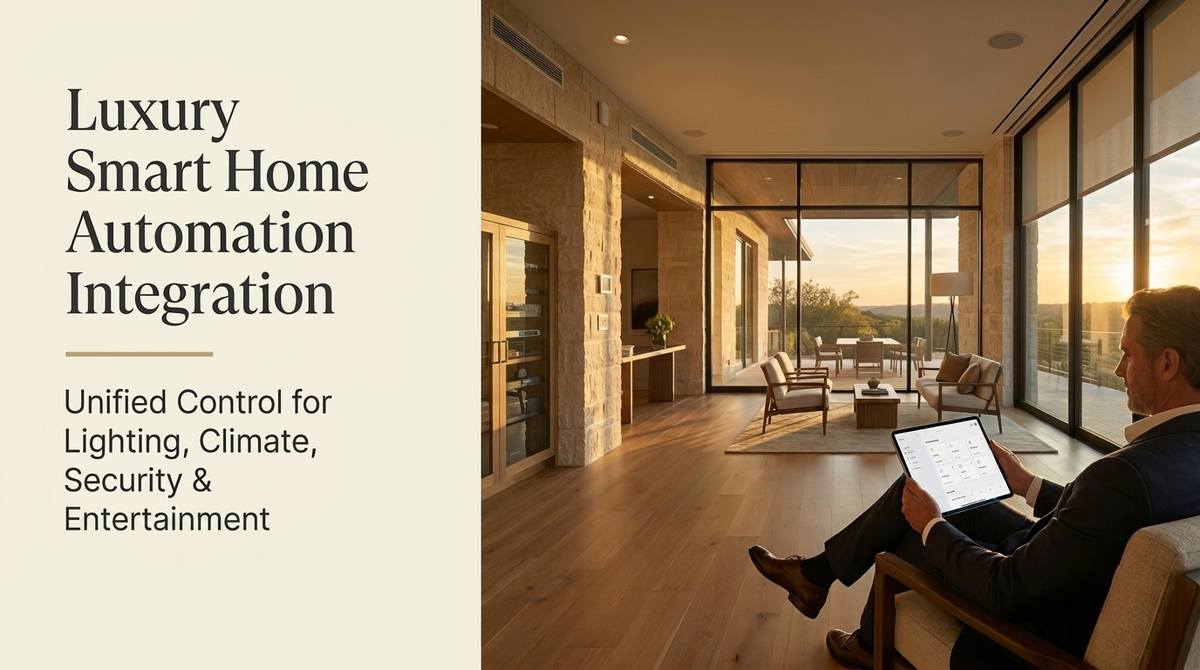
Across 500+ luxury estate implementations I have led across Frisco, Southlake, Dallas, and Austin, smart home automation integration is the service where the gap between a qualified consultant and a device installer produces the most visible and most expensive client outcomes. The term "smart home automation integration consultant Texas" describes a discipline that the majority of companies advertising it do not actually practice.
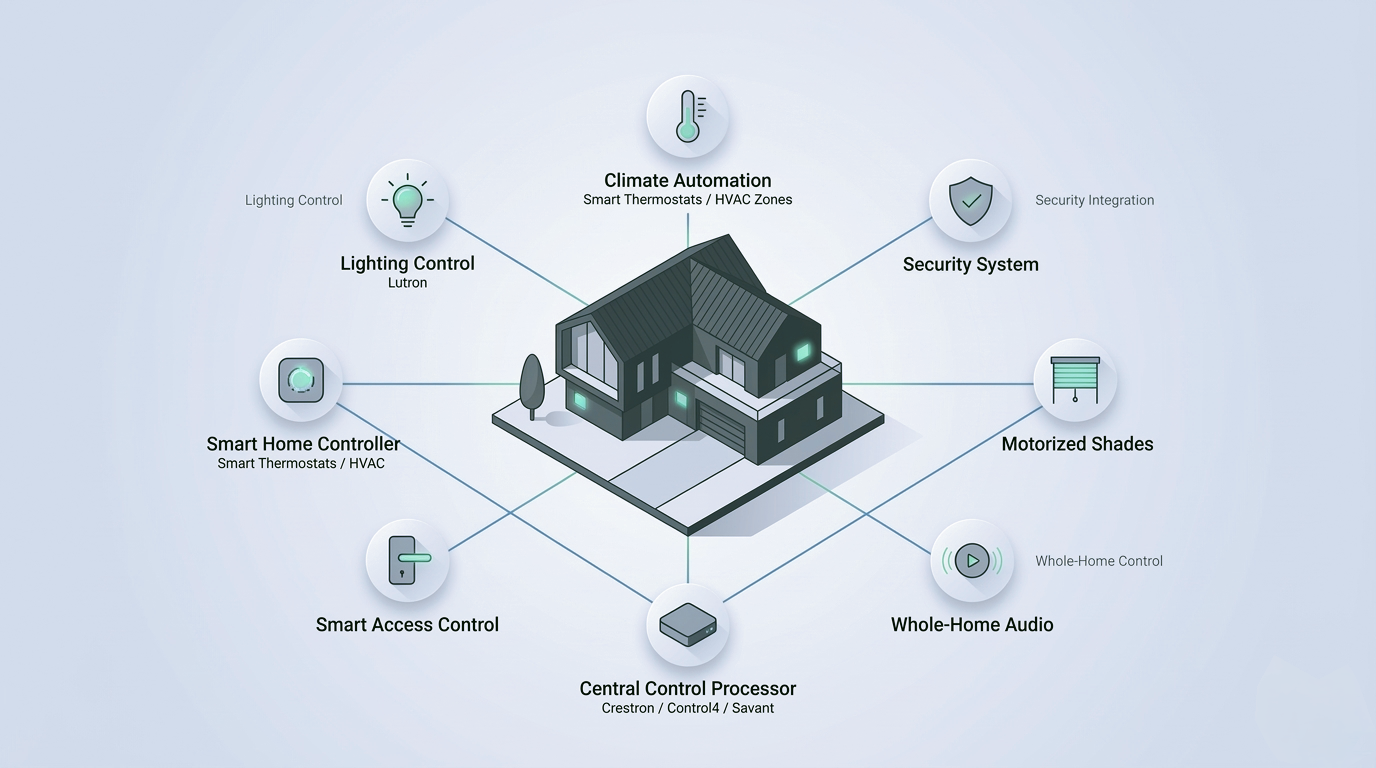
Smart home automation integration means designing a whole-home technology architecture where every subsystem, including lighting, climate, security, audio, shading, and access control, communicates through a single programmable platform and responds to occupancy, schedule, and manual input without requiring the homeowner to manage multiple apps or individual device interfaces.
The global home automation market was valued at $89.8 billion in 2025 and is growing at a compound annual rate above 11%. Texas luxury residential construction is one of the fastest-growing segments within that market. The demand is real. The quality of implementation across that demand is not consistent.
What follows is a framework for understanding what genuine smart home automation integration requires, how to select the right platform for a Texas estate, and why the consultant you choose determines outcomes more than any brand name on the hardware.
What Is Smart Home Automation Integration and Why Does It Require a Consultant?
Smart home automation integration is the design, installation, programming, and ongoing management of a unified control architecture that connects every technology subsystem in a luxury residence through a single platform. It is not the same as purchasing smart devices and connecting them to a consumer app.
The distinction matters because most smart home failures I encounter during intake assessments are not hardware failures. They are integration failures, where the devices were installed correctly but the architecture was never designed to function as a whole. The homeowner has a Nest thermostat, a separate security app, a Sonos controller, and a Lutron app, each requiring individual management. That is automation in name only.
A qualified consultant brings three things a device installer does not: system architecture design before any hardware is purchased, programming expertise that determines how subsystems communicate and respond to each other, and a managed support relationship that maintains platform performance after the installation crew leaves.
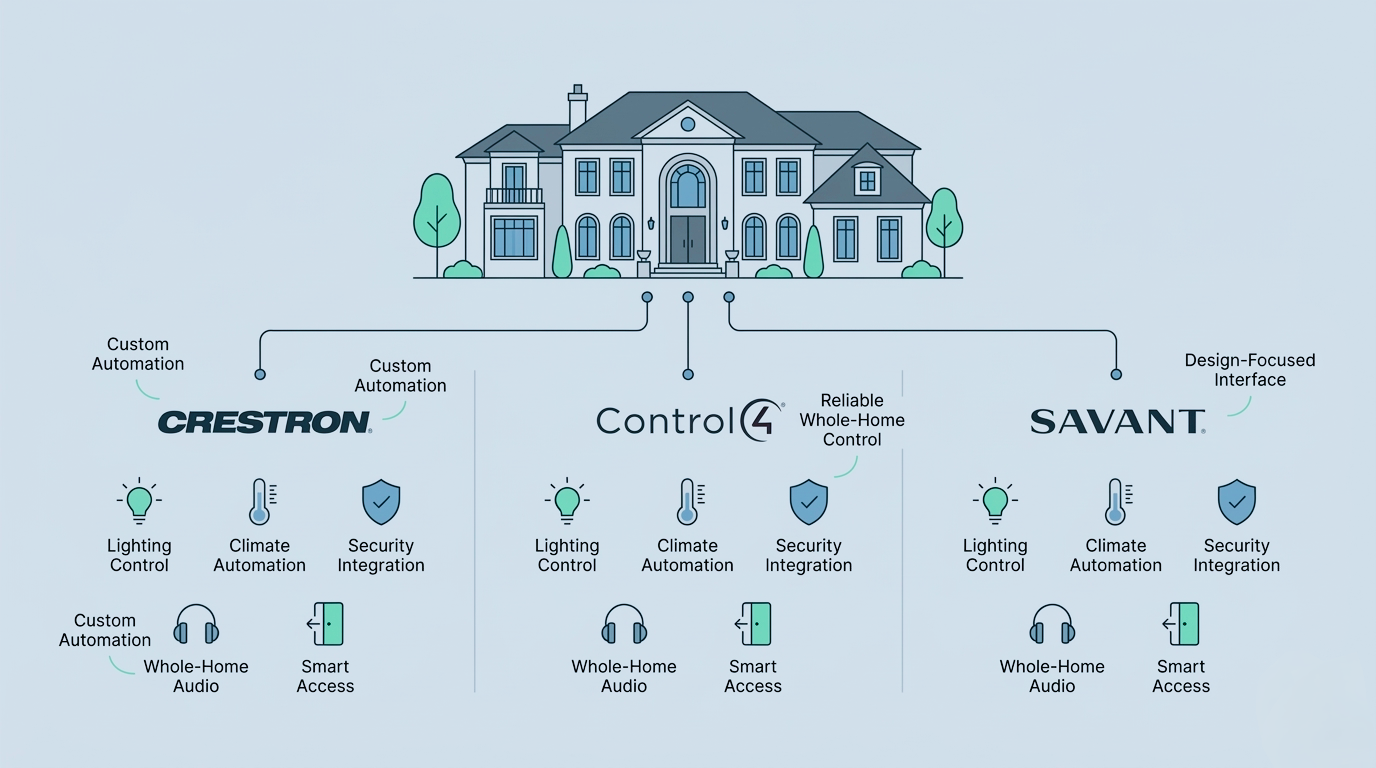
The platform (Crestron, Control4, or Savant) is the brain of the system. But the brain only produces the outcomes it was programmed to produce. I have remediated Control4 systems that underperformed because the programming logic was shallow, and I have seen entry-level Control4 installations that outperformed poorly programmed Crestron systems on significantly larger budgets. The platform is not the limiting factor. The consultant is.
For a 6,000 to 10,000 square foot estate in Plano, Westlake, or Highland Park running 80 to 150 connected devices, integration without a qualified consultant is not a cost saving. It is a deferred remediation expense.
Which Smart Home Platform Is Right for a Luxury Texas Estate: Crestron, Control4, or Savant?
The right platform for a Texas luxury estate is determined by three factors: estate size and complexity, the client' s relationship with technology in daily life, and the integrator' s depth of programming expertise on the platform being considered.
Control4 is the most appropriate platform for estates between 3,500 and 6,500 square feet running 40 to 100 devices. Installation cost ranges from $15,000 to $50,000 depending on subsystem scope. Control4 has the largest dealer and programmer network in the U.S., which means post-install support is accessible. The platform handles lighting, climate, security, audio, and access control integration reliably at this scale. For a Frisco or Plano estate with a family that wants whole-home automation without daily technology management, Control4 is typically the correct answer.
Savant is the right platform for design-forward clients in Highland Park, Westlake, or Austin who prioritize interface quality and Apple-native integration above all else. Installation cost ranges from $25,000 to $80,000. The Savant interface is the most refined in the luxury residential market. The platform integrates natively with Apple HomeKit and performs exceptionally well in estates where the homeowner' s daily technology relationship is iPhone-centered. Savant' s dealer network is smaller than Control4' s, which means integrator selection is more critical.
Crestron is the appropriate platform for estates above 8,000 square feet with complex multi-zone requirements, dedicated home theater, whole-estate surveillance integration, and clients who require mission-grade reliability with unlimited programming customization. Installation cost ranges from $40,000 to $150,000 or more for full-architecture builds. Crestron has no proprietary app ecosystem. It is a blank programming canvas, which is its greatest strength and the reason it requires the most experienced programmer to deliver its full potential.
The control system cannot compensate for a poorly designed installation. I have assessed estates where Crestron hardware was installed on a consumer-grade flat network with no VLAN segmentation, producing the same instability problems the homeowner would have experienced with a $3,000 consumer system. Platform selection without network design and programming discipline is a decision that will produce a remediation project within two years.
For a detailed platform comparison, the Control4 vs Crestron guide for architects and the Crestron vs Savant guide for new luxury builds cover the technical distinctions in full.
Lutron Lighting and Shade Control: The Subsystem That Defines the Whole-Home Experience
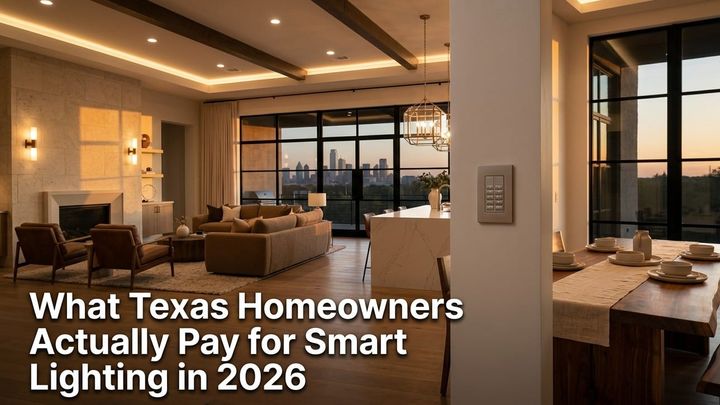
Lighting and shade control is the subsystem a luxury homeowner interacts with more than any other, in every room, every day, multiple times. It is also the subsystem where the quality gap between a Lutron HomeWorks QSX installation and a standard dimmer retrofit produces the most immediate and most consistent client satisfaction difference.
Lutron HomeWorks QSX is the professional-grade lighting control platform used in high-end residential and commercial installations globally. It is not a consumer product. It requires a Lutron-certified programming specialist and integrates with Control4, Crestron, and Savant through two-way communication, meaning the smart home platform can read the state of every light in the estate and trigger lighting scenes based on time, occupancy, security events, or manual input.
For Texas estates, the shade control integration carries specific performance value that northern markets do not share at the same intensity. Lutron Sivoia QS motorized shades block direct solar heat gain during peak afternoon hours, which is a documented factor in HVAC load reduction for properties with large south and west-facing glazing. In a 7,000 square foot Southlake estate with floor-to-ceiling west-facing windows, automated shade deployment between 2pm and 6pm directly reduces the afternoon cooling load on a system that is already working against 100°F+ ambient temperatures.
Lutron's product portfolio saves an estimated $1 billion in U.S. utility costs annually across residential and commercial installations. For a luxury estate in Texas running 40 to 64 zones of lighting plus motorized shading, the energy performance case is secondary to the daily quality-of-life case, but both are real and both are quantifiable.
Scene programming is where Lutron' s value becomes experiential rather than technical. A morning scene that gradually raises bedroom lighting to 30% over 20 minutes, opens east-facing shades to natural light, and sets the kitchen to
full task lighting before the homeowner reaches the ground floor is not a feature. It is a designed daily experience. That scene is programmed once and maintained through the Seiits membership. The homeowner never touches it again unless they want to change it.
For the full lighting and shade control comparison across platforms, the Lutron vs Control4 guide covers the technical integration decisions in detail.
How Does Smart Climate Automation Actually Work in a Large Texas Home?
Smart climate automation in a luxury Texas estate is multi-zone HVAC control governed by occupancy logic, schedule programming, geofencing triggers, and coordinated shade deployment. It is not a single smart thermostat connected to a single air handler.
A 7,000 square foot estate in Dallas or Frisco typically runs three to five HVAC zones with independent air handlers. Each zone requires its own sensing and control logic. Whole-home climate automation means the control platform knows which zones are occupied, what the outdoor temperature is, what the solar angle is relative to each facade, and what the homeowner' s schedule dictates for the next six hours, and adjusts all zones accordingly without manual input.
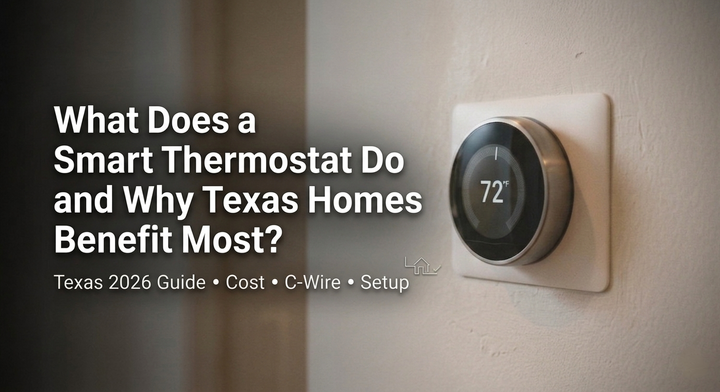
Ecobee smart thermostats with room sensors document up to 26% savings on heating and cooling costs when deployed with occupancy-aware logic.
ENERGY STAR data shows an average 8% reduction in energy costs for homes using certified smart thermostats versus standard programmable thermostats. In Texas, where summer cooling costs for a large estate can run $800 to $1,500 per month, an 8% to 26% reduction is not a rounding error.
The Texas-specific design consideration that most national integrators miss: summer cooling logic in DFW and Austin operates in a fundamentally different thermal environment than northern states. A northern climate automation system optimizes for morning warm-up and evening cool-down cycles. A Texas system in July and August is managing against sustained outdoor temperatures above 100°F for six to eight consecutive hours. The automation logic needs to anticipate peak load, pre-cool occupied zones before the heat builds, coordinate shade deployment to reduce solar gain, and protect HVAC equipment from the extended run cycles that cause premature failure.
Geofencing integration, where the control platform detects the homeowner' s smartphone approaching within a defined radius and activates the home' s arrival scene, eliminates the energy waste of cooling an unoccupied estate to full comfort levels for the duration of the workday. The system cools to energy-saving setpoints when the estate is unoccupied and begins the return-to-comfort sequence when the homeowner is 15 minutes away.
For estates with existing HVAC infrastructure, Seiits assesses zone compatibility, thermostat integration capability, and network requirements before any climate automation hardware is specified. Retrofitting climate automation into an existing estate is a standard implementation, not a new-construction-only capability.
The Case Study: 7,800 sq ft Frisco Estate, Full Automation Architecture
The client came to us 14 months after a previous integrator had installed a Control4 system that had never been fully commissioned. Three of six audio zones were non-functional. The lighting scenes had been partially programmed and abandoned. The security system was not integrated with the Control4 platform at all. It operated as a completely standalone system on a separate app. The HVAC ran on individual Nest thermostats with no inter-zone logic. The client had spent $52,000 on hardware and installation and was managing their home through six separate applications.
The Seiits assessment identified four root problems. The network had no VLAN segmentation and the Control4 processor was on the same flat network as 34 IoT devices, creating instability that manifested as random device dropouts.
The Control4 programming had never been completed to the scope the original proposal described. The security system integration had been scoped but never executed. And the lighting programming covered only 11 of 28 zones.
The remediation and full recommissioning took nine days on site and four weeks of off-site programming work. The final delivered system included a Control4 EA-5 processor as the primary controller, Lutron HomeWorks QSX across 64 lighting zones and 18 motorized Sivoia QS shades, four-zone HVAC automation with Ecobee SmartSensor deployment across 11 rooms, whole-home audio across six zones fully integrated with the Control4 interface, and full security integration connecting the existing camera and access control infrastructure to the Control4 platform.
Total project cost including network remediation, full programming, and hardware additions: $38,500. The client enrolled in the Seiits Elite membership at $6,000 per year.
Outcomes documented at the 90-day mark: 23% reduction in HVAC costs compared to the same three-month period the prior year. Zero programming call-backs in the first 90 days of operation. The client managing 143 devices through a single Control4 interface on a 10-inch touchscreen and a mobile app. No separate security app, no separate audio app, no separate lighting app.
The prior integrator had the right hardware. The system failed because the programming and network foundation were never completed to professional standard. That is the pattern I encounter most consistently across intake assessments in Frisco, Plano, and Southlake.
Why Smart Home Automation Systems Fail and How Managed Support Prevents It
Smart home automation systems fail for four documented reasons, in order of frequency: an inadequate network foundation, incomplete or shallow programming, no post-install access to a qualified programmer, and no firmware or platform update management.
The network is the infrastructure every other subsystem depends on. A Control4 EA-5 processor managing 80 devices requires a properly segmented enterprise-grade network with dedicated VLANs for IoT devices, a separate VLAN for the control system backbone, and access point placement designed for the specific floor plan. A consumer mesh router cannot provide this reliably. A flat network that puts the Crestron processor, the IP cameras, the smart locks, and the family' s streaming devices on the same subnet is a stability and cybersecurity exposure simultaneously. The Wi-Fi 7 and enterprise networking guide covers this infrastructure requirement in full.
Incomplete programming is the most common failure mode I find in remediation assessments. The installer completed the hardware installation and left with a partially commissioned system. The homeowner accepted delivery because the lights turned on and the app connected. Six months later, when scenes stopped working or devices began dropping off the network, the original installer was unreachable or quoted a new service call fee.
No post-install programmer access means a firmware update that breaks a driver, a new device added to the estate, or a scene modification requires starting the vendor search process again from scratch. Smart home platforms release firmware updates on a regular cycle. Control4 OS updates, Lutron firmware releases, and Crestron SIMPL module updates all require a certified programmer to test and apply correctly. Without a managed relationship, these updates accumulate as deferred risk.
The Seiits membership model, covering Signature, Elite, Prestige, and Exclusive tiers from $2,400 to $9,600 per year, exists specifically to close this gap. Every membership includes remote monitoring of platform health, proactive firmware management, programming modifications on request, and remote resolution for 73% of reported issues without a site visit. The membership is not an upsell. It is the delivery mechanism for the outcome the installation was designed to produce.
For homeowners currently managing a system that is underperforming, the smart home integrator assessment guide covers the indicators that a professional remediation assessment is warranted.
Conclusion
Smart home automation integration for a luxury Texas estate is a system design discipline with a long tail. The hardware installation is the visible event. The network design, programming depth, and managed support relationship are the invisible infrastructure that determines whether the system performs as designed at 30 days, 18 months, and five years.
Three takeaways from 500+ implementations across DFW and Austin:
First, the platform matters less than the consultant. A correctly programmed and properly supported Control4 installation will outperform a poorly commissioned Crestron system at twice the budget every time.
Second, Texas climate automation requires Texas-specific design logic. The summer thermal load in Frisco, Southlake, and Dallas is not a variation on a standard automation template. It requires occupancy-aware pre-cooling, shade coordination, and HVAC protection logic designed specifically for sustained high-temperature operation.
Third, a smart home system that requires you to manage it was not built correctly. The correct outcome is an estate that responds to how you live in it, without requiring daily interaction with an app or a panel.
Seiits provides a no-obligation technology assessment for luxury estates across DFW, Austin, and Houston. If your current system is underperforming or you are planning a new build or significant renovation, contact us to schedule a consultation.
Frequently Asked Questions
How much does smart home automation cost for a luxury Texas estate?
Smart home automation integration for a luxury Texas estate ranges from $15,000 for a targeted single-subsystem installation to $150,000 or more for a full-architecture build covering platform, lighting, climate, security, audio, and access control. A 7,800 square foot Frisco estate with Control4 EA-5, Lutron HomeWorks QSX across 64 lighting zones and 18 motorized shades, four-zone climate automation, and full security integration was completed at $38,500 for remediation and recommissioning. Annual Seiits managed memberships range from $2,400 to $9,600 depending on estate size and required support level.
What is the difference between Control4 and Crestron for a large estate?
Control4 is a dealer-network platform optimized for estates between 3,500 and 6,500 square feet running 40 to 100 devices, with a large certified programmer base and installation costs from $15,000 to $50,000. Crestron is an open programming platform with no proprietary app ecosystem, designed for estates above 8,000 square feet requiring complex multi-zone customization and mission-grade reliability, with installation costs from $40,000 to $150,000 or more. In both cases, the quality of the programming and the network foundation determine the outcome more than the platform brand. Seiits implements both platforms across DFW and Austin.
Can smart home automation be integrated with an existing security system in Texas?
Yes. Seiits integrates existing security infrastructure, including IP cameras, access control panels, smart locks, and monitoring systems, into Control4, Crestron, and Savant platforms as a standard service. Integration means the smart home platform receives real-time security status, triggers automated lighting and door responses on alarm events, and presents camera feeds on touchscreens and mobile interfaces without a separate security app. A full assessment of existing security hardware compatibility is conducted before integration scope is defined. Most established security systems in Plano, Southlake, and Dallas estates can be integrated without hardware replacement.
How long does smart home automation installation take for a 6,000 sq ft home?
A full smart home automation installation for a 6,000 square foot Texas estate typically requires seven to twelve days on site for hardware installation and initial commissioning, followed by two to four weeks of off-site programming work before final delivery and client walkthrough. Timeline varies based on subsystem scope, existing network infrastructure quality, and whether the project is new construction or a retrofit. New construction installations with pre-wire completed to specification are faster. Retrofit projects in occupied estates are sequenced to minimize daily disruption. Seiits provides a project timeline document at the conclusion of the technology assessment.
What is Lutron HomeWorks and why is it used in luxury homes?
Lutron HomeWorks QSX is a professional-grade lighting control platform used in high-end residential and commercial installations globally. It requires Lutron-certified programming, integrates with Control4, Crestron, and Savant through two-way communication, and supports up to 100 zones of lighting and motorized shade control in a single system. HomeWorks QSX is specified in luxury estates because it provides scene-level programming precision, reliable performance over time, and native integration with Lutron Sivoia QS motorized shades, which is the shade platform most commonly specified for Texas estates requiring solar heat gain management and HVAC load reduction.
Can I add smart home automation to an existing home or does it require new construction?
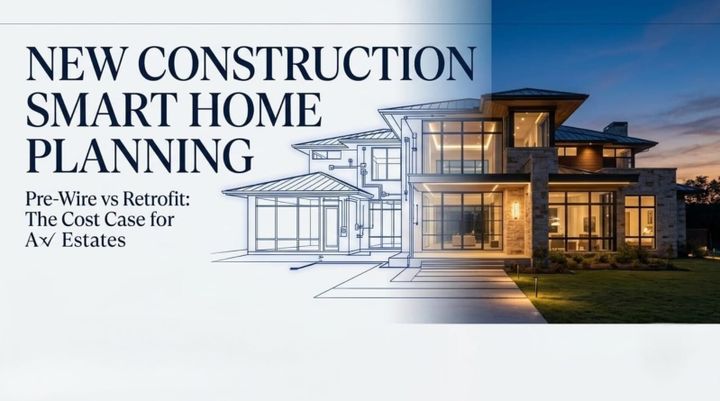
Smart home automation can be retrofitted into an existing Texas estate without a full renovation in the majority of cases. Lutron RadioRA 3 and Control4 Zigbee-based devices reduce the need for new wiring runs in retrofit scenarios. The network infrastructure typically requires upgrading, as consumer mesh routers cannot support enterprise-grade smart home architectures, but this does not require structural work. The most common retrofit constraint is HVAC integration, where older systems may require thermostat or zone controller upgrades to support full automation logic. Seiits conducts a full retrofit feasibility assessment covering network, lighting, climate, and control system compatibility before any hardware is specified.
What ongoing support does a smart home automation system need?
A luxury smart home automation system requires proactive firmware management across the control platform, lighting system, thermostats, and connected devices; programming modifications when the homeowner' s preferences or estate configuration changes; network health monitoring to identify instability before it produces device failures; and remote or on-site resolution when issues arise. Without managed support, firmware updates accumulate as deferred risk, programming modifications require sourcing a new programmer, and platform issues go unresolved until they produce visible failures. Seiits membership tiers from $2,400 to $9,600 per year cover all of these requirements as standard deliverables, with 73% of reported issues resolved remotely without a site visit.
Comments ()