
Luxury Home Theater and AV Design in Texas: Room Acoustics, Distributed Audio, and Platform Selection
A Frisco estate had a $195,000 theater and 11 audio zones, installed 18 months earlier. The Atmos channels were wired backward. Seven of eleven zones played the wrong source. The installer had gone out of business. Here is how a home theater is actually designed, so it never gets there.
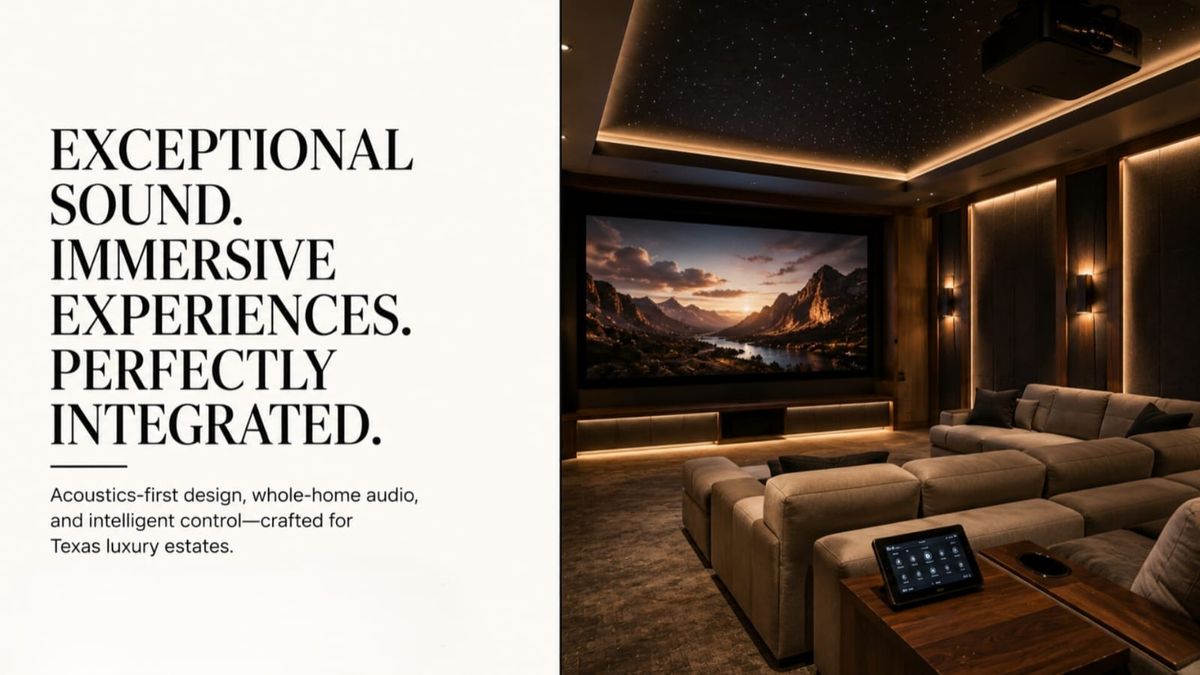
A Frisco estate called SEIITS eighteen months after a $195,000 theater and distributed audio installation. The room had a 14-seat layout, a JVC laser projector, a Kaleidescape server, and eleven audio zones across the property, all controlled through Control4. On paper, it was a complete system. In practice, the Dolby Atmos overhead channels had been wired out of phase since installation day, seven of the eleven audio zones played the wrong source, and the original integrator had closed four months after handoff. Nobody had caught any of it, because nobody had come back to check.
SEIITS sees this pattern across DFW estate audits: the equipment is excellent, and the design and integration around it are not. A home theater is an acoustic environment before it is a hardware list, and a distributed audio system is a zoning problem before it is a speaker count. Get the sequence backward, and a $195,000 system performs like a $40,000 one.
This guide covers how SEIITS designs and integrates home theater and whole-estate audio through its audiovisual service: the room, the zones, and the control platform that ties them together, in the order they should actually be decided.
What is luxury home theater and AV design for a Texas estate?
Luxury home theater and AV design for a Texas estate is the sequence of acoustic room design, equipment specification, and control integration that determines whether a system performs to its hardware's actual capability. It covers a dedicated cinema room with projection, surround sound, and a media server; whole-estate distributed audio across kitchen, primary suite, pool, and guest structures; and the Crestron, Control4, or Savant platform that unifies both under one interface. Home theater installations typically run $25,000 to $250,000+, and whole-home AV runs $8,000 to $150,000+, depending on zone count and scope.
Why do so many Texas AV systems underperform within the first year?
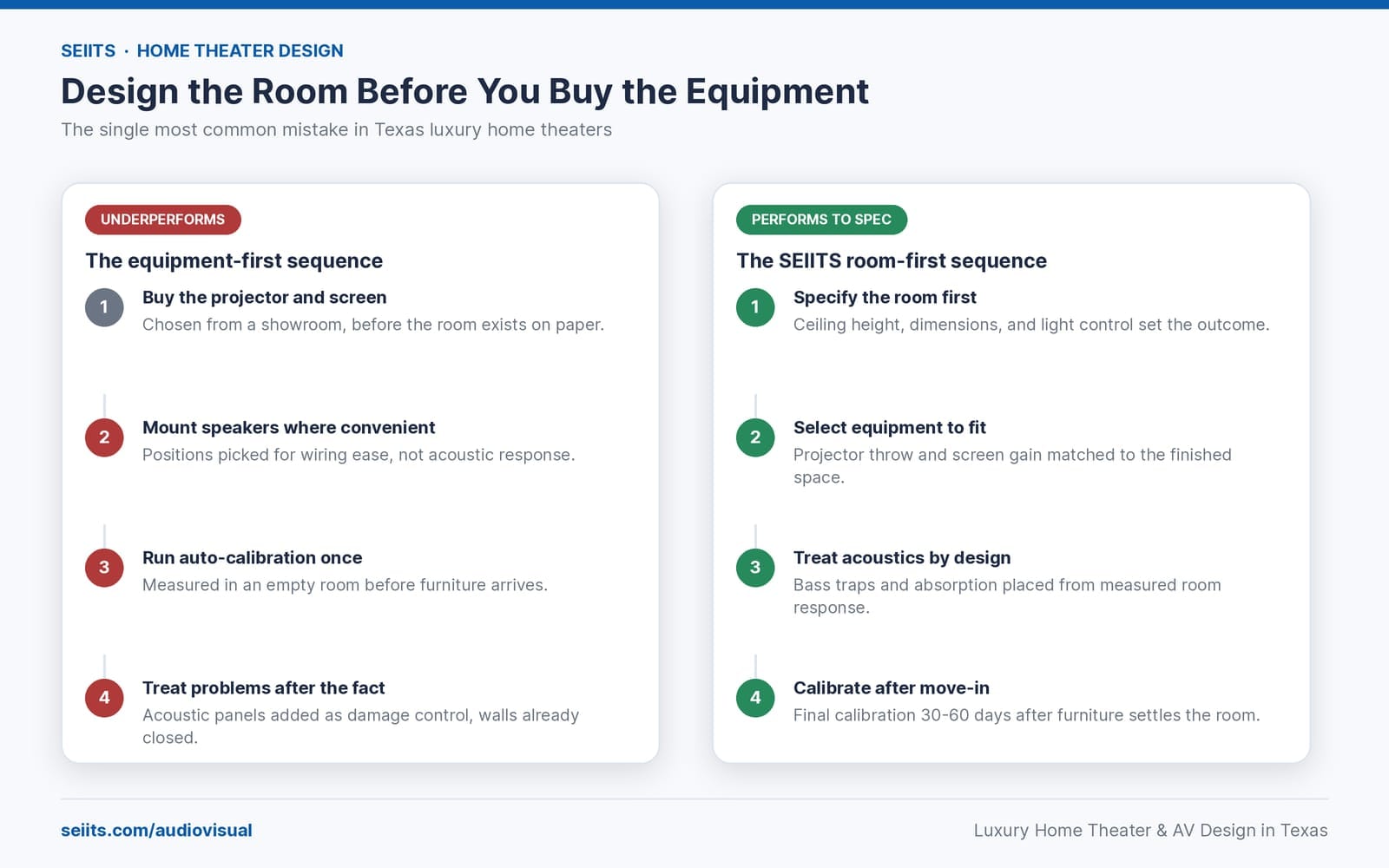
Most Texas AV systems underperform within the first year because they were calibrated once, in an empty room, on installation day, and never touched again. A room's acoustic response changes once furniture, rugs, and drapery arrive, and a subwoofer calibrated to an empty shell is wrong for the finished room. Firmware updates, added streaming devices, and configuration drift compound quietly until the homeowner is living with a degraded system and assumes that is just how it performs now. A new streaming box gets added and nobody reprograms the remote to include it. An AV receiver firmware update changes how it talks to the control processor, and a scene that used to work now fails silently. None of this shows up as an obvious failure. It shows up as a system the family slowly stops using the way it was designed to be used.
SEIITS treats every AV installation as the start of a managed relationship rather than a one-time sale, which is the same philosophy behind its ongoing smart home maintenance model, the fuller argument for why proactive management outperforms reactive service calls across an entire estate, not just AV.
What does proper home theater room design actually require?
Proper home theater room design requires acoustic treatment, projector throw distance, and screen selection to be specified before any equipment is purchased, because a room's dimensions determine what that equipment can achieve. SEIITS has reviewed installations where a homeowner bought a Kaleidescape server and a $45,000 laser projector before the room was finalized, the projector's throw ratio did not match the available distance, the screen ended up smaller than specified, and the acoustic treatment was added afterward as damage control. The system sounded adequate. It should have sounded extraordinary.
For new construction across Frisco, Highland Park, and Southlake, SEIITS engages at the architectural design stage, before framing, because ceiling height, the width-to-length ratio of the room, and sidewall distance all shape frequency response in ways that no amount of treatment fully corrects after the fact. For retrofit projects in an existing estate, SEIITS runs a room acoustic analysis before specifying any equipment, so the correction strategy is built around what the room's actual physical constraints allow rather than around a manufacturer's showroom conditions.
Laser projection and screen selection
Laser projectors deliver 20,000 to 30,000 hours of lamp life against 1,500 to 3,000 hours for lamp-based units, which eliminates the most common maintenance event in a home theater and holds color accuracy over the system's life. SEIITS specifies projectors by room size, throw distance, and ambient light, and pairs them with an ambient-light-rejecting screen when the room cannot achieve full light control, since a well-matched screen in an imperfect room consistently outperforms a premium screen chosen without regard to the space.
Acoustic treatment and Dolby Atmos
A theater room without acoustic treatment is a large room with a projector, not a home theater. Dolby Atmos delivers three-dimensional sound through front, surround, and overhead channels, and the overhead channels are especially sensitive to room response: untreated parallel walls create comb filtering that flattens the spatial imaging Atmos exists to produce. SEIITS specifies bass trapping at corners, broadband absorption at first-reflection points, and rear-wall diffusion as part of the room's original specification, not as a fix applied after the speakers are already mounted.
Kaleidescape or streaming: how to actually decide
A Kaleidescape media server is the right choice for a homeowner who has invested in reference-grade projection and audio and wants lossless 4K HDR content at the source master's bitrate, without the compression or buffering a streaming connection introduces. For a household whose primary use is sports and everyday streaming, a well-configured Apple TV or Nvidia Shield paired with a quality AV processor performs excellently at a fraction of the cost. The decision is about content habits, not budget alone, and SEIITS makes the recommendation based on how the family actually watches, not the highest-margin option.
Sonos or dedicated multi-zone audio: which does your estate need?
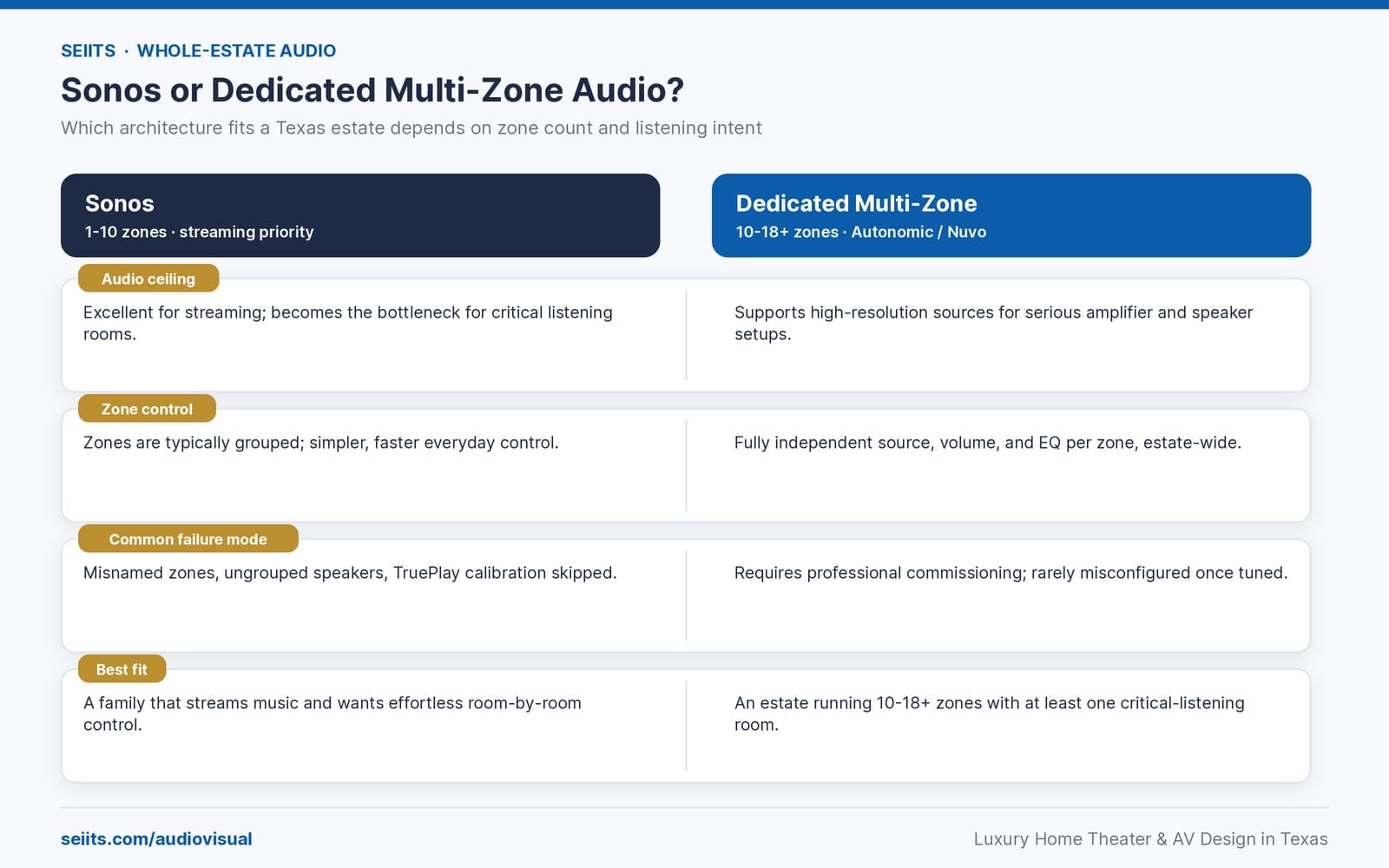
Sonos is the right choice for an estate where the priority is streaming convenience and easy room-by-room control without a full AV processor architecture, and it integrates cleanly with Crestron, Control4, and Savant. Its limitation is an audio quality ceiling: for a homeowner with an $8,000 amplifier and serious speakers in a primary listening room, Sonos as the source becomes the bottleneck. Once an estate reaches 10 to 18 zones, kitchen, primary suite, pool, guest house, gym, it needs dedicated multi-zone platforms such as Autonomic, Nuvo, or Systemline, which give every zone independent source assignment, volume, and EQ rather than one shared configuration.
SEIITS regularly inherits Sonos systems that were installed correctly as hardware but never configured correctly: zones misnamed, speakers grouped wrong, subwoofers never calibrated, TruePlay never run. These are setup failures, not equipment failures, and they are why a technically sound Sonos install still sounds mediocre. Outdoor zones need their own specification: Texas summers regularly clear 100 degrees Fahrenheit with intense UV exposure, and indoor speakers repurposed outdoors fail within 18 months. SEIITS specifies weatherproof displays and speakers rated for the Texas climate zone, not indoor equipment with a claimed weather rating that does not hold up.
Zone architecture starts with how the family actually lives in the house, not with a speaker count. Which rooms need independent control, and which are typically grouped together when the family entertains? Which sources need to reach which zones, and does the primary suite need the same source options as the pool deck? A well-designed zone layout means a homeowner can run jazz in the dining room, a game in the media room, and music at the pool from a single app, with none of the three zones bleeding into or interfering with each other, which is the actual test of whether a distributed audio system was designed or just wired.
Which control platform is right for your estate: Crestron, Control4, or Savant?
Crestron fits estates above 8,000 square feet with complex multi-zone requirements and needs a Crestron-certified programmer to deliver its full capability. Control4 is the most widely deployed luxury platform in DFW, with the broadest third-party ecosystem and a strong out-of-box experience at a lower implementation cost than Crestron. Savant is the design-forward choice, with the most visually refined interface of the three, best suited to estates where the interior design drives every technology decision. Platform choice depends on estate size, integration complexity, and budget more than any single feature.
Programming quality matters as much as the platform itself, especially with Crestron. Crestron is programmable, not plug-and-play: a system programmed by a technician who does not deeply understand the platform feels clunky and slow to respond, while the same hardware programmed by someone who understands how the household actually uses each room feels effortless. This is where a significant share of Texas AV installations underdeliver, not because the platform was wrong, but because the programming behind it was generic rather than built around the family's actual routines. SEIITS assigns certified programmers to every Crestron installation for exactly this reason, and applies the same standard of custom configuration to Control4 and Savant projects.
Full platform specifications are documented directly by Crestron Home, Control4, and Savant. SEIITS has already published the full head-to-head comparisons: Lutron vs Control4, Crestron vs Savant, and Control4 vs Crestron. This guide will not repeat those comparisons; it exists to help decide which one to read.
Case study: the Frisco theater and audio rebuild
SEIITS was engaged to assess a Frisco estate's home theater and distributed audio system eighteen months after a previous integrator's installation. The original scope: a 14-seat dedicated theater with a JVC 4K laser projector, a Klipsch speaker array, and a Kaleidescape server, plus eleven distributed audio zones across the property controlled through Control4. Original investment was approximately $195,000.
At intake: the theater had never been recalibrated after the original installer ran the auto-calibration routine in an empty room before furniture arrived. The Dolby Atmos overhead channels were phase-inverted, an installation error nobody had caught. Seven of eleven audio zones had misassigned sources. Kaleidescape was never integrated with the Control4 lighting scenes. The original integrator had closed four months after the install.
SEIITS ran a full room acoustic analysis with measurement microphones, corrected the Atmos phase inversion, rebuilt the Control4 programming for all eleven zones with correct source assignments, and integrated Kaleidescape's lighting automation. Total remediation cost was $18,500, and the client enrolled in the Prestige membership tier. At the 90-day review, the client described the system as performing, for the first time, the way it had been described during the original sale, and the eleven zones have stayed correctly configured since, because the estate is now on a managed membership rather than a one-time installation contract.
Frequently asked questions
What is the difference between a media room and a dedicated home theater?
A media room is a multipurpose space with added AV capability. A dedicated home theater is a single-purpose room engineered entirely for audio and visual performance, with acoustic treatment, projector throw distance, and light control specified as part of the room design. The difference is design intent, not just equipment cost.
Do I need a Kaleidescape media server, or is streaming enough?
Kaleidescape suits a homeowner with reference-grade projection and audio who wants lossless 4K HDR content without streaming compression or buffering. For primarily sports and everyday streaming use, a well-configured Apple TV or Nvidia Shield performs excellently at a lower cost. The right choice depends on content habits, not budget alone.
How much does a luxury home theater or whole-home AV system cost in Texas?
Dedicated home theaters in Texas estates run $25,000 to $250,000+, and whole-home AV systems run $8,000 to $150,000+, depending on zone count and scope. SEIITS breaks down the full cost tiers separately in its home theater and AV installation cost guides.
Which control platform should I choose: Crestron, Control4, or Savant?
Crestron suits large estates with complex multi-zone needs and requires certified programming. Control4 offers the broadest ecosystem and strong usability at moderate cost. Savant offers the most refined interface for design-driven interiors. SEIITS's platform comparison guides cover the full decision in depth.
How long does a luxury home theater installation take in Texas?
Equipment installation and initial configuration typically take 5 to 10 business days, followed by a calibration visit 30 to 60 days after move-in once the room's acoustic environment has settled with furniture in place. Full timelines from assessment to final calibration usually run 4 to 8 weeks.
Where SEIITS designs and installs luxury AV systems
SEIITS designs, installs, and supports luxury home theater and AV systems across Frisco, Dallas, Highland Park, Plano, Southlake, University Park, and Westlake, with full-scope work in Austin and Prestige/Exclusive-tier engagements in Houston.
For detailed cost breakdowns, see the home theater installation cost guide and the AV installation cost guide. For the platform decision in full depth, see Lutron vs Control4 and Crestron vs Savant. For new construction, SEIITS engages at the design stage. see the pre-construction integration guide for Texas architects and 10 questions every builder should ask their integrator. Lighting scenes tied to Kaleidescape and Control4 draw on the same platforms covered in the smart lighting installation guide, and a broader view of what SEIITS delivers is in the home automation guide for Dallas, Austin, and Houston.


Comments ()