
Home Theater & AV System Maintenance for Texas Luxury Estates: The Complete Guide to Proactive Care, ISF Calibration, and Annual Technology Audits
Most Texas luxury AV systems run on factory settings and stale firmware. Here's what real home theater and smart home maintenance costs, what ISF calibration actually does, and what a proper annual audit finds.
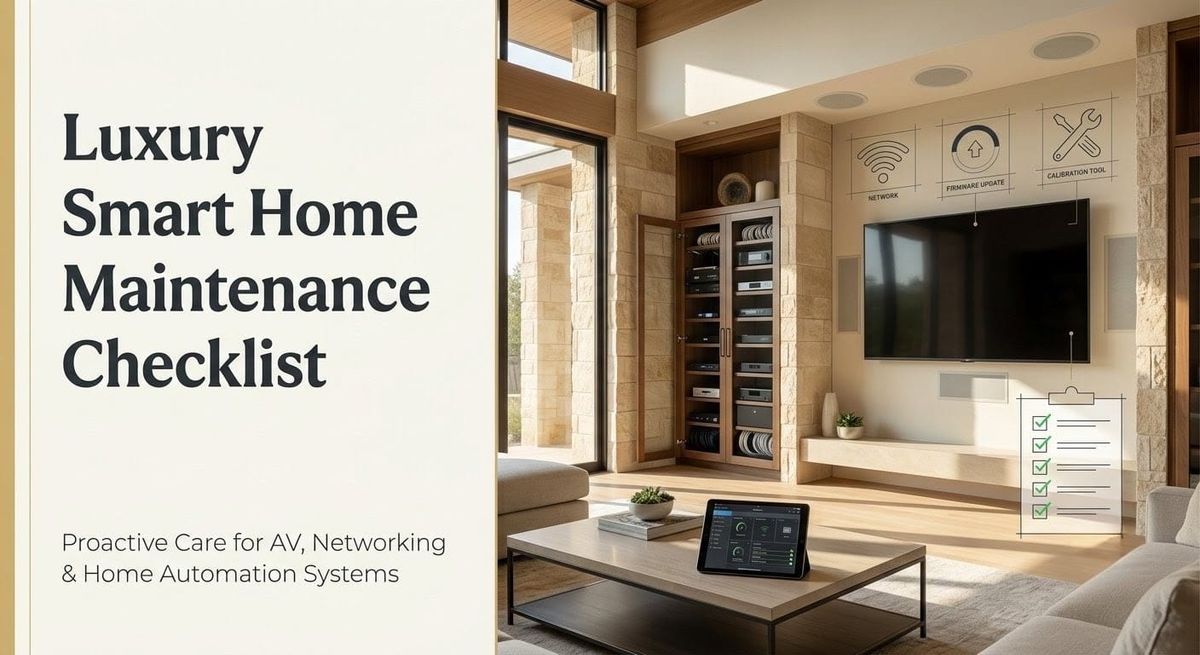
An 85-inch OLED has been running factory picture settings since it was delivered eighteen months ago. The Control4 system is two firmware versions behind. The AV receiver has been power-cycled by hand four times this quarter because it stops recognizing the Apple TV. None of this reads as unusual to most homeowners, because none of it looks broken. It just quietly performs at a fraction of what was actually paid for.
That is the default state of most luxury home technology installations across Dallas, Frisco, Austin, and Houston. High-net-worth homeowners invest heavily in AV and smart home systems, then manage them the way they manage a refrigerator: use it until it fails, then call someone.
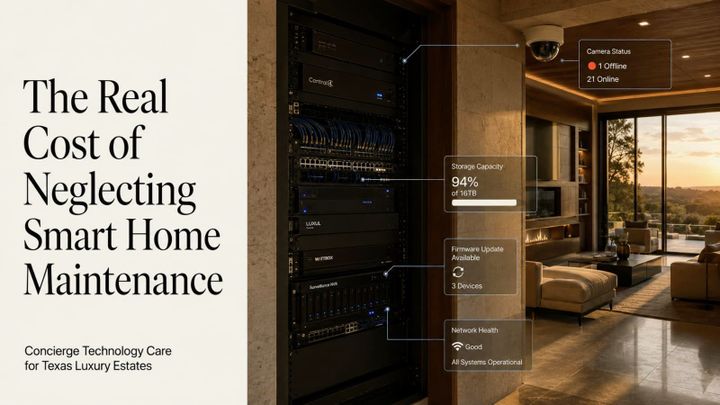
The difference is that a refrigerator does not develop firmware conflicts, drift out of color calibration, or lose network segmentation over time. A $90,000 AV and automation system with stale firmware and no proactive oversight degrades quietly and fails at the worst possible moment, a dinner party, a client presentation, the first cold night the heating automation scene has run in eight months.
This guide covers three things: what proactive AV and smart home maintenance actually includes, what professional ISF display calibration costs and why it matters, and what a real annual technology audit finds on a Texas luxury estate.
The Break-Fix Trap: Why Waiting for Failure Costs More
Break-fix is still the default model for most luxury home technology. The system works until it does not, then someone calls the original installer, or a new company that has to spend hours diagnosing an unfamiliar rack and network before any actual repair begins.
The math is worse than it looks at first glance. A firmware conflict between a Control4 controller and a newly updated streaming device can take four to six hours to diagnose from scratch. The identical issue resolves in under an hour for a technician who already performed a quarterly firmware check, and already has the rack configuration, device inventory, and programming history on file.
This is not a hypothetical risk. Parks Associates research published in 2025 found that 52 percent of consumers who set up their own smart home devices reported connectivity or setup problems, and that loss of wireless connectivity is consistently the most common smart home complaint. On a professionally integrated system with Control4, Crestron, or Savant automation layered on top of dozens of connected devices, that same underlying instability compounds rather than resolves itself.
Beyond avoided repair cost, there is a performance gap most homeowners never notice because nobody points it out. Factory display settings are tuned for a brightly lit showroom floor, not a media room. An AV receiver left on automatic room correction in an untreated space with asymmetric furniture will consistently underperform a properly calibrated system. Most homeowners have never heard or seen what their own system is actually capable of, because nobody finished the job after installation.
Proactive AV and Smart Home Maintenance: What It Actually Includes
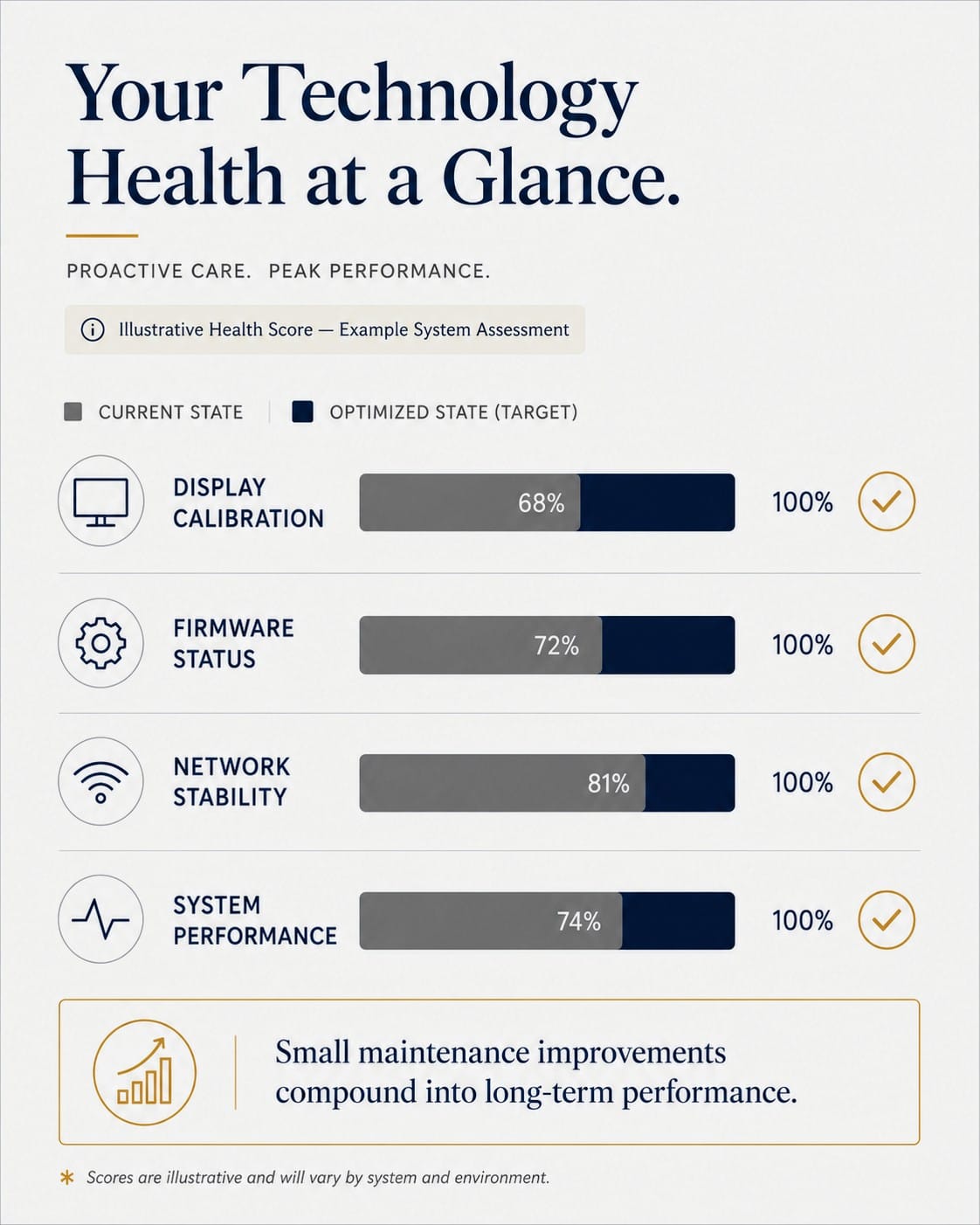
A proactive maintenance plan replaces the break-fix model with a standing service relationship: a technician visits on a defined schedule to update, test, and optimize the system before problems surface, rather than after.
Why Firmware Management Matters More Than It Seems
On a Control4 or Crestron system, a driver update pushed by a device manufacturer can break existing automation programming outright. A door lock that used to trigger a goodbye scene stops communicating with an updated Z-Wave driver, and the fix requires a programming session, not a simple firmware rollback. A technician actively managing the system tests driver updates in a staging environment before pushing them live, catching this before it becomes a Friday-night service call.
Texas heat adds a real, physical variable on top of the software layer. AV racks in unconditioned mechanical rooms across Dallas, Austin, and Houston regularly run at ambient temperatures exceeding 90 degrees Fahrenheit through summer. Sustained heat accelerates component wear, which is precisely why a maintenance visit scheduled in May, ahead of peak summer heat, is the right time to inspect rack ventilation and flag any component already running hot.
What Remote Monitoring Can and Cannot Do
Remote monitoring pings connected devices on a schedule, alerts when something goes offline, and allows software-layer fixes without a physical visit. It is useful for catching a router that lost connection overnight and power-cycling it before anyone wakes up, or flagging a stalled streaming device before a weekend of guests arrives.
It cannot fix a failed HDMI board, replace a worn projector lamp, re-terminate a loose speaker connection, or reprogram a scene broken by a firmware update. It is an early-warning layer, not a substitute for scheduled on-site visits. The strongest plans combine both.
Display and Audio Calibration: The Layer Most Systems Never Get
Professional ISF display calibration is the single most overlooked upgrade available to a luxury home theater owner. It costs a fraction of a new display, takes three to five hours, and the difference is immediately visible to anyone in the room.
ISF stands for the Imaging Science Foundation, the body that trains and certifies professional calibrators. A certified technician uses CalMAN measurement software paired with a colorimeter or spectrophotometer to measure a display's actual output against industry reference standards, Rec. 709 for standard content and DCI-P3 for HDR, rather than adjusting picture presets by eye.
Factory settings on every display are tuned to stand out under bright showroom lighting: brightness inflated, color temperature running cool and blue, contrast exaggerated. None of that suits a media room or dedicated theater, where those same settings produce a picture that is fatiguing to watch and inaccurate to the creator's intent.
The Annual Technology Audit
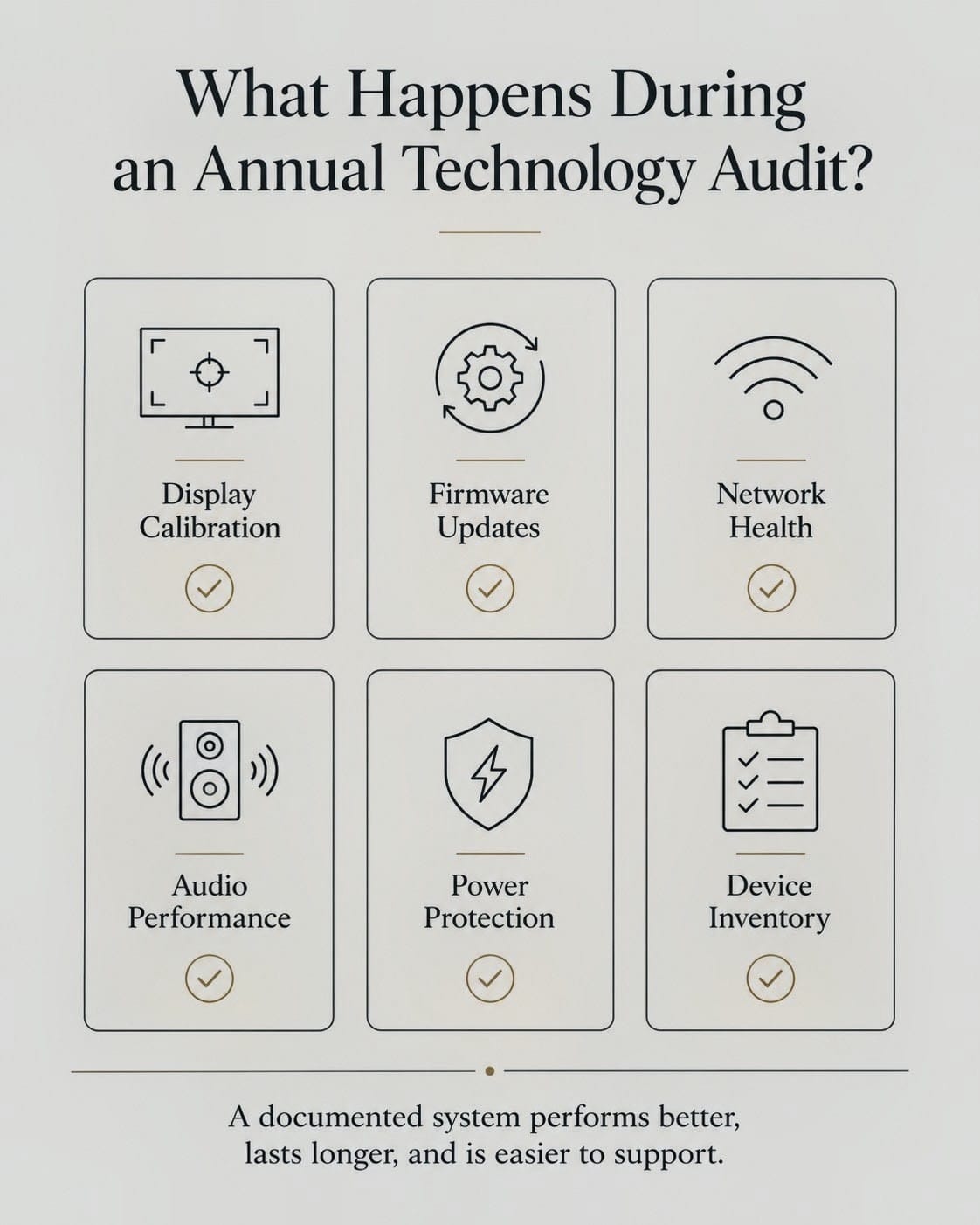
The annual technology audit is the least glamorous and most valuable service on this list: a systematic, room-by-room review of every networked device, cable run, automation scene, and subscription tied to the estate's technology ecosystem.
The audit concludes with a written Home Technology Health Report: current status by category, items resolved on-site, items flagged with estimated cost and priority, and a revised device inventory with firmware versions and warranty status. This same report has become useful at the time of a home sale, since luxury buyers increasingly ask for technology documentation as part of due diligence.
What Maintenance Actually Costs in Texas
Individual, non-member service calls through SEIITS run a flat $250 to $500 per visit, covering AV troubleshooting, firmware issues, and reconfiguration. Standing maintenance relationships are structured through SEIITS membership tiers rather than a separate per-service pricing table, starting at $6,000 per year for the Signature tier, which includes proactive maintenance, calibration access, and annual auditing across all technology categories, not maintenance priced in isolation.
The math favors a standing relationship for any estate with a home theater, a smart home platform, and a meaningfully sized device count. One avoided emergency call at $250 to $500 already offsets a real portion of the membership's cost, before counting the performance difference a calibrated, actively maintained system delivers year-round.
Inheriting and Stabilizing Existing Systems
A meaningful share of SEIITS maintenance clients arrive with systems installed by a previous integrator who is no longer responsive, a Control4 dealer who left the market, a Crestron installer who became unreachable, an AV company that closed. These are common situations in the Texas luxury market, not rare exceptions.
SEIITS performs a full system assessment on any inherited system before beginning maintenance: documenting hardware, recovering backup programming where possible, and identifying what can be maintained as-is versus what needs reprogramming.
Frequently Asked Questions
What is a home electronics maintenance plan and why do I need one?
It is a standing service agreement replacing break-fix repairs with scheduled visits that update firmware, test performance, and catch problems before they cause failures. For estates running Control4, Crestron, or Savant alongside dedicated AV systems, unmanaged firmware and compatibility drift create real, avoidable risk.
How much does AV and smart home maintenance cost in Texas?
Individual SEIITS service calls run a flat $250 to $500 per visit. Standing maintenance is included within SEIITS membership tiers starting at $6,000 per year, which bundles proactive maintenance, calibration, and annual auditing rather than pricing maintenance as an isolated line item.
What is ISF calibration and what does it cost?
ISF calibration is professional display tuning using measurement instruments to match industry color and brightness standards, correcting factory settings built for showroom lighting rather than home viewing.
Why does my smart home system keep glitching after updates?
Post-update glitches on Control4, Crestron, or Savant are almost always driver conflicts: a device manufacturer pushes a firmware update, and the automation controller's driver no longer matches it cleanly. Proactive driver management, testing updates before they reach the live system, is the direct fix.
Can SEIITS take over maintenance of a system installed by another company?
Yes. SEIITS regularly inherits systems from integrators who are no longer responsive or have left the market, beginning with a full assessment that documents hardware and recovers programming backups before establishing an ongoing maintenance relationship going forward from that point.
Where SEIITS Provides Home Electronics Maintenance
SEIITS serves luxury residential clients across Texas's primary markets for AV maintenance, calibration, and annual technology audits:
- Dallas-Fort Worth: Highland Park, University Park, Preston Hollow, Frisco, Plano, Southlake, Westlake, Colleyville
- Austin: West Lake Hills, Rollingwood, Barton Creek, Lake Travis
- Houston: River Oaks, Memorial, Tanglewood, The Woodlands, Sugar Land
- San Antonio: Alamo Heights, Dominion, Stone Oak
Stop managing break-fix calls. Start managing outcomes.
SEIITS's free Home Technology Lifestyle Assessment covers proactive maintenance, calibration, and audit needs across your entire estate.

Comments ()