
Whole-Estate Surge Protection for Texas Homes: Why a $200 Gadget Isn't Protecting What You Think It Is
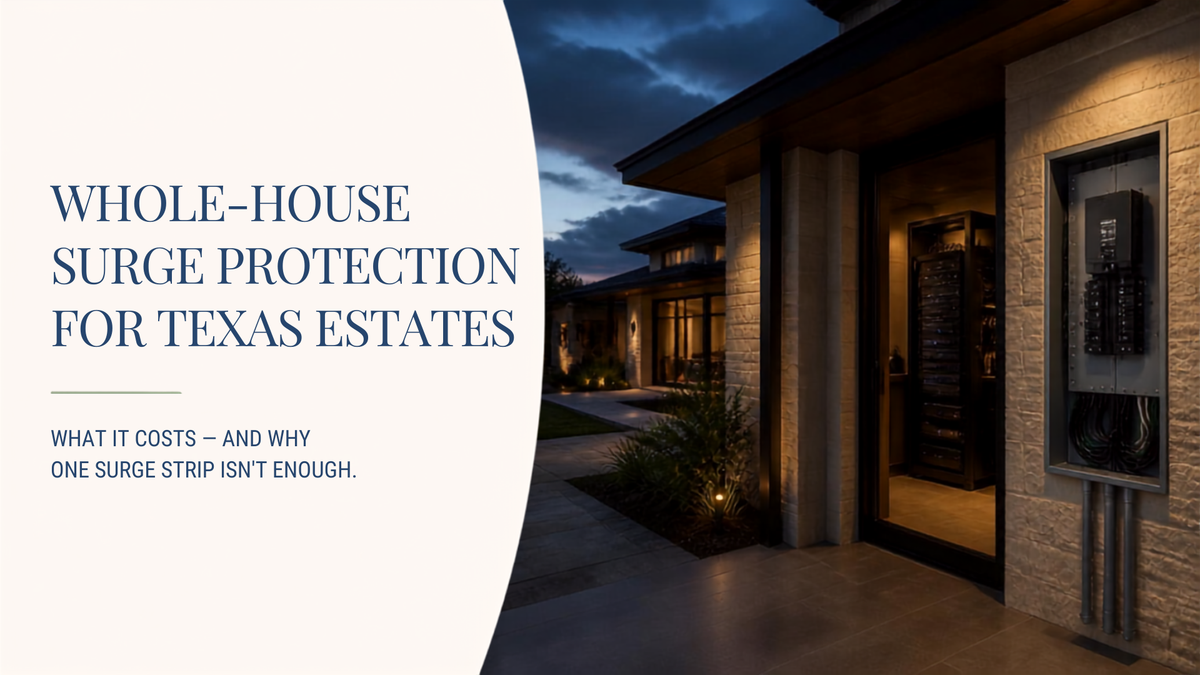
A Barton Creek estate loses an AV receiver, a network switch, and two security cameras in the same storm that trips neighborhood power twice within an hour. The homeowner had a surge strip behind the theater rack, the kind sold at any electronics store for under $200. It protected exactly what was plugged into it. Nothing else on the property had any protection at all.
This is not a rare scenario in Texas specifically. It is close to the default outcome for a state that leads the nation in total lightning activity, layered on top of a power grid with documented instability during severe weather. Every national buying guide for surge protection assumes a single home theater, a single rack, a single point of failure. None of them assume a property with a main residence, a guest house, and a pool house, each running its own electrical panel and its own set of connected technology.
Here is what real, whole-estate surge protection actually involves, what it costs, and why a single retail gadget was never going to be enough.
How Much Does a Whole House Surge Protector Cost?
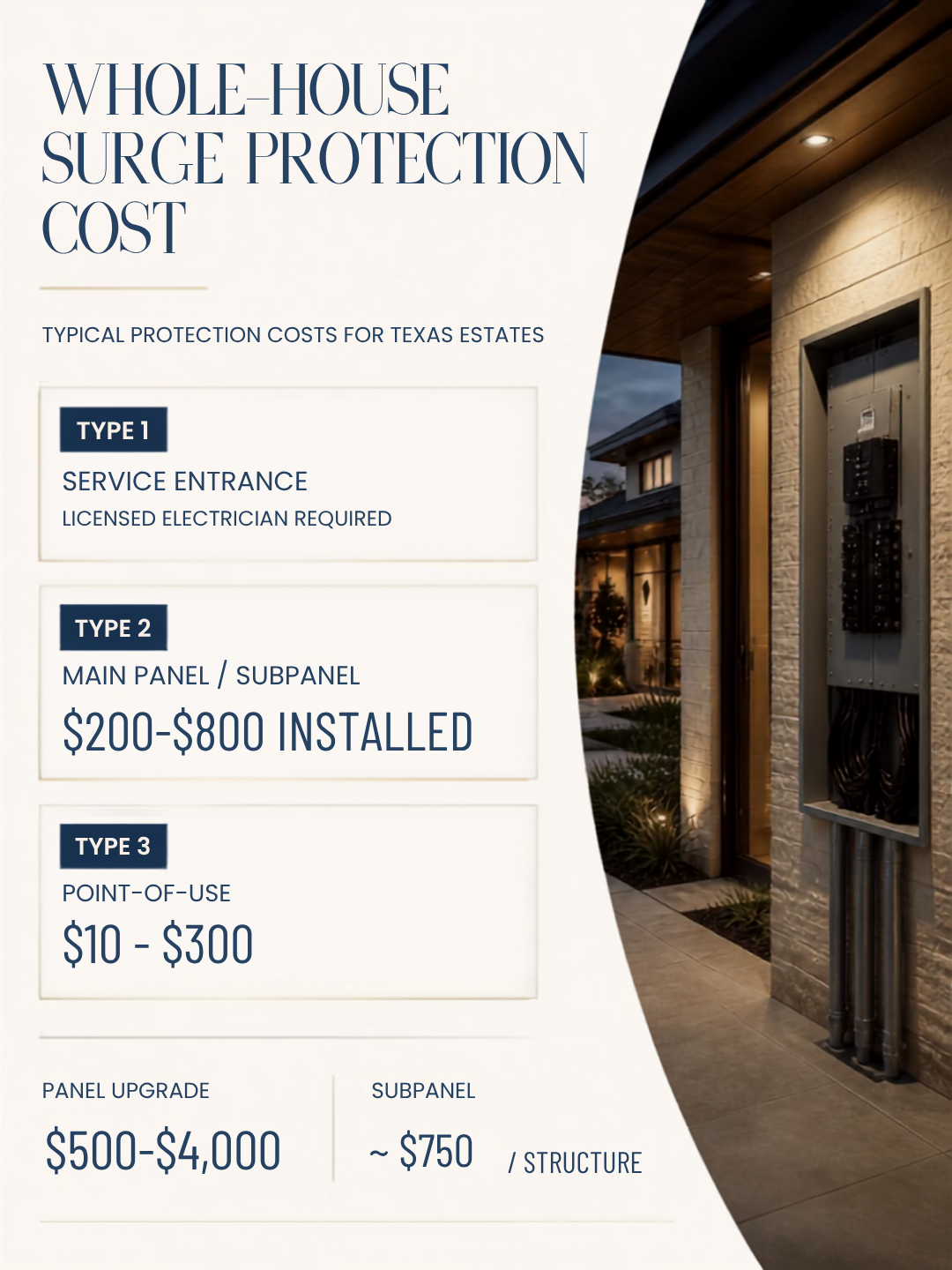
A professionally installed whole-house surge protector, mounted at the main electrical panel, typically costs $200 to $800 total, combining a $60 to $600 device with $140 to $800 in licensed electrician labor. Multiple independent electrician and home-improvement sources converge on this range.
Additional cost applies if the panel itself needs work first. A panel upgrade or replacement, sometimes required before a surge protector can be safely installed, runs $500 to $4,000 depending on the home's electrical capacity and age. A subpanel, common on a property with a guest house, pool house, or detached garage, adds roughly $750 more per structure, since each subpanel is a separate installation point requiring its own protection.
|
Protection Type |
Installed Location |
Typical Cost |
|
Type 1 (service entrance) |
Utility connection point |
Licensed electrician
required |
|
Type 2 (panel/subpanel) |
Main panel or subpanel |
$200-$800 installed |
|
Type 3 (point-of-use) |
Individual outlet/rack |
$10-$300, no license needed |
|
Panel upgrade (if needed) |
Main electrical panel |
$500-$4,000 |
|
Subpanel addition |
Guest house, pool house,
garage |
~$750 per structure |
Is a Whole House Surge Protector Worth It?
For a Texas property, yes, though the actual risk profile is more nuanced than a single statistic suggests. According to Vaisala Xweather's 2025 Annual Lightning Report, Texas recorded more total lightning strikes than any other state in the nation, more than Florida and Oklahoma combined. That said, once those numbers are adjusted for the state's sheer size, Texas actually drops to 6th place in lightning density, behind Florida, Oklahoma, Louisiana, Mississippi, and Arkansas. The raw total is real and driven largely by Texas simply being a very large state, not because any individual property there is struck more often than one in a denser state.
What doesn't change with that nuance is the second, compounding risk most homeowners never connect to the same conversation: grid instability during extreme weather. ERCOT operates one of the most independent power grids in the country, and its own seasonal reliability assessments acknowledge vulnerability during severe weather events, when rapid power cycling during outages and restoration can send damaging surges through utility lines, independent of any lightning strike at all.
These two risks compound rather than simply add together, because the same severe weather system that produces the lightning is often the same system straining the grid. A single spring thunderstorm rolling through the Hill Country can trigger a direct lightning strike, a nearby strike that induces a surge through the utility line, and a grid-side voltage fluctuation as the local utility cycles power during and after the storm, all within the same hour. A homeowner who has only ever thought about lightning as the risk is prepared for one of these three events, not all three.
What's the Difference Between a Surge Protector and a Power Conditioner?
A surge protector clamps a voltage spike before it reaches connected equipment, reacting to a single event. A power conditioner does that and additionally filters ongoing electrical noise, an entirely different, continuous problem that affects audio and video quality even when no surge event is occurring.
This distinction is precisely why a whole-house panel-level device and a point-of-use device at an AV rack are not substitutes for each other. The panel-level Type 2 protector blocks large external surges from spreading through the home's wiring. It does nothing to filter the electrical noise a sensitive AV receiver experiences on its own circuit day to day, which is what point-of-use conditioning at the rack itself addresses. A serious system needs both layers functioning together, not one chosen instead of the other.
Not sure what's actually protecting your estate's technology investment? SEIITS's technology audits review equipment health and lifecycle status as standard practice, and can incorporate a full surge and power protection review across every panel on the property. Book a free Home Technology Assessment at seiits.com/assessment
Does Homeowners Insurance Cover Surge Damage?
Often only partially, and coverage frequently depends on proving the cause and demonstrating reasonable prevention measures were in place, which is a meaningfully different position than simply filing a claim after equipment fails.
Several electrician-published sources note that surge protector warranties, and by extension the manufacturer's own equipment protection guarantees, typically require licensed professional installation to remain valid at all. A homeowner relying solely on a homeowner's policy after a DIY or unprotected installation may find the claim more complicated than expected, on top of whatever the policy's own deductible and coverage limits already impose.
Do I Need Surge Protection for a Guest House or Pool House?
Yes, if that structure has its own electrical subpanel, which is typical for any secondary structure on a luxury property. A whole-house surge protector installed only at the main residence's panel does not extend protection to a subpanel feeding a separate building.
This is the single most commonly missed detail on multi-structure estates. A homeowner who protects the main house reasonably assumes the job is done, without realizing that a pool house's audio system, a guest house's network equipment, or a detached garage's security cameras are running on an entirely separate, unprotected electrical path back to the utility connection.
What's Actually at Risk on an Estate-Scale System
National surge protection guides frame the stakes as roughly $10,000 in potential appliance damage, a reasonable number for a refrigerator, a washing machine, and a few television sets. That figure has almost no relationship to what a fully integrated luxury estate has connected to its electrical system.
A home automation controller, a multi-zone AV rack with a receiver and amplifiers, a network closet with switches and servers, and a security system with a dozen or more networked cameras represent a technology investment commonly running into six figures across a single estate. None of that equipment is protected by a $150 surge strip plugged into one outlet in one room, and none of it is accounted for in a cost guide written for a household with a television and a coffee maker.
The math changes considerably once the actual equipment at risk is priced correctly. A $200 to $800 whole-house surge protector, plus point-of-use conditioning at each equipment rack, is a small fraction of the cost of replacing even one damaged AV receiver and automation controller after an unprotected surge event, before counting the labor to diagnose and reprogram whatever automation logic broke along with the hardware.
Why This Belongs in an Estate Technology Audit, Not a Separate Project
Surge and power conditioning review belongs inside a proper technology audit, alongside equipment health and lifecycle assessment, not as a standalone electrical project disconnected from the technology systems it actually protects. Treating it separately is how a home ends up with a single retail gadget behind one rack and nothing everywhere else.
The right sequence starts with identifying every panel and subpanel on the property, confirming what each currently protects and what it does not, and then layering panel-level and point-of-use protection together based on what equipment sits downstream of each connection. That is an audit finding, not a guess made after a storm already caused the damage it was meant to prevent.
Frequently Asked Questions
How much does a whole house surge protector cost?
A professionally installed Type 2 surge protector at the main panel typically costs $200 to $800 total. If a panel upgrade is needed first, that adds $500 to $4,000. A subpanel for a secondary structure adds roughly $750 more per building.
Is a whole house surge protector worth it?
Yes, especially in Texas, which recorded more total lightning strikes than any other state in 2025, more than Florida and Oklahoma combined, even though Texas ranks 6th rather than 1st once those numbers are adjusted for the state's size. Combined with documented grid instability during severe weather, the practical risk to unprotected equipment remains real regardless of the density ranking.
What's the difference between a surge protector and a power conditioner?
A surge protector reacts to a single voltage spike event. A power conditioner additionally filters ongoing electrical noise that affects audio and video quality continuously. A serious AV system benefits from both, since they solve different problems at different points.
Does homeowners insurance cover surge damage?
Often only partially, and coverage can depend on demonstrating reasonable prevention measures were already in place before the damage occurred. Many surge protector and equipment warranties also require licensed professional installation to remain valid, which affects both insurance and manufacturer claims equally.
Do I need surge protection for a guest house or pool house?
Yes, if that structure has its own electrical subpanel, which is standard for most secondary buildings on a larger property. Protecting only the main residence's panel leaves any structure on a separate subpanel entirely unprotected from the same underlying risk.
Comments ()