
Luxury Smart Home Security Systems for Texas Estates: Surveillance, Access Control & Non-ADT Monitoring
A Plano estate had 14 cameras, a national monitoring contract, and three false police dispatches in six months. The cameras had gaps. The NVR was wide open on the internet. The alarm never talked to the smart home. Here is what an estate security architecture actually requires.
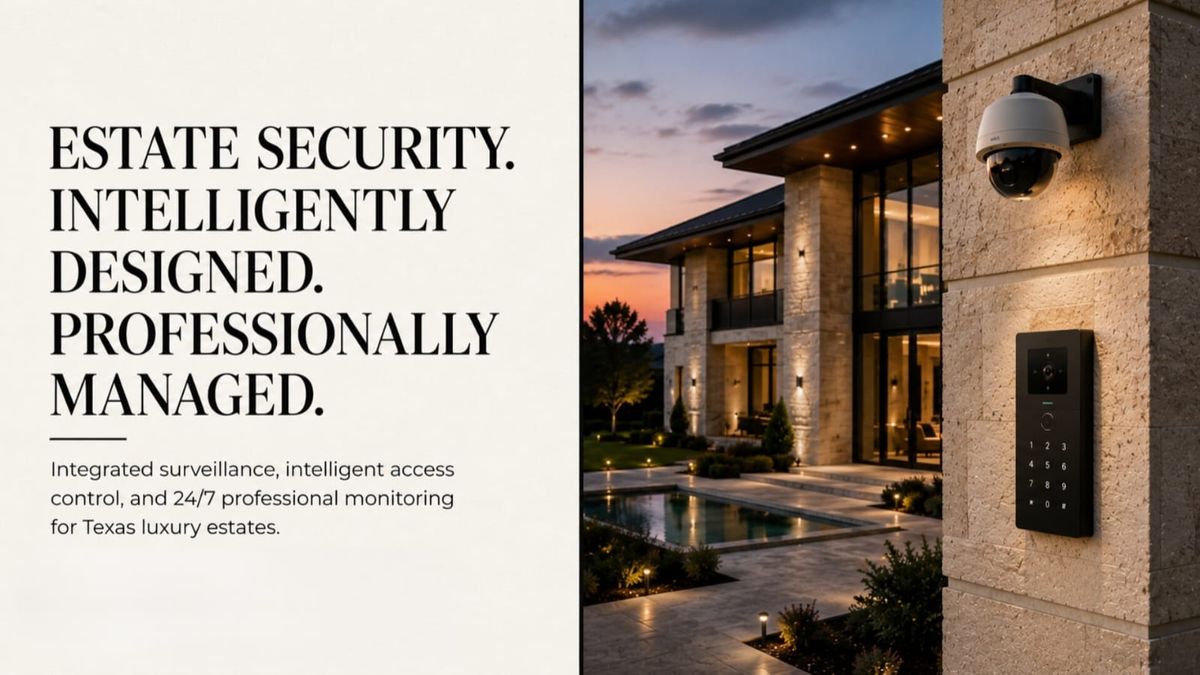
A Plano estate called SEIITS after a security company dispatched police three times in six months, every one a false alarm from the household manager's normal Tuesday morning arrival. The estate had 14 cameras, seven of them with coverage gaps at the rear fence line and the pool house. The video recorder was reachable from the open internet on its factory-default password. The alarm panel had never once talked to the home's Control4 system. On paper, this was a sophisticated security installation. In practice, it was fourteen separate liabilities wearing one label.
SEIITS sees this same mismatch across new client assessments in DFW: homeowners who have spent $40,000 to $120,000 on cameras, panels, and locks that were installed for convenience rather than coverage, running on a monitoring contract with an operator who has no idea who the household manager is. The system looks complete. The security outcome is not.
This guide covers what SEIITS designs and manages for Texas estates through its home security service: full-estate surveillance, layered access control from gate to interior, and monitoring that is actually built around how the estate operates.
What is a luxury smart home security system for a Texas estate?
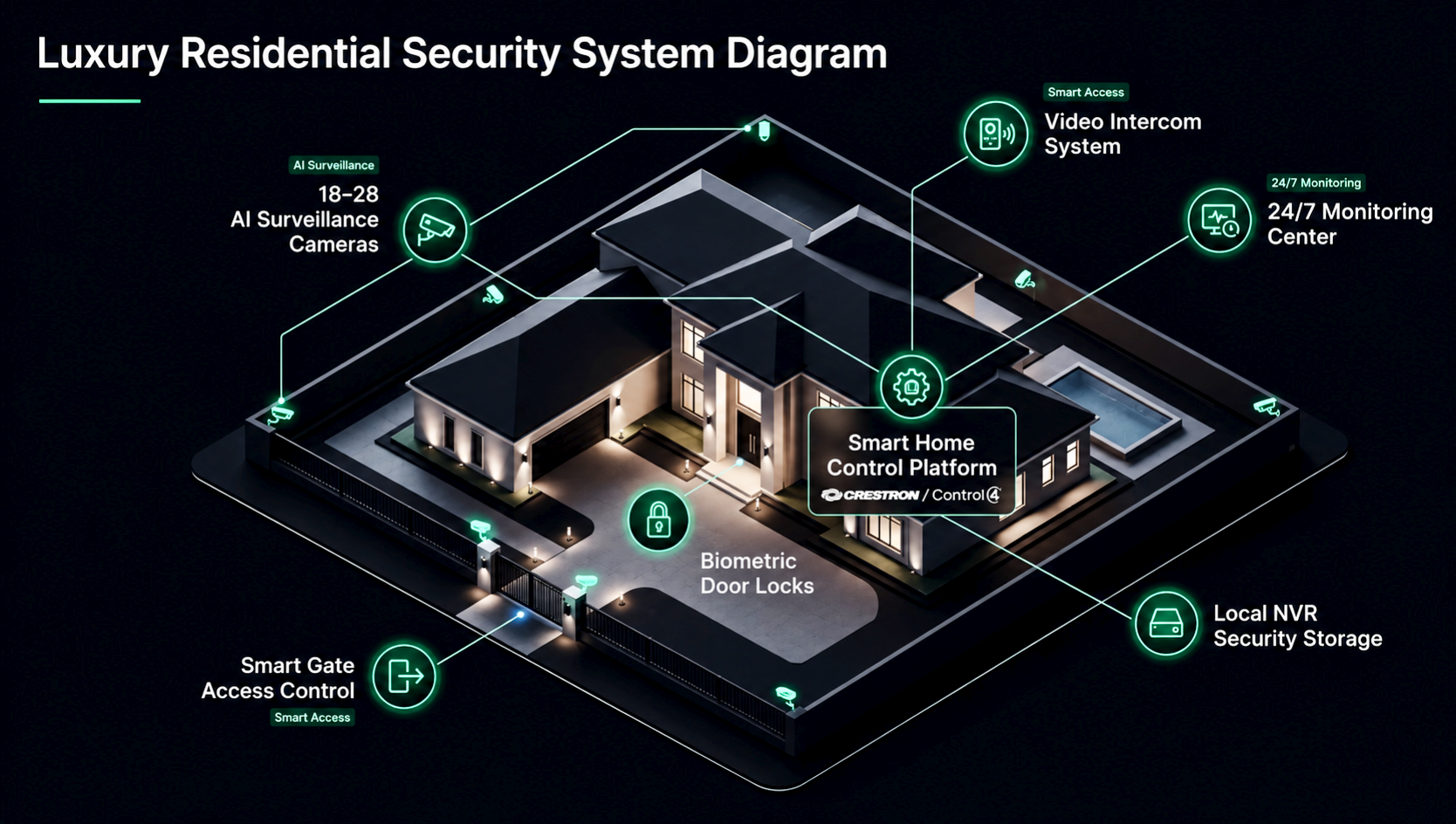
A luxury smart home security system for a Texas estate is an integrated security architecture combining full-property AI-powered camera surveillance, biometric and smart access control at gates and entry points, intrusion detection, and 24/7 professional monitoring, fully integrated with the estate's Crestron, Control4, or Savant smart home platform. It is designed for 5,000 to 20,000+ square foot properties with 10 to 30+ cameras, gated access, and household staff protocols, and its monitoring runs independent of national consumer alarm providers.
Why do standard alarm companies fall short on Texas luxury estates?
Standard alarm companies fall short on Texas luxury estates because their entire infrastructure, monitoring model, and operator training are sized for a 2,500 square foot home with one or two entry points, not a four-acre property with 20+ cameras, a gated entry, a detached guest house, and a household staff. A national monitoring center receiving an alert from camera 17 of 22 has no floor-plan context and no way to distinguish the landscaping crew's Tuesday arrival from an actual intrusion, which produces either alert fatigue or a genuine event escalated too slowly.
The deeper problem is integration. An estate running Crestron or Control4 already knows the state of every door, gate, and camera on the property. Left unconnected to the alarm system, that platform cannot trigger lighting on an intrusion event or lock access points automatically, and the monitoring operator never sees any of it. The security system is not actually smart until the platforms talk to each other.
What does full-estate surveillance actually require?
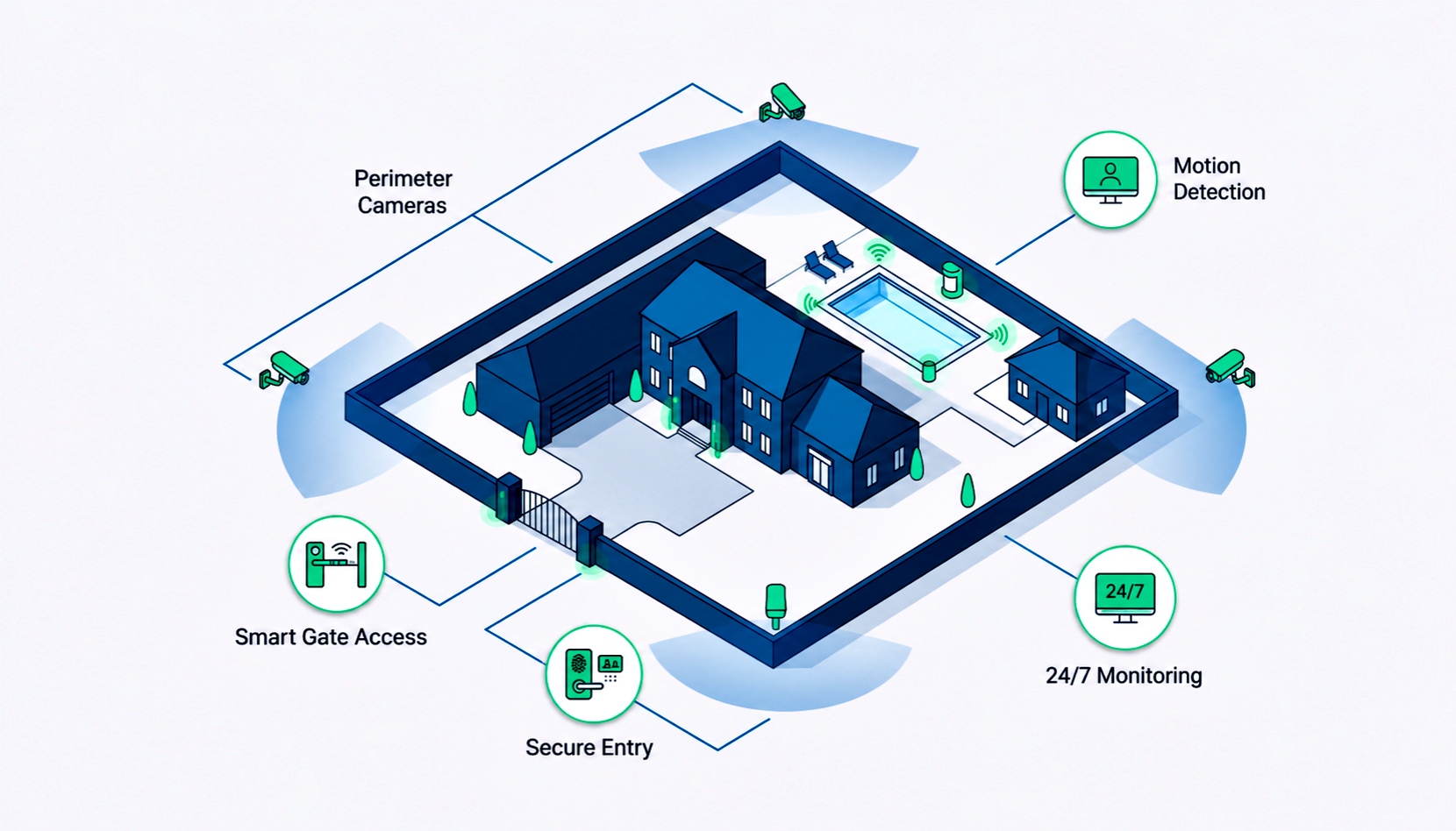
Full-estate surveillance for a Texas property requires a documented coverage analysis, not cameras placed at convenient mounting points. A 4-acre estate in Southlake or Plano typically needs 18 to 28 cameras: perimeter units along the fence line, entry cameras at gates and doors with resolution sufficient for facial and license-plate detail, zone cameras over motor courts and pool areas, and interior units in common areas for staff and access monitoring. Camera positions are documented in a coverage map that becomes part of the estate's permanent security record.
PTZ (Pan-Tilt-Zoom) cameras at key positions let a monitoring operator actively track movement across a large property instead of reviewing fixed footage after the fact, with optical zoom ranges typically in the 20-32x range on the enterprise-grade units SEIITS deploys, sufficient to track a vehicle continuously from the gate to the front entrance. AI-based analytics change the entire alert model, from motion-triggered to behavior-triggered: a basic motion sensor fires on every branch that moves in the wind, while an AI-filtered camera distinguishes a person from a vehicle from an animal and alerts only on the behavior that actually matters, which meaningfully reduces the false-alarm volume that causes homeowners to stop trusting their own system.
Facial recognition and LPR (License Plate Recognition) at entry points automate access for known household members and pre-approved vendors while flagging anyone unrecognized, with every vehicle entry and exit logged for security review. For detailed camera-tier pricing by system type, see SEIITS's security camera installation cost breakdown for Texas estates, which this pillar does not repeat.
What does layered access control involve, from gate to interior?
Layered access control on a Texas estate operates in three tiers: the property gate, the building envelope, and interior zones such as a home office, server room, or safe room, each requiring different hardware and credential management. A gate that opens for every approaching vehicle provides no security, and a gate that demands manual intercom interaction for every daily vendor creates enough friction that households prop it open. SEIITS installs intercom systems with integrated camera, card reader, and video display at estate gates, delivering gate video to any touchscreen or phone on the property and automating entry for LPR-recognized vehicles.
Biometric access at exterior doors removes the vulnerabilities of keys and shared PINs entirely: a fingerprint or facial credential is tied to one specific person and produces a timestamped log of every entry, which matters most for estates managing household staff turnover without re-keying or PIN rotation. For multi-structure properties, guest house, pool house, staff quarters, a unified video intercom platform lets any entry point be seen and admitted from any device on the estate rather than requiring a separate system per building. For new construction across Frisco and Highland Park, this wiring is specified at the design stage, well before framing closes, at a fraction of retrofit cost.
Why does non-ADT professional monitoring make the actual difference?
Non-ADT professional monitoring makes the difference because national monitoring centers run scripted protocols built for a standard residential alarm, a door opens, a motion sensor fires, an operator calls, then dispatches police if there is no answer, which is the wrong protocol for a gated estate with a household staff and predictable vendor traffic. SEIITS delivers every managed security client a custom monitoring protocol document specifying who has authorized access, the property's normal activity patterns, expected vendor schedules, and the escalation path for specific alert types, independent of any national provider's proprietary equipment.
The cybersecurity layer most estates are missing
Physical security and network security are the same problem on an estate running 30+ IoT (Internet of Things) devices, a smart home processor, and a NAS server on one flat network. Every camera with a weak credential is a potential entry point for a remote attacker, and an unsecured NAS can expose family financial records with no forced entry required at all. A compromised smart lock with unpatched firmware can open a door remotely without ever touching the physical hardware. SEIITS runs security cameras on an isolated VLAN (Virtual Local Area Network) with no direct internet access, recording locally to an NVR (Network Video Recorder) and streaming to the monitoring platform through a secured outbound-only connection, while smart locks and access control sit on a separate IoT VLAN from personal devices. Firmware is managed proactively under the membership agreement, since an unpatched credential is the most common residential security exposure SEIITS finds during estate audits.
The same logic applies to the household's non-security devices. A NAS server holding tax documents, a Crestron processor controlling every door in the home, and a laptop the household manager uses for scheduling should never share a broadcast domain with a camera facing the street. VLAN segmentation is the architectural decision that keeps a single compromised device from becoming access to everything else on the property, and it is why SEIITS treats network design as inseparable from the security system itself rather than something a separate vendor handles later.
This segmentation approach follows the guidance CISA and NIST publish for securing networks with many connected devices, and the PTZ specifications SEIITS deploys are documented directly by Axis Communications.
A security system that fails during the event it exists for is not a security system. SEIITS designs communication redundancy (IP and cellular paths, switching automatically if internet is lost), power redundancy (UPS backup on the panel, NVR, and access points through outages), and, for Prestige and Exclusive membership clients, direct coordination with a homeowner's private security provider so both teams work from the same real-time data.
Case study: a full security rebuild on a Plano estate
SEIITS was engaged on an 8,400 square foot, 1.8-acre Plano estate after a series of incidents the existing system failed to detect or respond to. At intake: 14 cameras on a Hikvision NVR with seven coverage gaps at the rear fence line and pool house entrance, an NVR reachable from the open internet on factory-default credentials, an alarm panel with zero integration to the home's Control4 system, and a national monitoring provider that had dispatched police three times in six months for the household manager's routine morning arrival.
SEIITS rebuilt the architecture completely: 22 cameras on a fully isolated security VLAN with onsite NVR storage and encrypted cloud backup, PTZ coverage added at the previously blind rear fence line and pool house, LPR at the gate for automated entry of known vehicles, a video intercom at the gate and front entry integrated with Control4, biometric locks at all four exterior doors, a new alarm panel with IP and cellular redundancy, and a custom monitoring protocol document delivered to the new monitoring provider.
At the 90-day review: zero false-alarm dispatches, the household manager's entry auto-recognized and logged at the gate, full camera coverage at the rear fence line and pool house, the NVR's internet exposure eliminated, and the alarm now triggering a full exterior lighting response through Control4. The client enrolled in the Prestige membership tier. Total installation investment was $67,500, with an annual membership of $7,200.
Frequently asked questions
What is the difference between a luxury estate security system and a standard residential alarm?
A luxury estate system is an integrated architecture combining full-perimeter AI surveillance, biometric access control, and smart home platform integration, built for large, complex properties. A standard alarm is a sensor-and-panel system for one or two entry points, monitored identically for every account. The difference is architecture and monitoring depth, not just price.
Can SEIITS integrate a security system with an existing Crestron or Control4 system?
Yes. SEIITS designs security systems to integrate natively with Crestron, Control4, and Savant, so the platform receives real-time alarm state, door and gate status, and camera events, and can trigger lighting, locks, or camera feeds automatically in response. Estates with an existing standalone system receive a full integration assessment during the Home Technology Assessment.
How much does a luxury home security system cost in Texas?
Luxury security installation for a Texas estate typically runs $25,000 for a camera and access-control upgrade to $120,000+ for a full architecture build including AI cameras, biometric access, gate integration, and network segmentation. Annual monitoring and management memberships range $4,800 to $9,600 depending on estate size and response level.
What is smart home cybersecurity and why does it matter for luxury estates?
Smart home cybersecurity secures the digital side of a connected estate, cameras, locks, processors, and NAS servers, against unauthorized remote access. Weak camera credentials or unpatched lock firmware can expose live footage or open doors remotely without any physical break-in. SEIITS addresses this through VLAN segmentation, device isolation, and proactive firmware management on every installation.
Does SEIITS offer non-ADT professional monitoring for luxury estates?
Yes. SEIITS partners with professional central monitoring stations that follow a custom, property-specific protocol rather than the scripted residential response national providers use. Every client receives a monitoring document detailing authorized access, normal activity patterns, and escalation rules, independent of ADT, Vivint, or any other national provider's equipment.
How does SEIITS handle security for estates with household staff?
Biometric credentials at exterior doors give each staff member an individually logged entry and exit with no key management or PIN rotation needed. LPR automates gate entry for known staff vehicles. Access can be modified or revoked immediately when roles change, and normal staff activity patterns are documented in the monitoring protocol to prevent false dispatches.
Where SEIITS installs and manages luxury security systems
SEIITS designs, installs, and manages luxury security systems across the primary Texas markets: Plano, Dallas, Frisco, Southlake, Highland Park, University Park, and Westlake in DFW, with full-scope installations in Austin and Prestige/Exclusive-tier engagements in Houston. SEIITS also audits and rebuilds existing installations where coverage gaps, failed integration, or cybersecurity exposure went unaddressed by the original installer.
Security depends on the network beneath it: see how SEIITS approaches network segmentation and securing home WiFi and eliminating WiFi dead zones across a large estate. For camera-tier pricing specifically, see the security camera installation cost guide. For new construction, see the pre-construction integration guide for Texas architects and 10 questions every builder should ask their integrator. For gated developments and multifamily properties, see smart technology for multifamily properties in Texas and why Texas developers are integrating smart home technology. If a device is behaving erratically rather than showing a clear fault, start with when to call a professional, and see the ongoing maintenance model SEIITS applies across every managed system.
Comments ()