
Smart Locks vs. Access Control Systems: What Do Luxury Developments Really Need?
Smart locks vs access control systems explained for luxury developments. Learn why builders and developers need centralized access control for security, operations, and tenant management.
A Real Conversation That Led To This Guide
I met with a custom home builder in Austin earlier this year. We were developing specifications for a 12-unit luxury development. He said, "The client asked us if we could install smart locks on every unit and bypass a full access control system. Are they essentially the same thing?"
That question—so simple, so innocent, yet so typical—exposes the largest misconception that builders and developers struggle with today.
Smart locks and professional access control systems are not two versions of the same product. They serve two very different worlds.
And picking the incorrect one will cause:
- Credential headache problems for tenants
- Security issues
- Operational inefficiency
- Chaos at move-in/move-out
- Zero audit logs (a problem most developers underestimate until it is too late)
This guide breaks down the confusion with a B2B answer for builders and developers.
What Is The True Difference Between Smart Locks and Access Control Systems?
Q1: What is a smart lock?
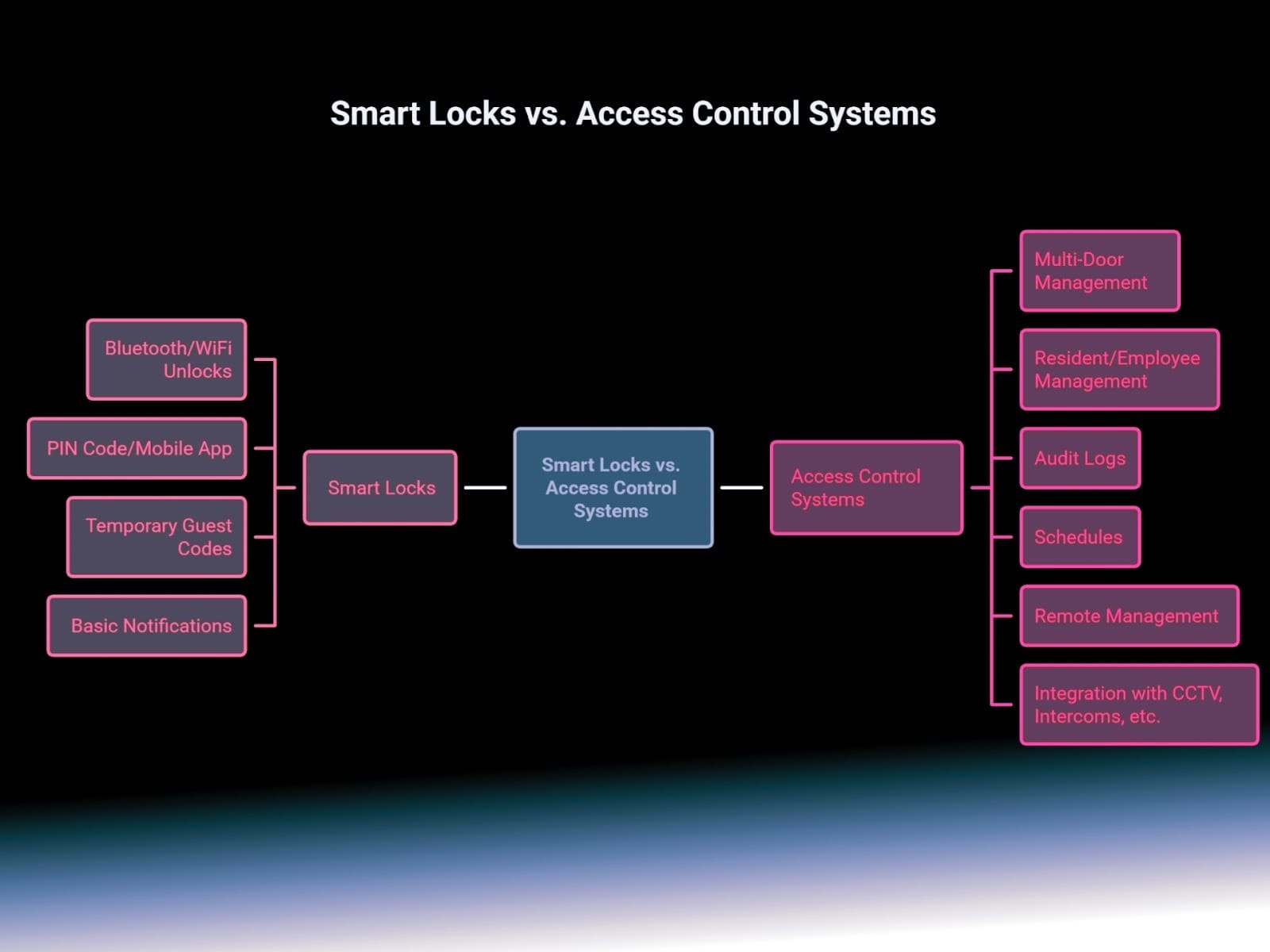
A smart lock is a self-contained, consumer-grade product for single-family homes.
Some of the standard features include:
- Unlocks via Bluetooth/WiFi
- Unlocks using PIN code or mobile application
- Temporary guest codes
- Basic notification about access/exit events
Smart locks only allow you to unlock one door at a time.
Smart locks are not able to manage your buildings, employees, schedules, or many credentials.
Q2: What is an access control system?
An access control system is a centralized, commercial-grade system that manages:
- Every door in a building
- All residents, employees, and visitors
- Audit logs
- Schedules
- Remote management
- Integrates with: CCTV, intercoms, gates, elevators, garage, etc.
Access control uses server-based or cloud-based management and encrypted credentials (PIN, fob, card, mobile credential) and unifies dashboards for all doors.
It’s the standard in:
- multifamily
- gated communities
- commercial buildings
- horizontal developments
- luxury condos
Smart locks = hardware Access control = full ecosystem
Can Smart Locks Be Used For Multi-Unit Development Or Luxury Development?
Short Answer: No, and Here Is Why:
Q3: Why are smart locks not sufficient for multi-unit developments?
Because each smart lock is independent.
In a 20-unit building:
- Each smart lock must be programmed separately.
- Move-out requires manually deleting each lock.
- No global permissions.
- There is no way to view a building-wide activity log.
- You cannot give universal permission to staff and/or vendors.
This creates a great deal of administrative complexity for property managers.
Most smart locks cannot:
- Be integrated into the building systems
- Control shared spaces
- Connect to elevators
- Log parking gate access
- Log visitor access
Smart locks are well-suited for single-family homes; however, they are not suitable for multi-residence settings.
What Can Access Control Do That Smart Locks Cannot?
Q4: How does access control provide better security than smart locks?
Access control provides:
- Audit logs (Who accessed the door, when, what door)
- Time-based scheduling for access
- Emergency lockdown mode
- Revoking credentials immediately for all doors
Smart locks do not provide any of the above access-control level features.
Q5: How does access control simplify operations for developers?
With an access control system, a property manager can:
- Remove/add a tenant from the entire building in seconds.
- Send a mobile credential to the tenant.
- Grant temporary vendor access.
- Manage all shared amenities from one screen.
- Review access logs for disputes or incidents.
Therefore, every significant multifamily developer in the United States uses an access control system instead of smart locks for standalone use.
Do Smart Locks Ever Have Value In Luxury Projects?
Q6: When would you want to use smart locks?
Smart locks can be a viable option for:
- Interior rooms within a luxury home
- Home office
- Wine room/storage room
- Guest suite
- Back-of-house area
Never as the primary building-wide access method.
Q7: Can smart locks be included as part of an access control ecosystem?
Yes. Pro-grade platforms can integrate some smart locks through hubs or bridges.
However:
- Requires a developer to professionally specify the integration.
- Not all smart locks can easily be integrated.
- Reliability limits exist with consumer-grade locks.
If a developer wishes to utilize smart locks for ease of use, then smart locks should be integrated through a central platform, not as a standalone unit.
What Should Builders And Developers Actually Spec Out? (Expert Recommendations)
Q8: What do luxury builders usually select?
Across the luxury markets in Texas, Florida, California, and New York, builders and developers almost uniformly select:
- Access control for perimeter/common areas
- Smart lock integrations are only required for unit entry
- Unified mobile credentials that function for both
Provides:
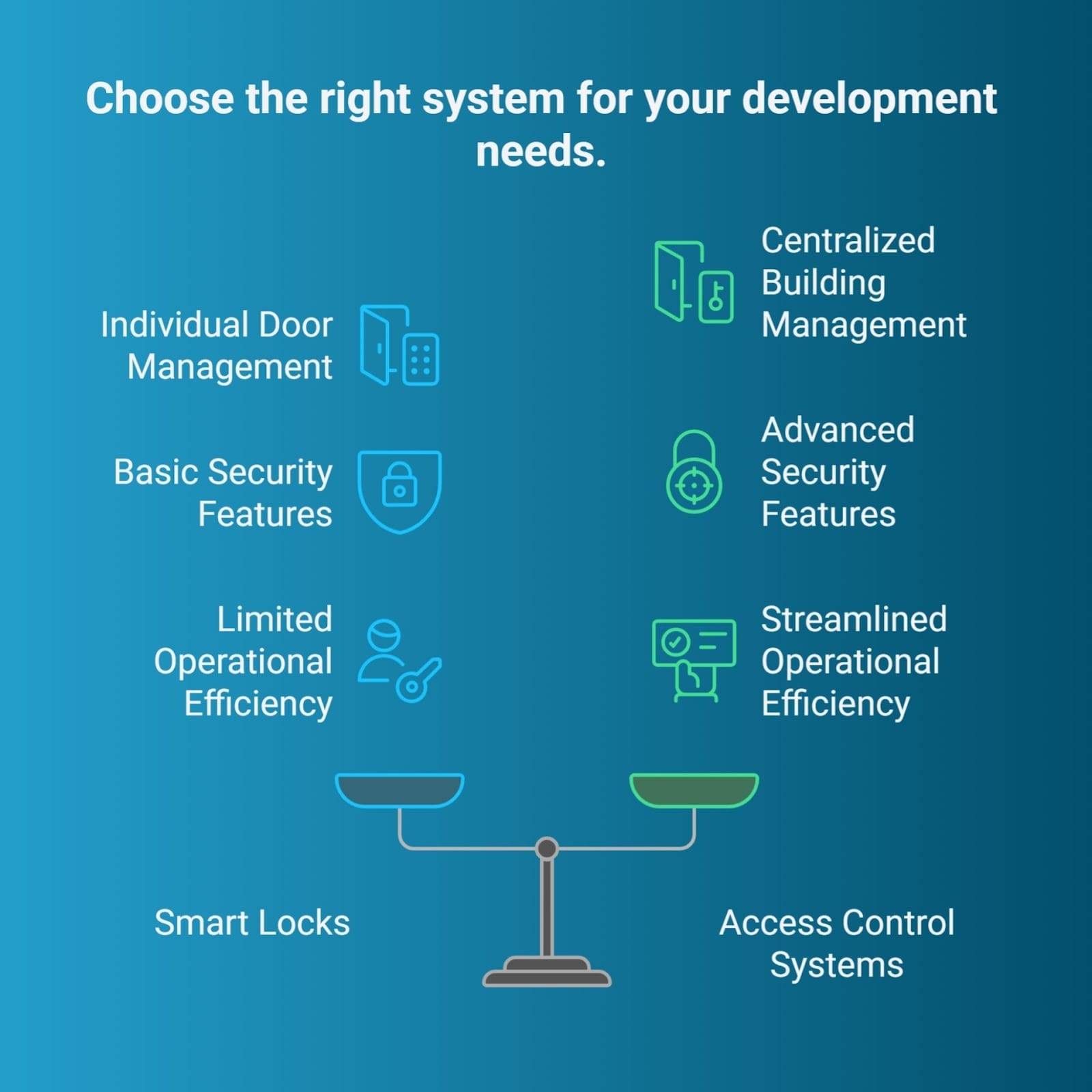
- Centralized management
- Full audit logs
- Seamless tenant experience
- Building-wide consistency
- Future scalable.
How Should Developers Vet an Integrator for Access Control Installations?
Q9: What questions should builders ask before hiring an integrator?
Ask these 10 essential questions (practical vetting checklist):
- Do you provide full design drawings and door schedules?
- When do you prefer to join the construction timeline?
- Which platforms do you recommend (and why)?
- Can all doors be managed from one dashboard?
- Do mobile credentials come standard?
- What are your networking and power requirements?
- Can this scale if the project expands?
- What backup/override methods exist during power or internet loss?
- What’s your service/support plan for year one?
- Can you integrate CCTV, intercoms, garage gates, and elevators?
A trained integrator should confidently answer all ten.
So, Which One Does Luxury Development Really Need?
Q10: Final Answer: Smart Locks vs Access Control, Who Wins?
For developers, the correct choice is almost always:
👉 Access Control System as the foundation
👉 Smart locks only when integrated as part of that system
Because luxury buyers and tenants expect:
- seamless access
- mobile credentials
- unified control
- security transparency
- no operational friction
A standalone smart lock can’t deliver any of that.
If you’re a builder or developer planning a new project, the smartest first step is a pre-construction access control consultation. It prevents redesigns, wiring mistakes, and last-minute door hardware changes that cost time and money. Contact us at seiits.com for professional assistance.
FAQs
Q1: What’s the main difference between smart locks and access control systems?
Smart locks secure individual doors, while access control systems secure entire buildings with centralized dashboards, activity logs, bulk credential management, and integrations with leasing/property management software.
Q2: Can smart locks be used for apartment buildings or multi-family developments?
Not effectively. Smart locks are B2C devices designed for single-door use. Multi-family buildings require centralized credential management, automated move-in/move-out control, and portfolio-wide oversight—all features that only access control systems offer.
Q3: Why do developers prefer access control systems over smart locks?
Because access control reduces operational risk:
- No manual rekeying
- Remote credential revocation
- System-wide visibility
- Integration with PMS systems. Smart locks don’t provide these functions, making them inefficient for large properties.
Q4: Can smart locks work together with an access control system?
Yes. Many luxury developers use access control for exterior and amenity doors and smart locks for individual units, as long as both systems integrate into one platform or dashboard.
Q5: Which option is more secure for luxury developments?
Access control. It delivers encrypted mobile credentials, cloud-based monitoring, audit logs, and instant access revocation. Smart locks lack portfolio-wide oversight and create isolated “data silos,” which can increase risk.

Comments ()