Best Smart Technology Systems for Multifamily Properties in Texas (2026 Guide)
Smart technology is table stakes for Texas multifamily in 2026. This guide compares SmartRent, ButterflyMX, and PointCentral with real pricing, Texas operator case studies, and a plain decision matrix for Austin, Dallas, and Houston property owners.
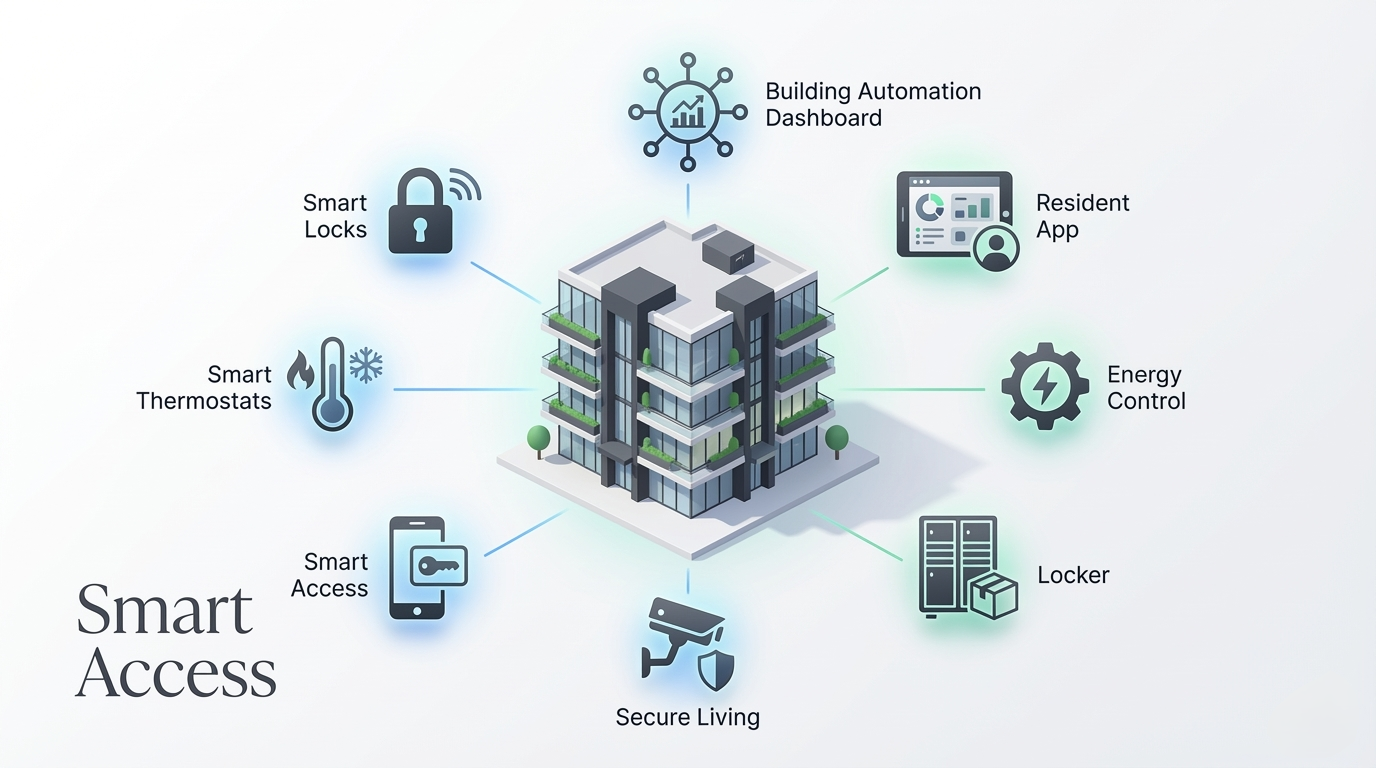
Smart technology is no longer optional for Texas multifamily owners. In 2026, renters expect smart locks, connected thermostats, and mobile access as standard features, not upgrades. This guide covers the top platforms, real Texas case examples, honest pricing benchmarks, and a clear decision matrix for choosing the right system. If you own or manage multifamily property in Austin, Dallas, or Houston, this is your starting point.
Why This Matters to the Texas Multifamily Owner
Smart technology is no longer a luxury. It's expected.
In 2026, renters across the U.S. routinely list smart locks, thermostats, and secure package delivery among the features that make them choose one property over another. Texas's fastest-growing markets, including Austin, Dallas, and Houston, are leading the way. Smart-enabled apartments command higher rents, lease faster, and reduce onsite staff time.
This guide walks owners and developers through the best multifamily smart systems in 2026, practical costs, and how to prioritize features for the clearest ROI.
One of my friends who owns a Houston complex upgraded 30 units with smart locks and climate control. Within 3 months, tenants were paying an additional $20 per unit. They hardly noticed the charge because the comfort outweighed the premium. The owners got their installation costs back within less than a year. Real ROI, not hype.
If you're planning a smart technology rollout for a multifamily property, the same integration principles that apply to luxury single-family estates apply here. Read our guide on when to hire a smart home integrator to understand why integrator selection matters more than product selection.
Why Smart Systems Are Critical to 2026 Multifamily Success
Smart technology has crossed the line from differentiator to baseline expectation.
65% of renters find apartments with smart home technology more appealing, and 65% are willing to pay extra for smart amenities, with 52% comfortable paying over $20 more per month. Owners report measurable business benefits: faster lease signings, higher retention when tenants feel secure and comfortable, and real operational savings when energy and access are automated.
The NMHC and Grace Hill survey, the largest renter preferences study in the multifamily industry with data from 172,703 renters, shows high-speed internet ranked as the third most essential apartment feature overall. Connectivity and smart access are no longer differentiators. They're requirements.
In Texas specifically, projects that marketed smart amenities showed stronger absorption in city centers. Tenants in Austin and Dallas are more focused on convenience and security when selecting properties. RealPage market data indicates that friction-reducing amenities such as self-showing and package delivery are critical when leasing velocity tightens.
A few months ago, I visited a mid-rise building in Dallas that tenants specifically chose because it had an app key and smart thermostat. The manager told me 10 units had leased faster than any comparable property nearby. It had nothing to do with luxury. It was about convenience. In 2026, smart is no longer a bonus. It is the baseline.
77% of renters say they would sign a longer lease if smart security and energy-saving devices were included in their unit. That number alone should settle the ROI question for most Texas operators.
2026's Most In-Demand Multifamily Smart Features
What do renters actually use, and what should operators install first?
The highest-ROI features solve daily friction for both the resident and the operator at the same time. Here's what that looks like in 2026:
Mobile-first access control. Video intercoms and app keys that let residents buzz guests and accept deliveries without front-desk involvement. Smart lock adoption more than doubled from 7% in 2022 to 16% in 2024, and that trajectory continues upward in 2026.
Smart thermostats and AI climate control. Reduced HVAC costs for owners and predictive scheduling that improves comfort for residents. HVAC systems account for 40-60% of a building's energy use, making smart thermostats the fastest-payback upgrade in any multifamily portfolio.
Security and monitoring. Door and window sensors, property-wide cameras, and smart locks work together. 41% of renters cite feeling safer at home as their number one reason for wanting smart tech, outpacing energy savings and convenience combined.
Unified automation platform. SmartRent, PointCentral: one dashboard for lighting, climate, security, and resident access. In 2026, multifamily operators are prioritizing centralized platforms that automate manual work and reduce handoffs between teams.
AI-based predictive maintenance analytics. Sensors that predict equipment failure before it happens. This eliminates the reactive maintenance cycle that drains staff time and generates emergency call costs.
Package management. Smart lockers and visitor flow management. ButterflyMX package room integration reduces staff sorting time significantly and eliminates lost-key and missed-delivery complaints.
These features bring resident experience and operator value together. Mobile control for the renter. Telemetry and fewer truck rolls for the operator.
For developers planning new construction, getting the automation platform right from day one is critical. Our detailed breakdown of Control4 vs Crestron for the 2026 architect covers platform selection for new builds in depth.
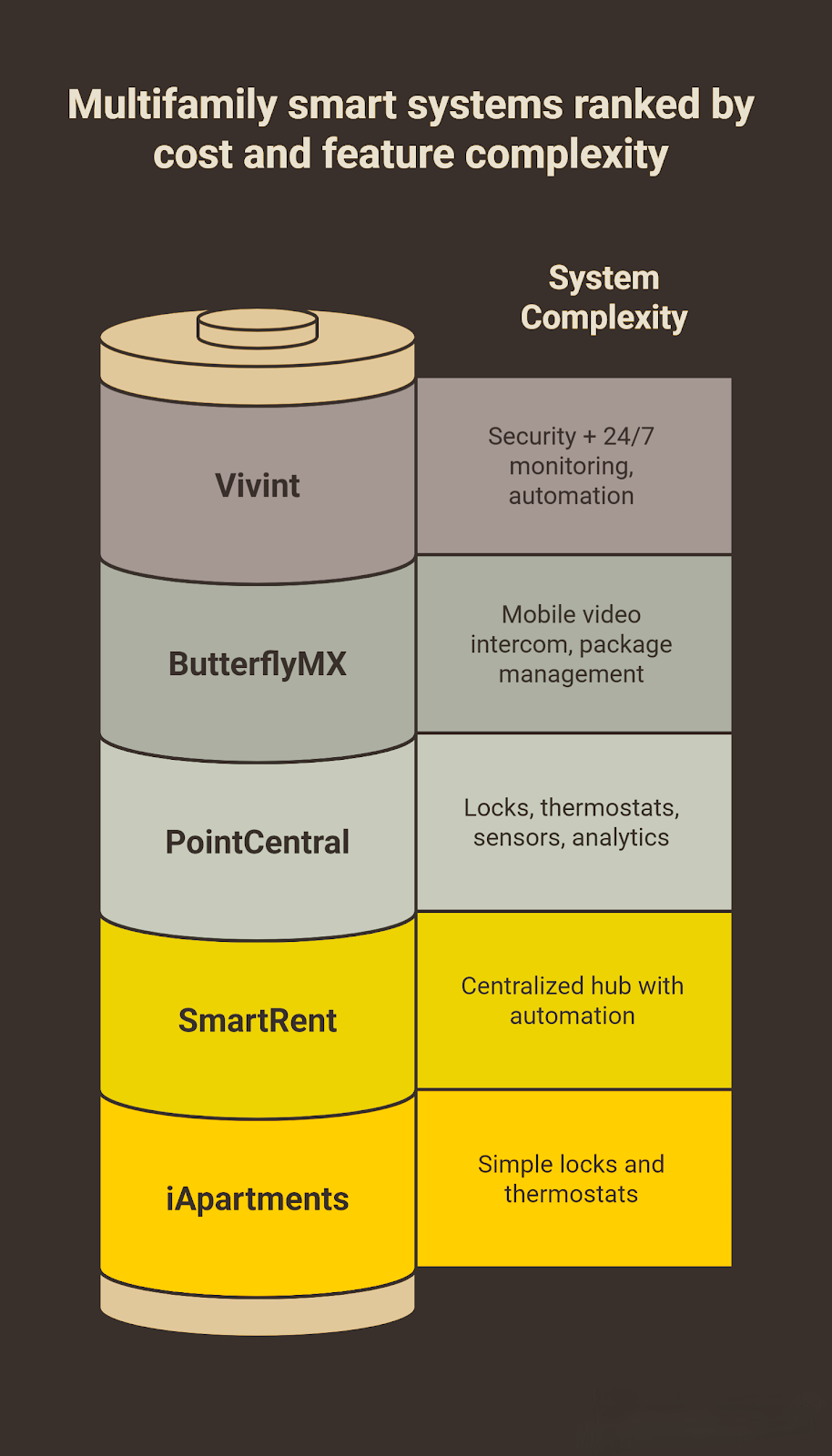
Comparison Table: Leading Multifamily Smart Systems (USA / Texas, 2026)
| System | Core Features | Integrations | Est. Cost / Unit | Best For (TX) |
|---|---|---|---|---|
| SmartRent | Centralized hub: access, thermostats, automation, energy management | Yardi, RealPage, Alexa, Google | $150-$300 upfront; $8-$15/mo | Portfolios, owner-managed commercial properties. Widely used in TX. |
| ButterflyMX | Mobile video intercom, visitor and package management, access | PMS, Amazon Key, package rooms | $500+ entry; $6+/unit/mo | Urban, high-density (Austin, Dallas). Strong package workflows. |
| PointCentral (RealPage) | Locks, thermostats, sensors, analytics | Yardi, RealPage | $100-$350 upfront; $10-$12/mo | Mid-large portfolios. Strong Sunbelt adoption. |
| Vivint Multifamily | Security + 24/7 monitoring, automation | Alexa, Google, Z-Wave | $200+ upfront; $15-$25/mo | Gated or luxury assets seeking premium monitoring. |
| Apartments / Self-install | Basic locks, thermostats, resident app | Leasing platforms | $90-$150/unit; $5-$9/mo | Value / Class B retrofits. TX growth markets. |
Costs are indicative. Final quotes depend on building wiring, gateway counts, and service tiers.
Must-Have 2026 Checklist for Owners and Managers
Before you sign a vendor contract, confirm:
- Central dashboard for staff device and user control.
- AI and remote monitoring that flags maintenance before failures occur.
- Resident mobile application for lock, climate, and visitor controls.
- Energy reporting to track and act on HVAC and lighting usage.
- Matter compliance and open APIs for future integration.
Multifamily managers who implemented smart property technology reported a 20% increase in operational efficiency and an 18% reduction in operating costs. Those are the numbers to benchmark your vendor against before signing anything.
Case Examples: Texas Smart Multifamily in Action (2026)
Dallas luxury high-rise: Owner installed keyless entry and AI thermostats. Operations documented a $25 per month rent increase, marketed as smart-ready units, and lease renewals reached 85% in year one.
Austin garden community: ButterflyMX rollout reduced front-desk package handling time by approximately 60%, freeing staff for higher-value tasks and eliminating lost-key fees.
Houston portfolio: PointCentral energy automation with zoned HVAC and sensors helped reduce energy spend by approximately 17% year over year on common systems. Operators reported increased NOI and fewer emergency HVAC calls.
A Rently financial model shows a payback point in as little as 8 months, with a five-year cumulative ROI of 781%. That number varies by property type and market, but the direction is consistent across every Texas operator I've spoken with.
For more on how smart technology drives developer ROI across Texas markets, read our detailed breakdown: How Smart Home Technology Helps Real Estate Developers Sell Homes Faster in Texas.
What Does It Cost: Pricing Benchmarks (2026, USA / TX)
Pricing has stabilized across tiers. Here's where the market sits in 2026:
Basic retrofit (DIY / value): $120 per unit install; $5-$10 per month SaaS. Good for quick retrofits on Class B properties.
Mid-tier (cloud central systems): $300-$700 per unit install; $10-$20 per month. The right balance of features and manageability for most Texas portfolios.
Luxury (whole-building, premium): $15,000+ site setup; $20+ per unit per month. Concierge integrations, custom dashboards, and 24/7 monitoring.
Over 15 of the top 20 multifamily operators in the U.S. have already deployed enterprise-grade smart platforms, with payback windows of 6-24 months documented depending on owner-paid utilities and rent uplifts. The smart home market is projected to grow from $33 billion in 2025 to $99 billion by 2032. Operators who delay this investment are not avoiding cost. They're deferring it while competitors take their lease prospects.
How to Pick the Right System: An Easy Decision Matrix
Which multifamily smart platform is right for your Texas property?
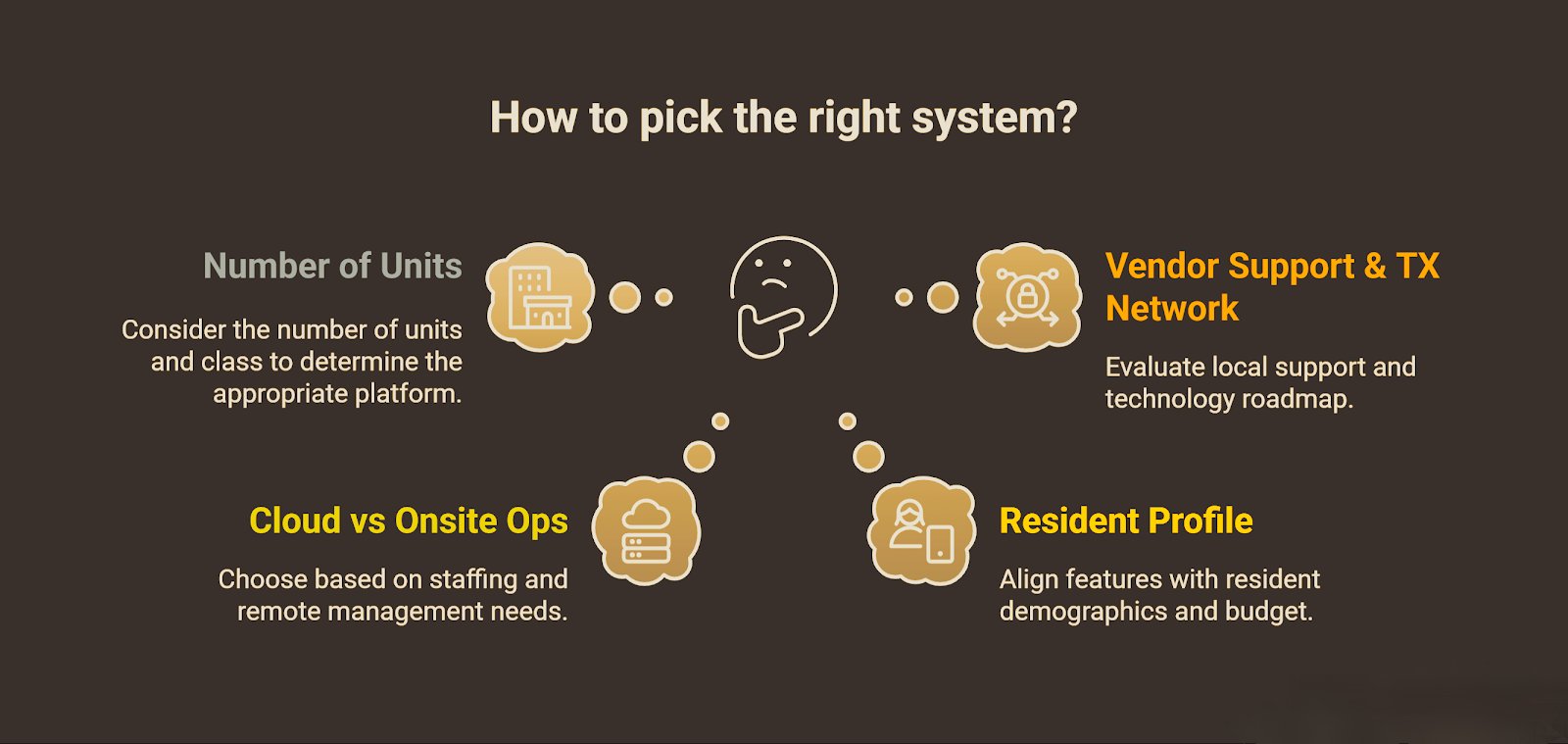
The answer depends on four variables: unit count, operations model, resident profile, and local vendor support. Work through each one before you talk to a vendor.
Number of units and class. For more than 20 units, centralized platforms such as SmartRent and PointCentral are the right call. Under 50 high-density units in urban cores, ButterflyMX delivers the strongest package workflow and intercom results.
Cloud vs onsite operations. If you have lean on-site staff, go with cloud platforms that offer effective remote management and vendor SLAs. The whole point of smart technology is reducing the operational load, not adding to it.
Resident profile. Young and tech-savvy demographics will justify high-end features and deeper integrations. About 62% of Gen Z renters say smart home technology is extremely important when choosing where to live. Budget communities need core features with minimal OPEX. Don't over-engineer a Class B retrofit.
Vendor support and Texas network. Check local integrator presence in Dallas, Austin, and Houston. Confirm warranty terms. Ask for the Matter roadmap and API documentation before you commit. If 2025 was the year of integration, 2026 is about optimization. The vendors who can show you a roadmap for what comes next are the ones worth partnering with.
Access control decisions in multifamily follow the same principles as luxury residential. Our comparison of smart locks vs access control systems for luxury developments applies directly to multifamily gate and entry decisions.
What Do Real Operators Say?
Resident satisfaction in smart-home communities reaches 83% to 91%, compared to industry averages that typically fall in the 60-70% range. That gap in satisfaction directly translates into lease renewal rates.
Industry operators consistently reinforce the same message I see in Texas: integration and documentation matter more than gadgets. A poor installation reduces property value. A well-integrated system that nobody maintains degrades within 18 months. The technology is only as good as the support structure behind it.
Renters favor paying for services that increase security and speed up maintenance fixes, with 42% willing to pay more for security monitoring and 37% for 24/7 maintenance support. Those are not nice-to-haves. Those are the operating standards residents expect in 2026.
Frequently Asked Questions
Q: Will renters pay more for smart features in 2026?
Yes. 65% of renters are willing to pay extra for smart amenities, with 52% comfortable paying over $20 more per month. Documented rent increases range from $25-$75+ per unit per month, depending on the market and features installed. Test at the local level before rolling out portfolio-wide to build accurate estimates for your specific submarket.
Q: How quickly can I retrofit a 100-unit property?
Most smart devices can be installed in phases by building level. Smart door locks and thermostats can typically be completed on the same floor, the same day. Smart intercoms, sensors, and dashboards generally require 1-3 months for a complete property rollout. The recommended approach is to pilot first on a single floor or building, measure rent lift and renewal rates, then expand based on proven results.
Q: Which platform is best for Texas portfolios?
For large portfolios: SmartRent and PointCentral. For urban package delivery and mail flow in Austin and Dallas: ButterflyMX. For high-end luxury-level monitoring on gated assets: Vivint Multifamily. The location and quality of the regional integrator are often the deciding factors between platforms that look comparable on paper.
Q: Is smart technology worth it for Class B properties in Texas?
Yes, with the right scope. A basic retrofit with smart locks and thermostats at $120 per unit delivers measurable rent lift and retention improvement without enterprise-level complexity. Start with access control and climate. Add layers once the ROI from the first phase is documented. Properties that adopted smart technology in phases reported steady improvement in both NOI and resident satisfaction scores year over year.
Q: What is the biggest mistake Texas multifamily owners make with smart tech?
Installing hardware without a support plan. I see this consistently: a well-specified system that performs beautifully on handoff day and degrades steadily over 18 months because nobody is managing firmware updates, misconfigured zones, or platform integrations that break when software updates roll through. Technology benefits residents most when it is supported with ongoing care, including regular updates, remote diagnostics, and, when needed, in-person fixes. Without that structure, convenience turns into frustration.
Final Take
Smart technology in Texas multifamily in 2026 is not a trend. It's table stakes.
The properties winning on leasing velocity and retention are not necessarily the ones with the most expensive systems. They're the ones with systems that work consistently, that residents can actually use, and that operators maintain proactively.
If you're in Austin, Dallas, Houston, or anywhere in Texas and want a free on-site smart home consultation, reach out to Seiits. We'll help you plan lighting, climate, security, and automation tailored to your property and budget.
Also see our pre-construction planning guide for developers: Smart Home Integration Planning for Texas Architects: The 2026 Pre-Construction Guide.
/
Comments ()