
Home Automation Company Near Me: The Complete Guide for Dallas, Austin, and Houston Homeowners (2026)
Your Texas smart home installer disappeared after installation. Here is how to choose a CEDIA-certified home automation company that stays, and what real 2026 costs look like in Dallas, Austin, and Houston.
A homeowner in Plano called us after spending $4,200 on a smart home installation that left her with three separate apps, a thermostat that stopped talking to her lights, and an installer who stopped answering his phone two weeks after the job. Her question to me was simple:
"How was I supposed to know he was not legitimate?"
That question is why I wrote this guide. Searching for a "home automation company near me" in Dallas, Austin, or Houston returns hundreds of results. Some are CEDIA-certified professionals with a decade of Texas projects under their belts. Others are solo contractors who installed one Ring doorbell and started calling themselves smart home experts.
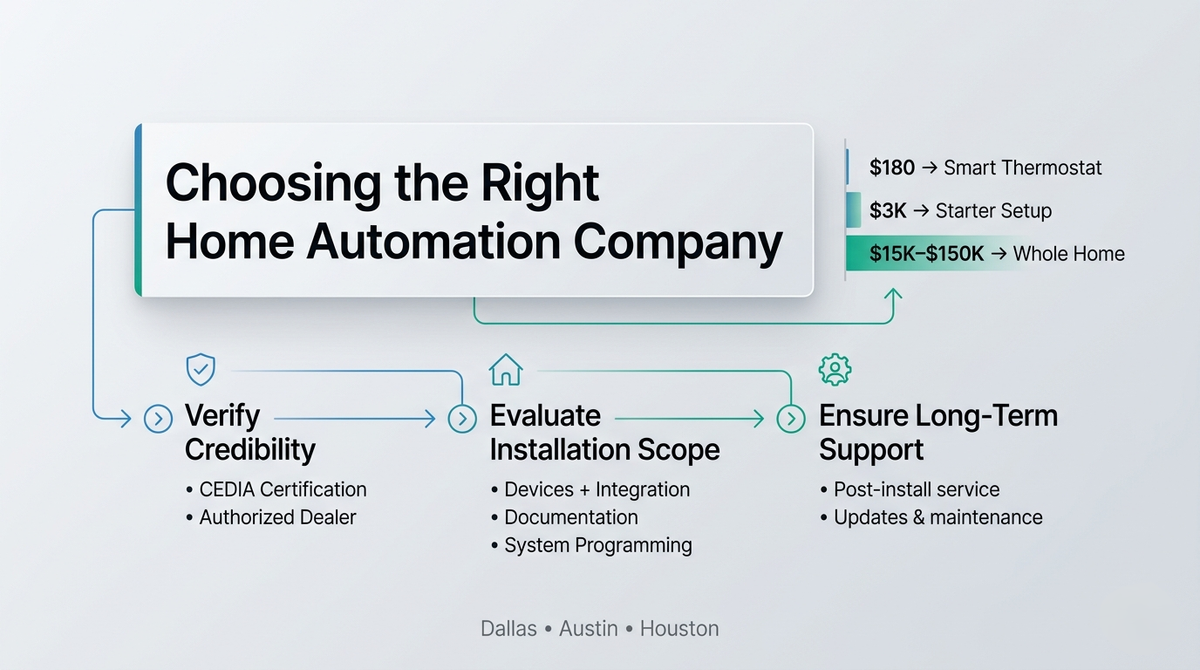
This guide will tell you exactly how to tell the difference. It covers what a professional smart home installation service actually includes, what it costs in each Texas city in 2026, which brands are worth paying for, and the six questions every Texas homeowner should ask before signing anything.


What Does a Smart Home Installation Service Actually Include?
A smart home installation service is any professional setup, configuration, or integration of connected home technology, from a single Nest thermostat to a whole-home Crestron or Savant system. A legitimate service includes site assessment, hardware installation, full system programming, documented handoff, and a post-installation support plan. Any company that disappears after payment is not a professional installation service.
The difference between a good installation and a frustrating one is not which brand of device you choose. It is whether the devices are configured to work together reliably, documented properly, and supported after the installer leaves. Across more than 500 implementations I have led across Texas, most homeowners who call us for a second opinion have already paid a first company for devices. The devices are fine. The integration is broken.
Here is what a genuine smart home installation service in Texas should include:
- Site assessment before any work begins. An honest installer visits your home, identifies your existing wiring, HVAC setup, and internet infrastructure before quoting. A quote without a site visit is a guess.
- Brand selection guidance. Not every brand works well together. A qualified integrator explains which systems are compatible with your home and lifestyle before you spend money on hardware.
- Professional installation and programming. Devices are installed, wired correctly, and programmed with scenes and automations that work from day one. No loose wires, no unprogrammed remotes.
- Full documentation handoff. Labelled wiring diagrams, written scene descriptions, app setup on your devices, and a clear explanation of what to do if something stops working.
- Post-installation support. A service plan, support number, or retainer that covers firmware updates, scene changes, and hardware issues. Any company with no post-install support plan disappears after payment.
If you are deciding whether to handle this yourself or bring in a professional, the difference between a licensed integrator and an electrician doing smart home work matters more than most homeowners realise before they have a problem.
Smart Home Installation Costs in Texas: What Homeowners Actually Pay in 2026
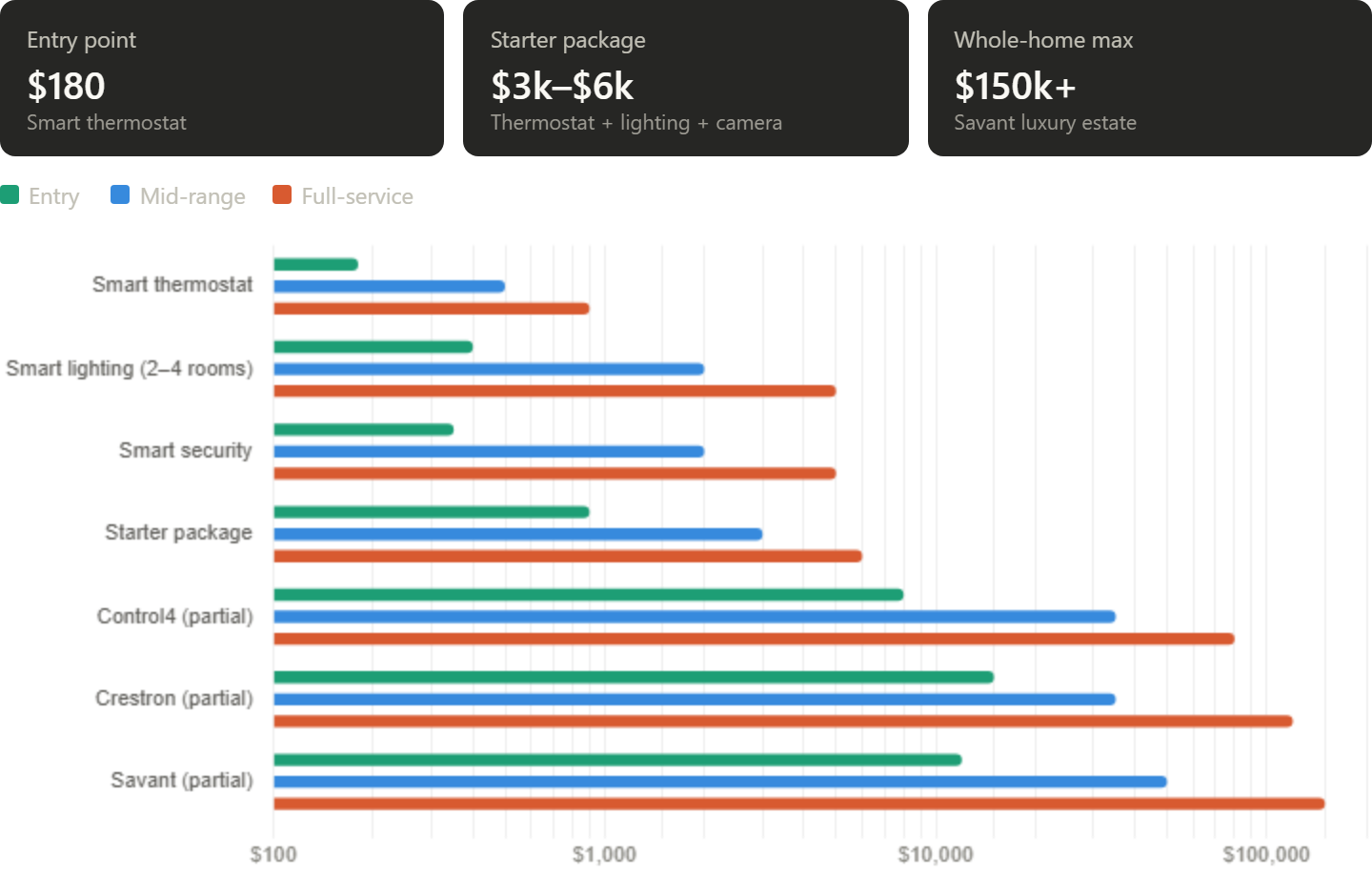
Smart home installation in Texas ranges from $180 for a single thermostat to $150,000 or more for a full Savant estate. The most common budget surprise is the cost of running cabling through finished walls in older Texas homes. Retrofitting structured wiring costs $10,000–$15,000 versus $2,000–$3,000 during new construction.
The most common reason homeowners call us after a bad first experience is cost surprise. They were quoted one number, paid another, and received something different entirely. Here are realistic 2026 cost ranges for every tier of smart home installation service in Dallas, Austin, and Houston.
What is the cost to install a smart thermostat in Texas?
The cost to install a smart thermostat in Texas ranges from $180 to $900, depending on whether your home has a C-wire (the thin wire that powers the thermostat's display and Wi-Fi). Most Texas homes built before 2000 do not have one. Without it, an installer either runs a new C-wire ($150–$350 additional) or uses an add-a-wire adapter ($30–$80 device, simpler install). EPA Energy Star certifies that smart thermostats save an average of 8 percent on heating and cooling bills. For Nest specifically, independent studies showed 10–12 percent on heating and 15 percent on cooling. For a Texas home paying $200–$400 per month in summer, that is $240–$720 per year back in savings at the conservative end.
What does it cost to automate a home with smart tech end-to-end?
The cost to automate a home with smart tech from entry level to whole-home Crestron or Savant depends almost entirely on three decisions: which automation platform you choose, how many rooms are included, and whether your home was pre-wired during construction.
Pre-wired new builds, common in Frisco, Prosper, Westlake, and Bee Cave developments built after 2015, cost significantly less to automate than older homes, in which structured wiring needs to be added. A Plano homeowner retrofitting a 2008 build pays 30–50 percent more for the same outcome as a buyer in a 2022 Frisco development that already has ethernet and conduit runs in place.
In my experience working with estate owners in Plano and Highland Park, the largest single budget surprise is always the same: the cost of running structured cabling through finished walls. Getting your technology infrastructure in during construction costs $2,000–$3,000 per unit. Retrofitting after the walls are closed costs $10,000–$15,000 for the same result.
Home Automation Company Near Me: What to Expect in Texas City
The Dallas–Fort Worth market has the highest concentration of CEDIA-certified integrators in Texas and prices 5–10 percent above the national average. Houston leads in Crestron and Savant whole-home adoption. Austin's fastest growth is in AV and multi-room audio. Westlake and Southlake buyers typically enter the conversation already deciding between platforms rather than whether to automate.
Dallas–Fort Worth
Home automation in Dallas is the largest and most competitive smart home market in Texas. DFW has the highest concentration of CEDIA-certified integrators in the state, covering every price tier from entry-level Nest installations to full Savant estates in Westlake and Southlake.
For homeowners searching home automation system in Dallas, TX, the most common request is whole-home lighting automation combined with smart security, particularly in homes built after 2015 where structured wiring already exists. Home automation Dallas, TX pricing runs 5–10 percent above the national average due to higher labor rates and strong demand.
Home automation services in Dallas range from independent contractors ($75–$100/hour) to full-service integrators ($125–$175/hour). The difference is not just price. It is documentation, post-install support, and manufacturer-dealer status. Always verify whether your Dallas integrator is an authorised Control4, Savant, or Crestron dealer before signing.
If you want to see systems working before committing, look for a home automation experience center in Dallas. Several integrators maintain showrooms where Lutron, Crestron, and Savant systems are demonstrated live. Seeing a system operate in person eliminates most of the uncertainty around whole-home automation purchases.
Austin
Austin's tech-forward homeowner base means most people arrive having already researched platforms. The fastest-growing segment in Austin is AV integration and multi-room audio in Barton Creek, Bee Cave, and Westlake. Smart thermostats are near-universal in new builds. Austin Energy's summer rates and the city's solar adoption make smart energy management a genuine financial priority, not just convenience.
Houston
Houston's smart home market is driven by energy-sector executives in The Woodlands, River Oaks, and Memorial who frequently request Crestron home automation cost breakdowns as their first question. Whole-home Crestron and Savant installations are more common in Houston than in any other Texas market. Outdoor smart systems, including security cameras rated for heat and humidity, smart landscape lighting, and smart garage doors, are more commonly specified here than in drier Texas metros.
Savant home automation cost in Houston's River Oaks and Memorial neighbourhoods typically starts at $20,000–$35,000 for a partial installation and scales to $150,000 or more for a full estate. These buyers prioritise brand, support infrastructure, and a single point of contact for all home technology.
Westlake and Southlake
A pattern I see consistently in client intake assessments across Westlake and Southlake is that buyers in these markets are not asking whether to automate their home. They are asking which platform to use and who will support it long-term. The Crestron versus Savant decision alone is worth a dedicated conversation. Our Crestron vs Savant comparison for luxury builds covers this in full.


The Most Popular Smart Home Brands Texas Homeowners Are Choosing in 2026
Nest and Ecobee dominate smart thermostat installations across Texas. Control4 is the most widely deployed professional whole-home platform statewide. Crestron leads in Houston luxury estates. Savant commands the Westlake, Barton Creek, and River Oaks markets. Lutron Caseta is the professional standard for smart lighting, particularly in pre-2003 homes without neutral wires.
Thermostats
Smart thermostat installation remains the most common entry point for Texas homeowners and the fastest return on investment, given summer cooling costs. EPA Energy Star certifies an average saving of 8 percent on heating and cooling bills, or roughly $50 per year nationally. In Texas, where summer cooling bills run $200–$400 per month, the real-world impact is considerably higher. Nest's independent certification data shows 10–15 percent on cooling. Ecobee's EPA-submitted data shows 12 percent on cooling.
- Nest Learning Thermostat. Best for most homeowners. Auto-learns your schedule. Works with Google Home and Alexa. Device: $130–$280. Installed: $250–$500.
- Ecobee SmartThermostat Premium. Best for larger homes with multiple HVAC zones. Includes room sensors. Device: $180–$300. Especially popular in DFW and Houston.
- Honeywell Home T9. Best compatibility with older HVAC systems. Strong reliability record. Device: $150–$250.
Whole-home automation platforms
For a detailed platform comparison, our Control4 vs Crestron guide for 2026 covers the technical and support differences between the two most common professional platforms in Texas.
Control4. Most widely deployed professional platform in Texas. Reliable dealer network statewide. Requires an authorised dealer. Verify at control4.com before any installation. Starting at $8,000–$15,000.
- Crestron. Enterprise-grade platform preferred by Houston energy executives and large estate owners. Highest reliability ceiling, highest cost. Crestron home automation cost starts at $15,000 for a basic setup and scales without an upper limit.
- Savant. Strongest brand recognition among luxury Texas buyers. Savant home automation cost starts at $12,000–$20,000 for a partial installation. Common in River Oaks, Westlake, and Barton Creek.
- Apple HomeKit / Amazon Alexa / Google Home. Best for homeowners who want smart home capability without a professional platform. Wide device compatibility, lower cost, and requires more self-management.
Security and lighting
Lutron Caseta. The professional standard for smart lighting in Texas. Works without a neutral wire, which is critical for homes built before 2003. Lutron Caseta integrates with virtually every major automation platform. For a full comparison of Lutron versus Control4 for lighting and shades, see our Lutron vs Control4 guide.
- Ring and Arlo. Most widely used security cameras among Texas homeowners. Easy DIY setup, flexible monitoring plans. Ubiquiti UniFi Protect is the professional alternative with no monthly subscription fee.
- Philips Hue. Best for colour and ambiance lighting. Easy to layer onto an existing setup.
How to Find a Reliable Home Automation Company Near Me: 6 Questions to Ask
Ask six questions before signing with any Texas smart home integrator: CEDIA certification, authorised dealer status, a reference from a project in your city in the last 12 months, documentation examples, their post-installation support model, and proof of liability insurance with written warranty terms.
The question I receive most frequently from new clients in Plano, Frisco, and Southlake is not which brand to choose. It is how to know whether the company they are talking to is legitimate. Here are the six questions I give every client before they speak to any integrator.
The installer you choose matters more than the technology. A well-installed mid-range system beats a poorly installed premium one every time.
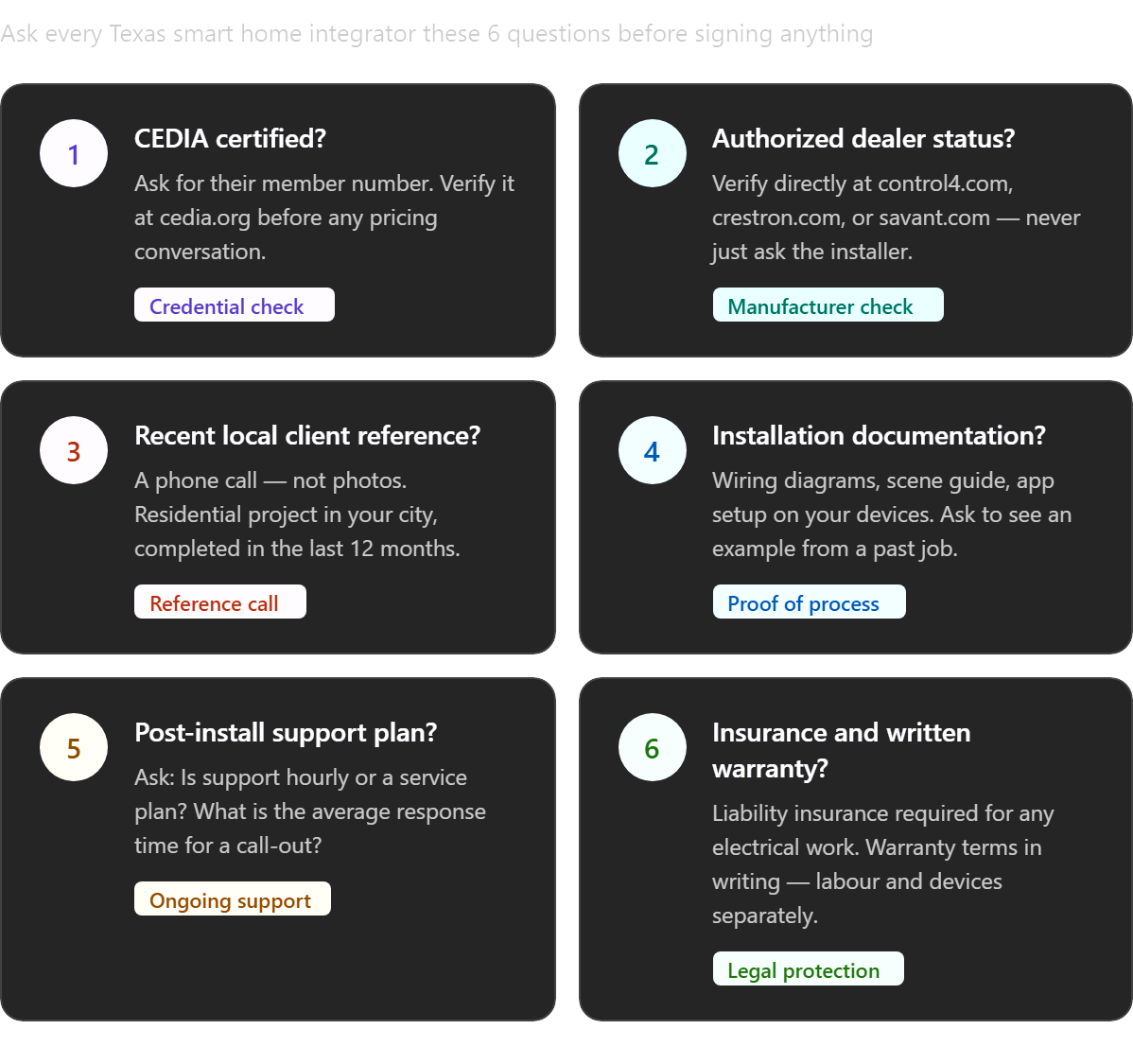
1. Are you CEDIA certified or affiliated?
CEDIA-certified installers complete formal training, follow documented installation standards, and are accountable to a professional body. CEDIA is the Custom Electronic Design and Installation Association. Ask for their CEDIA member number and verify it at cedia.org before any conversation about pricing.
2. Are you an authorised dealer for the brands you install?
Control4, Savant, and Crestron require authorised dealers. An unauthorised installer cannot provide manufacturer warranty support or firmware updates. If the person quoting you a Crestron system is not a Crestron authorised dealer, walk away. Verify dealer status directly at the manufacturer's website, not by asking the installer.
3. Can I speak with a recent Texas client rather than just see photos?
A legitimate smart home installation service will have clients willing to take a five-minute call. Not show you photos. Speak with them. If an installer hesitates when you ask for a reference call, that is a significant red flag. Ask specifically for a residential project in your city completed within the last 12 months.
4. What does your installation documentation include?
Professional installation ends with a physical or digital handoff package: labelled wiring diagrams, documented scene names and what triggers them, completed app setup on your devices, and a written explanation of what to do if any component stops responding. If an installer cannot show you an example from a past job, they do not have one.
5. What does post-installation support look like?
Smart home systems require ongoing support as apps update, firmware changes, and devices are added. Ask specifically: Is support billed hourly? Is there a service plan? What is your average response time for a service call? A company with no structured post-installation support model will not answer the phone six months from now.
6. Do you carry liability insurance and provide a written warranty?
Any electrical work inside a Texas home requires the installer to carry liability insurance. Get the warranty terms in writing, covering both labour and devices separately, before any work begins. Verbal warranties are unenforceable.
A homeowner in Frisco switched integrators mid-project after the original company could not produce a wiring diagram for work already completed. The cost of switching mid-project: over $18,000. The cost of asking these six questions before signing: nothing.
DIY vs Professional Smart Home Installation: What Texas Homeowners Need to Know
The right answer depends entirely on what you are trying to accomplish.
My recommendation: DIY your first device, starting with a smart thermostat or doorbell, to build familiarity. The moment you want two or more systems to reliably communicate with each other, or when you want scenes that involve lighting, climate, and security together, stop and call a professional. The time cost of troubleshooting a DIY multi-system setup consistently exceeds the labour cost of a professional installation.


Book Your Service Call Now
Case Study: Full Smart Home Installation in Plano, Dallas–Fort Worth
Project Details
Location: Plano, TX (Dallas–Fort Worth)
Property: 3,200 sq ft, built 2008
Starting condition: Three disconnected apps (Ring, Nest, Philips Hue). No cross-device automations. Temperature hot spots in two upstairs bedrooms.
Total investment: $6,800, including all devices, labour, programming, and full documentation
What Seiits Installed
- Lutron Caseta smart switches: 22 switches covering all interior and exterior zones
- Ecobee Smart Thermostat: with 4 room sensors for zoned temperature control
- Ubiquiti UniFi Protect: 8 cameras, no monthly subscription fee
- Amazon Alexa: an app-controlled unified voice layer across all systems
- Four programmed scenes: Morning, Movie Night, Away, Goodnight: all voice and app-controlled
Results After First Summer
Energy bill: 14 percent lower than the prior summer season
App consolidation: All systems controlled from a single Amazon Alexa interface
Comfort: Hot spots in upstairs bedrooms eliminated by Ecobee room sensors
"I wish I had done this when we moved in four years ago. I spent two years fighting with apps that did not talk to each other." Plano homeowner, Seiits client
Book Your Free Smart Home Consultation in Texas
Whether you are starting with a single smart thermostat or planning a whole-home Crestron or Savant installation, the right starting point is a conversation with someone who has installed these systems across Texas, specifically, not a national call centre reading from a script.
Across more than 500 implementations I have led in Dallas, Frisco, Southlake, Plano, Westlake, Austin, and Houston, the single biggest cost driver is not the technology chosen. It is whether the homeowner had the right conversation before any work began.
Seiits offers free on-site smart home consultations across Dallas, Austin, Houston, and surrounding Texas areas. We assess your home, recommend the right system for your lifestyle and budget, and provide a clear, itemised quote with no pressure and no obligation.
Seiits offers free on-site smart home consultations across Dallas, Austin, Houston, and surrounding Texas areas. We assess your home, recommend the right system for your lifestyle and budget, and provide a clear, itemised quote with no pressure and no obligation.
Frequently Asked Questions
How do I find a home automation company near me in Texas?
Search for CEDIA-certified integrators in your Texas city using the professional directory at cedia.org. In Dallas, Austin, and Houston, verify that any company you contact holds authorised dealer certification for Control4, Savant, or Crestron before agreeing to a quote. Ask for a reference from a residential project completed in your city within the last 12 months. Seiits serves Dallas, Frisco, Austin, and Houston with free onsite consultations and no obligation to proceed. Dealer status can be verified directly at control4.com, crestron.com, or savant.com.
What is the cost to install a smart thermostat in Texas in 2026?
Smart thermostat installation in Texas costs $180–$900, depending on HVAC complexity and whether your home has a C-wire. Most Texas homes built before 2000 require C-wire work, adding $150–$350 to the installation. Nest and Ecobee are the most common brands in Dallas and Houston. EPA Energy Star certifies an average saving of 8 percent on heating and cooling bills. Nest's own certification data shows 10–15 percent on cooling. For a Texas home running $200–$400 per month in summer, that is $240–$720 per year in real savings. Smart thermostat installation in Dallas, TX, starts at $180 for homes with an existing C-wire.
What does a smart home installation service include?
A professional smart home installation service includes a pre-installation site assessment, hardware procurement and installation, system programming and scene setup, full documentation, including wiring diagrams and a written scene guide, plus app configuration on your devices, and a post-installation support plan. CEDIA-certified integrators in Dallas, Austin, and Houston deliver all of these as standard. Any company that cannot describe its documentation and support process clearly before you sign is not a professional installation service.
How much does Crestron home automation cost in Texas?
Crestron home automation cost in Texas starts at $15,000–$35,000 for a partial installation covering lighting, climate, and AV in a primary living area. Full whole-home Crestron integration for a 4,000 sq ft or larger home in Houston or Dallas runs $50,000–$120,000 or more. Houston's River Oaks and The Woodlands markets see the highest Crestron adoption in Texas. Verify your installer holds active Crestron authorised dealer status at crestron.com before proceeding.
How much does Savant home automation cost in Texas?
Savant home automation cost starts at $12,000–$20,000 for a partial Texas installation and scales to $150,000 or more for full luxury estate deployments. Savant is the dominant platform in Westlake, Barton Creek in Austin, and River Oaks in Houston. It commands a premium over Control4 due to its proprietary OS, Apple-like interface, and dedicated concierge support model. Savant requires authorised dealer installation. Verify status at savant.com before signing with any Texas integrator.
What smart home setup service near me should I use in Texas?
Look for a smart home setup service near you that is CEDIA-affiliated, carries authorised dealer certification for the brands they install, and can provide a Texas homeowner reference from the last 12 months. In Dallas, the home automation experience center model lets you see Crestron, Savant, and Lutron operating in person before committing. Seiits serves Dallas, Austin, Houston, and the surrounding Texas areas with full installation documentation and ongoing managed membership plans. Book a free consultation at seiits.com/assessment.
How long does a smart home installation take in Texas?
A single smart thermostat installation in Dallas or Houston takes 1–3 hours. A starter package covering thermostat, lighting in 2–4 rooms, and a doorbell camera takes one full day. A whole-home Control4 or Savant installation in a 4,000–8,000 sq ft Texas property typically runs 3–7 days for installation and programming. Complex Crestron estates with full AV integration take 2–4 weeks. The timeline depends on the number of subsystems and whether the home was pre-wired during construction.
Comments ()