
Wi-Fi 7 Installation Services in Texas: Why Consumer Routers Fail in Luxury Homes & Large Properties
Wi-Fi 7 installation services in Texas solve the performance, latency, and roaming issues that consumer routers cannot handle in luxury homes, hotels, and multi-dwelling units with high device density.

Introduction: Why Wi-Fi 7 is Important in 2025 – 2026
Last year, I walked into a 9,000 square foot hill country estate where the homeowner purchased a $1800 gaming router for the best possible coverage in his home. He thought he would get perfect coverage.
What was the result? Rooms went offline. His video doorbell buffered. His lighting scenes took around two seconds longer to start. His theater room could not maintain 4K video streaming with more than two displays at the same time.
Why did the above happen?
The house contained over 160 connected devices, including smart lights, smart shades, sensors, smart TVs, cameras, etc... The router could not keep up with the Texas stone walls, the high-density network of devices, or the backhaul requirements.
That's the reason why Wi-Fi 7 installation service is essential to solve these problems, but you have to deploy it correctly.
This article explains why an enterprise-grade Wi-Fi 7 is a necessity for luxury homes, hotels, and multi-dwelling units today and why standard consumer routers will fail.
What Makes Wi-Fi 7 Different From Wi-Fi 6E? (And Why It Matters for Texas Properties)
Before explaining why consumer routers fail, let us first discuss how Wi-Fi 7 is different from Wi-Fi 6E.
Wi-Fi 7 offers three major advancements compared to Wi-Fi 6E:
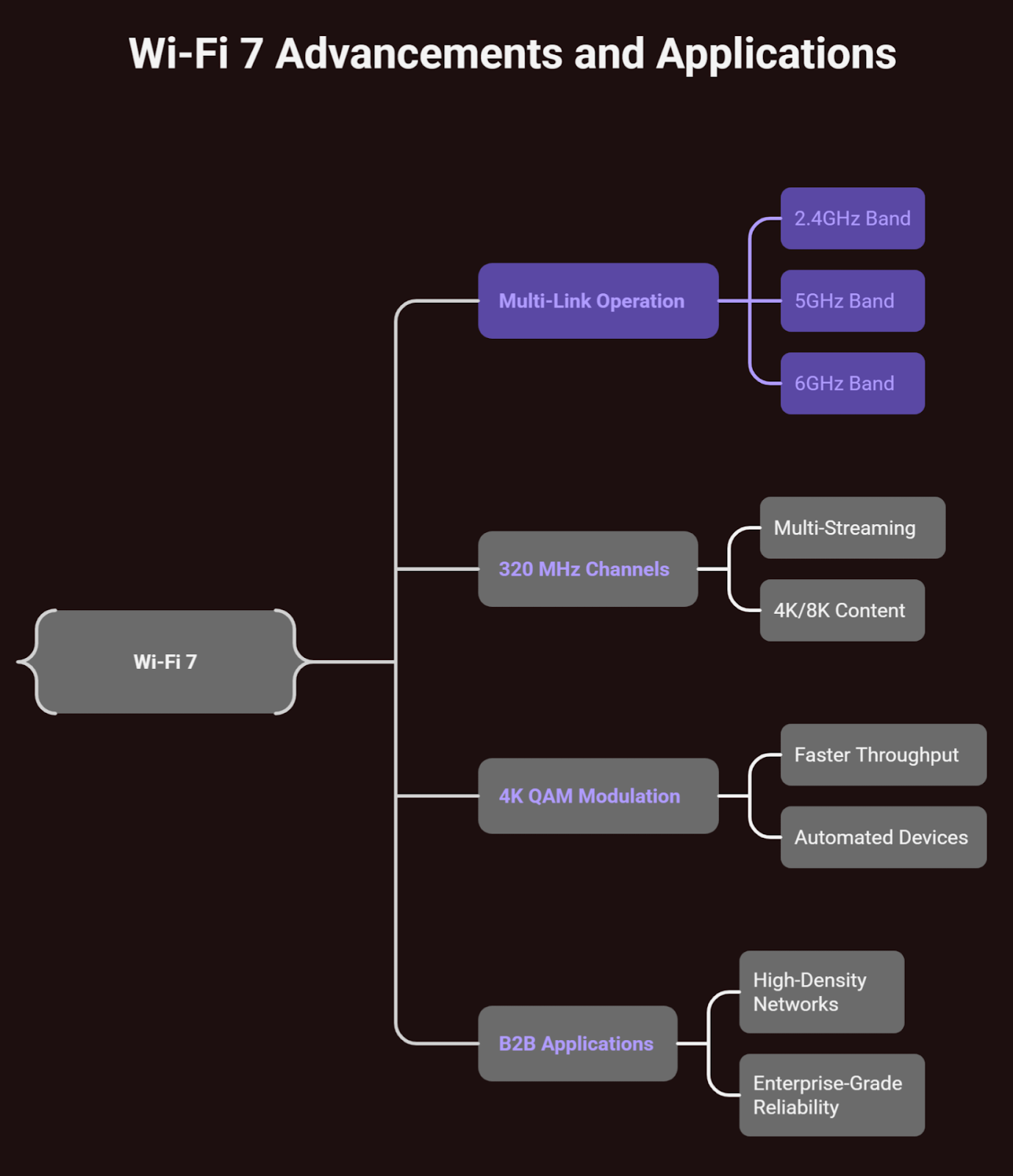
- Multi-Link Operation (MLO):
Devices can send data on multiple bands simultaneously (2.4GHz, 5GHz, 6GHz).
Using multiple frequency bands at the same time is similar to using multiple roads at the same time, which reduces congestion and latency.
(Source: Intel Wi-Fi 7 Overview)
- 320 MHz Channels:
This doubles the bandwidth available in Wi-Fi 6E.
Excellent for multi-streaming 4K/8K content in large homes.
- 4K QAM Modulation:
More data density per channel, resulting in faster throughput in real-world applications, especially in luxury homes with many automated devices.
The B2B truth:
Wi-Fi 7 is not designed only for faster speed tests.
It is designed for high-density networks, i.e., 100s of devices, thick walls, long range, roaming, multi-AP backhaul, and enterprise-grade reliability.
Why Consumer Wi-Fi 7 Routers Fail in Large Texas Homes (And Hotels)
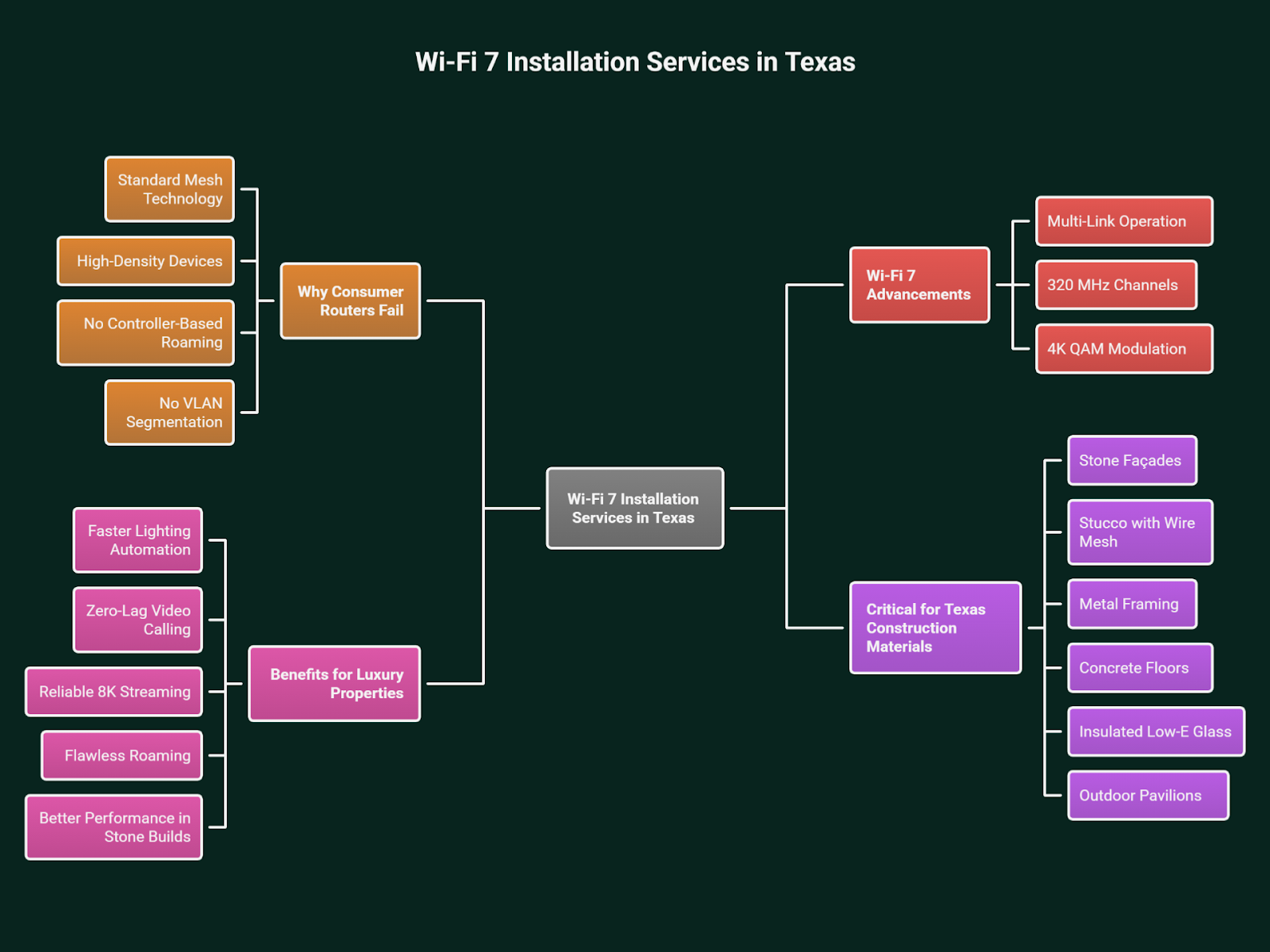
Standard consumer routers (Orbi, Asus ROG, Google Nest) are made for 1,200-2,000 square feet of space and 20-40 devices.
However, many Texas luxury homes and hotels have:
- 5,000 – 15,000 square feet
- Stone, Metal, Steel, Stucco, (very high RF blocking materials)
- 100–250+ devices
- Outdoor living areas
- Separate guest suites/casitas
- Server rooms and AV racks
- Multiple access points required
Why they fail:
1. Standard mesh technology is wireless backhaul.
Every time two Access Points (APs) communicate wirelessly, the signal is cut in half by each obstruction (stone, metal, or insulated glass).
Enterprise systems use wired PoE backhaul → provide no degradation of the signal.
2. Consumer routers cannot manage high-density devices.
Most Top-Tier routers max out at managing 60-70 devices.
A typical modern luxury estate will contain:
- 60 smart lights
- 20+ sensors
- 12 smart TVs
- 20 security devices
- 30–50 automation processors
That’s 150+ network clients — far beyond consumer capability.
3. No controller-based roaming
Hotels, multi-dwelling units, and large homes need seamless roaming like your phone experiences in airports.
Standard systems experience dropped calls, slow Zoom rooms, and buffering video streams.
Enterprise-grade platforms (Aruba, Ruckus, Meraki) provide seamless roaming without dropped calls or video stream buffering across multiple APs.
(Reference: Cisco Meraki High-Density Design Guide)
4. No VLAN segmentation for security
Luxury homes and hotels require VLAN segregation for:
- Security devices
- Guest networks
- Staff networks
- IoT devices
- Office/VPN traffic
Consumer/Standard routers cannot do this effectively.
How Multi-Link Operation (MLO) Improves Luxury Living & Hotel Experiences
MLO is the feature that solves the problem of congestion in high-density networks.
Wi-Fi 6E uses only one lane at a time (Even if it has access to 6 GHz).
Wi-Fi 7 uses all lanes simultaneously.
Benefits for Texas luxury properties:
1. 0.5–1.5 seconds faster lighting automation
Smart lighting scenes activate immediately.
2. Zero-Lag Video Calling for Remote Workers
No freezing during a Zoom call when someone streams 4K in another room.
3. Reliable 8K streaming across 10–15 displays
High-end Media Rooms require the 320 MHz Channels only available in Wi-Fi 7.
4. Flawless roaming inside 6,000–15,000 Square Foot estates
Perfect for guests, staff, outdoor zones, and multi-level homes.
5. Better Performance in Stone, Concrete & Metal Builds
Wi-Fi 7 performs much better with interference in real-world conditions.
Why Texas Hotels, Resorts & MDUs Need Enterprise Wi-Fi 7 Now
Hotels in cities like Dallas, Austin, and Houston have seen an explosion of devices connected by guests, including:
- Phones
- Tablets
- Laptops
- Smart TVs
- Casting devices
- Wearables
- VR headsets
A single room can have up to 12-18 devices connected at once.
A 200-room hotel would have 2,400 - 3,600 devices.
Hotels that are currently using Wi-Fi 6 or Wi-Fi 5 are unable to accommodate this number of connected devices.
The hospitality reality:
Guests expect “home-like Wi-Fi” — and Wi-Fi 5/6 networks simply cannot meet this level of density.
RealPage’s managed Wi-Fi (Elemento) and AT&T Connected Communities are already deploying enterprise Wi-Fi platforms for MDUs because:
- They provide per-unit isolation
- They allow centralized management
- They prevent interference between guests
- They support roaming across buildings
This is becoming the industry standard for 2025-2026
Why Texas Construction Materials Make Wi-Fi 7 Even More Critical
Luxury homes in Texas often use:
- Stone façades
- Stucco with wire mesh
- Metal framing
- Concrete floors
- Insulated Low-E glass
- Outdoor pavilions + casitas
- All of these building materials have heavy absorption of RF signals.
- Consumer mesh networks collapse in these environments.
- Enterprise Wi-Fi 7 addresses these challenges through:
- Hardwired PoE+ and PoE++ access points
- careful placement of access points
- Heat-map-based RF design
- Controller-based optimization
This is one reason why all premium integrators treat Wi-Fi as infrastructure rather than as a gadget.
Who Should Upgrade to Wi-Fi 7 (And Who Should Wait)?
Upgrade If You Are:
- A luxury homeowner in Texas with over 5,000 square feet of living space
- A builder who designs smart estates or multi-dwelling units
- An owner/operator of a hotel with high occupancy levels
- A property manager dealing with Wi-Fi complaints
- A business with high-density employees or IoT devices
Wait If You Are:
- Living in a small apartment (less than 1,500 square feet)
- Using fewer than 25 devices
- not watching 4k/8k video content
Conclusion
Wi-Fi 7 is the first wireless standard designed specifically for:
- Large estates
- High-density buildings
- Multi-unit properties
- Automation-heavy environments
Consumer routers fail because they’re built for consumers — not developers, hospitality operators, or luxury homeowners.
Enterprise Wi-Fi 7 is the future of Texas connectivity.
Frequently Asked Questions
Q1: Is Wi-Fi 7 worth it for a Texas luxury home?
Yes - if you have over 80-100 devices connected, Wi-Fi 7 can improve the speed of automation, roaming, and overall stability.
Q2: Is Wi-Fi 7 backward compatible?
Yes. Wi-Fi 5/6 devices will still connect.
Q3: Should I buy a Wi-Fi 7 router from Amazon?
Consumer-grade routers are not designed for large estates or multi-dwelling units; instead, install enterprise access points with wired backhaul.
Q4: Do I need new wiring for Wi-Fi 7?
Ideally, yes, Cat6A or fiber ensures full performance for PoE++ access points.
Q5: Will Wi-Fi 6E be obsolete?
Not obsolete, but Wi-Fi 7 is significantly better for high-density areas.
Planning a new build or upgrading an existing network? Book a Wi-Fi 7 Design Consultation with Seiits.com — get a complete heat-map RF plan and an enterprise-grade deployment roadmap for your property.
Comments ()