
When to Hire a Smart Home Integrator (And Why It's Not the Electrician)
Learn when to hire a smart home integrator for new construction and why electricians aren’t a substitute for planning lighting, networking, AV, and automation in luxury homes.
The Most Common Problem All Luxury Builders Make (That Costs Them BIG time)
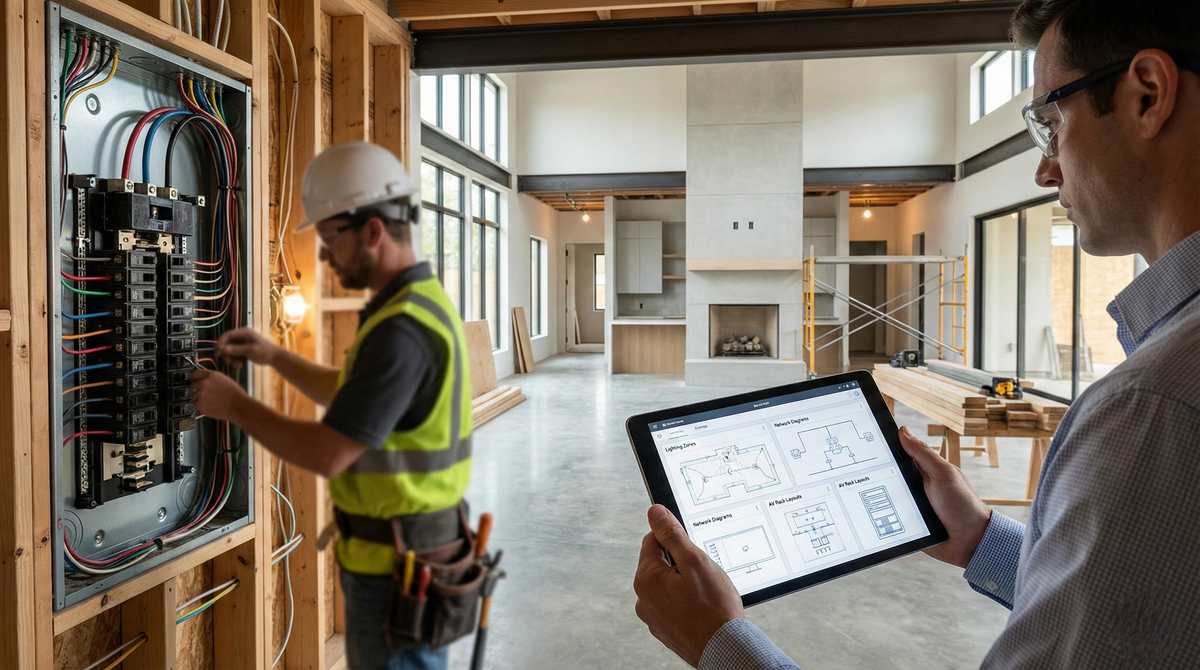
It was about two years back when I walked through a 7,800 sq. ft. custom-built in Dallas with a Builder who was pacing around a half-framed wall as he became increasingly frustrated.
Why? The Electrician had completed the Rough-Ins But the Homeowner had recently added:
- motorized shades
- whole-home audio
- Network (10 gigabit)
- centralized lighting system
All of which were NOT part of the original plan! The reopened Wall would now need to be reopened! Budget: +$42,000 Timeline damage: 4–5 weeks or more.
The Builder then looked at me and said, "I wish we had called you 6 months ago!"
That is exactly why I wrote this guide. Since the most costly tech issues in Luxury Builds occur because of Late Involvement, Role Confusion, and the assumption that an Electrician can “handle the Tech”. They can’t - and it's not their job.
At What Stage Of The Construction Process Should You hire a systems integrator?
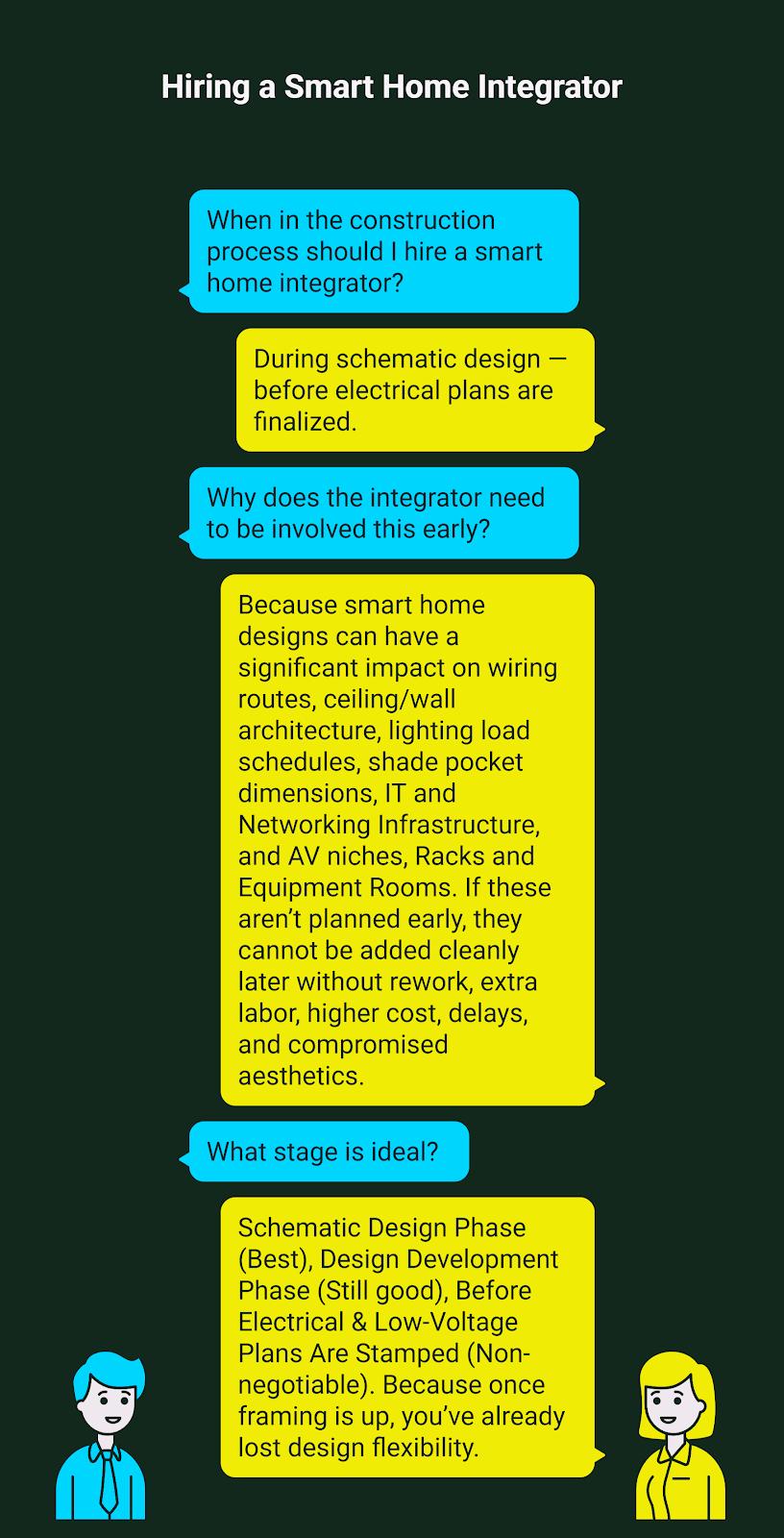
During schematic design, before electrical plans are finalized.
Why does the integrator need to be involved this early?
Because Smart home designs can have a significant impact on:
- wiring routes
- ceiling/wall architecture
- lighting load schedules
- shade pocket dimensions
- IT and Networking Infrastructure;
- AV Niches, Racks, and Equipment Rooms.
If these aren’t planned early, they cannot be added cleanly later without:
- rework
- extra labor
- higher cost
- delays
- compromised aesthetics
This matches what nearly every major integrator association (HTA, CEDIA) teaches: “Traditionally, smart home integrators come in after electrical work is done. That is often too late.”
What stage is ideal?
- Schematic Design Phase (Best)
- Design Development Phase (Still good)
- Before Electrical & Low-Voltage Plans Are Stamped (Non-negotiable)
Because once framing is up, you’ve already lost design flexibility.
Why Early Involvement Prevents Costly Retrofits
The number one builder pain point: Retrofits.
Retrofitting technology into a home mid-build is like trying to add plumbing after the tiles are installed.
It can be done. But it’s ugly in cost, coordination, and final aesthetics.
What early planning helps avoid?
1. Avoiding Re-wiring & Re-Routing
Re-Wiring & Re-Routing Smart Systems Require:
- Cat6/Cat6A structured wiring
- low-voltage runs
- distributed audio cabling
- fiber in some luxury builds
An electrician is not responsible for designing the low-voltage aspects of smart systems.
2. Ensuring Your Lighting Plan Works with Smart Keypads
- If your project uses Lutron, Control4, or Savant keypads, your lighting plan must be consolidated, circuit-mapped, and load-controlled. If this isn't done, you're left with:
If this isn't done, you're left with:
- wall clutter
- mismatched switches
- incompatible dimmers
- ugly retrofits
3. Planning For Hidden Technology (Designers Care A Lot About This)
Architects and designers need to know where:
- Invisible Speakers Sit
- Racks Must Be Placed
- Shades Recede
- Media Lifts Hide
- Wire Conduits Run
These cannot be “added later” without rebuilding sections of the home.
Example:
In Houston, a builder called me after he'd framed his home. The client wanted to install invisible speakers in his living room. The problem was that invisible speakers require a "mud-in" layer plus a certain amount of space within the drywall cavity to fit properly. Since the drywall had already gone up, he had to cut, reinforce, patch, re-float, and re-paint large areas of the ceiling and walls. The total cost was over $11,500, and all because I hadn't been called in to help plan the smart home systems 6-12 months prior.
Why a Smart Home Integrator Is Not the Electrician
There's a misconception about who should provide smart home services to homeowners. Many builders and contractors believe that hiring a smart home integrator is optional and that an electrician can take care of all of the smart home needs. However, this assumption is completely wrong. There are very specific reasons for this.
What Does an Electrician Do?
An electrician is a great electrician if:
- He knows about line voltage, breakers, fixtures, safe wiring, switches, conduit, and power distribution.
- His expertise lies in safety, code compliance, and the electrical infrastructure of a home.
What Does a Smart Home Integrator Do?
A smart home integrator is someone who can:
- Program smart lighting systems (Lutron, Control4, Savant).
- Automate shading systems.
- Design data networks.
- Install whole-home audio/video systems.
- Build rack systems.
- Create home theater systems.
- Install surveillance systems.
- Install access control systems.
- Design touch screens and app interfaces.
- Program the brains of smart home systems (the entire system).
These are not electrical tasks. These are software-driven, behavior-driven, user interface-driven systems.
Can You Swap These Tasks?
No, you cannot swap these tasks. Each technology platform requires:
- precise load calculations.
- data networks (not power).
- programming logic.
- user-interface coordination.
- drivers, firmware, and API integrations.
Electricians are not trained to do any of these things. Nor should they be. Just as an integrator is not trained to install 240V breakers.
Benefits of Smart Home Integration for Builders
1. A single point of responsibility for all technology
Instead of: electrician + AV guy + IT vendor + shade installer + security vendor
You get: one integrator = one cohesive system.
2. Predictable Scheduling
Integrators create plans based on:
- framing
- electrician rough-in
- drywall
- trim-out
- final programming
- turnover to the homeowner
This removes the random “When do we contact the AV guy?” issue.
3. Reduced callbacks and higher client satisfaction
Well-planned luxury systems =
- fewer system failures
- fewer requests for rework
- fewer “My app won’t work” phone calls
- fewer warranty headaches
The better functioning the technology, the happier the client will be, and the fewer late-night calls to the builder there will be.
4. Better aesthetic options for architects and designers
Architects like:
- flush-mounted hardware
- hidden AV racks
- invisible speakers
- shade pocket cavities that disappear
- centralized keypads instead of wall clutter
This can only occur through early communication.
What Exactly Does an Integrator Do During Pre-Construction?
1. Technology Mapping
Room-by-room layout showing:
- speaker placement
- lighting load
- shade line
- network access point
- equipment location
- cable route
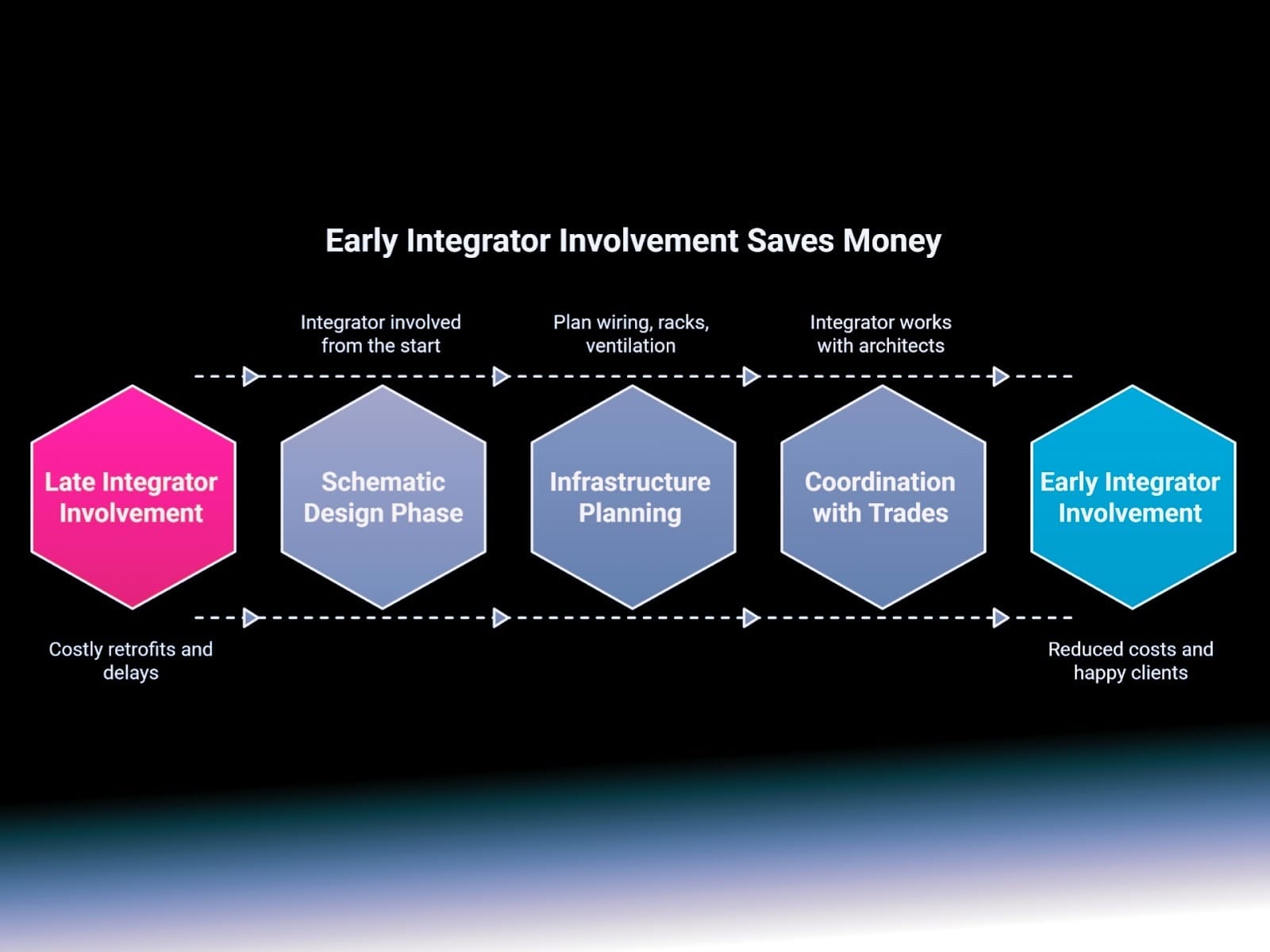
2. Infrastructure Planning
Deciding:
- Cat6A versus fiber
- rack room ventilation
- power conditioning
- conduit placement
- network backbone
3. Coordination with other trades
Working alongside:
- architects (design harmony)
- electricians (load/path alignment)
- HVAC (thermostat integration)
- carpenters (niches, cavities, shade pockets)
- designers (wall clutter reduction)
4. Client Technology Roadmap
Whether the owner wants:
- Lutron lighting + Control4 interface
- Savant + Lutron HomeWorks
- Crestron custom setup
- distributed audio
- dedicated home theater
This road map will prevent mid-project “scope explosions.”
FAQs
Q1: At what stage in construction should a smart home integrator be brought into the process?
During schematic design.Bringing the integrator in after electrical will ensure a cost increase.
Q2: Can an electrician also take care of smart home systems?
Electricians provide power. , Integrators design and program systems that operate over data networks. They are not interchangeable.
Q3: If I wait to hire an integrator, what will happen?
Expect:
- rework
- additional cost
- delays
- compromised aesthetics
- unhappy clients
Q4: Do all luxury homes need an integrator?
If the project includes smart lighting, shades, networking, audio/video, or security, then yes.
Q5: Will hiring an integrator early add cost to my project?
No. It will save money on the total project cost because it will reduce retrofitting costs and prevent scope creep.
Conclusion: The sooner the integrator is involved in the building process, the smoother it will go.
Inviting an integrator into the process at the beginning is not a luxury; it is a risk management option for architects and builders. It will protect the budget, schedule, and design intent. And on every high-end house I have ever worked on, they all have one commonality:
The technology was planned ahead of time, rather than added afterwards.
If you are currently working on a new project, regardless of where you are in the design phase, seiits.com can assist you in developing the ideal technology plan before the electrical drawings lock you in.
Just send us your floor plan, and I will develop the specifics regarding how to properly implement the required smart-home infrastructure for your build.
Comments ()