
Texas Solar Security Cameras: The Real Reason "Wire-Free" Cameras Fail in Extreme Heat
Why most solar security cameras fail in extreme Texas heat. A practical guide for ranches, estates, and construction sites to choose reliable commercial solar surveillance systems.
Introduction: What's Wrong with "Wire-Free Solar Cameras" in Texas?
If you search “Texas solar security camera” on Google or Amazon, you'll find hundreds of low cost, wire-free cameras promoting 24/7 video coverage, utilizing a tiny solar panel and a rechargeable battery. What's wrong with them? The extreme heat in Texas is typically 100–115°F, and the consumer-grade battery is not made to withstand extreme temperatures and extended periods of cloud cover. In fact, as per Amazon’s own documentation, most consumer grade wire-free solar camera manufacturers only rate their products as high as 113°F operating temps—and many fail far below that.Because of this issue, we have numerous ranch owners, developers, and construction managers contact us each week with the same complaints:
“The camera shows offline every afternoon.”
“The battery keeps dying after 2–3 cloudy days.”
“The Wi-Fi can’t reach the camera 800 feet away.”
In this blog, we will explain why wire-free consumer solar cameras fail, and the true professional-grade option Texas property owners should consider.
Do Solar Security Cameras Operate in Extreme Texas Heat?
Short Answer: Consumer wire-free solar cameras? No. Professional commercial solar units? Yes.
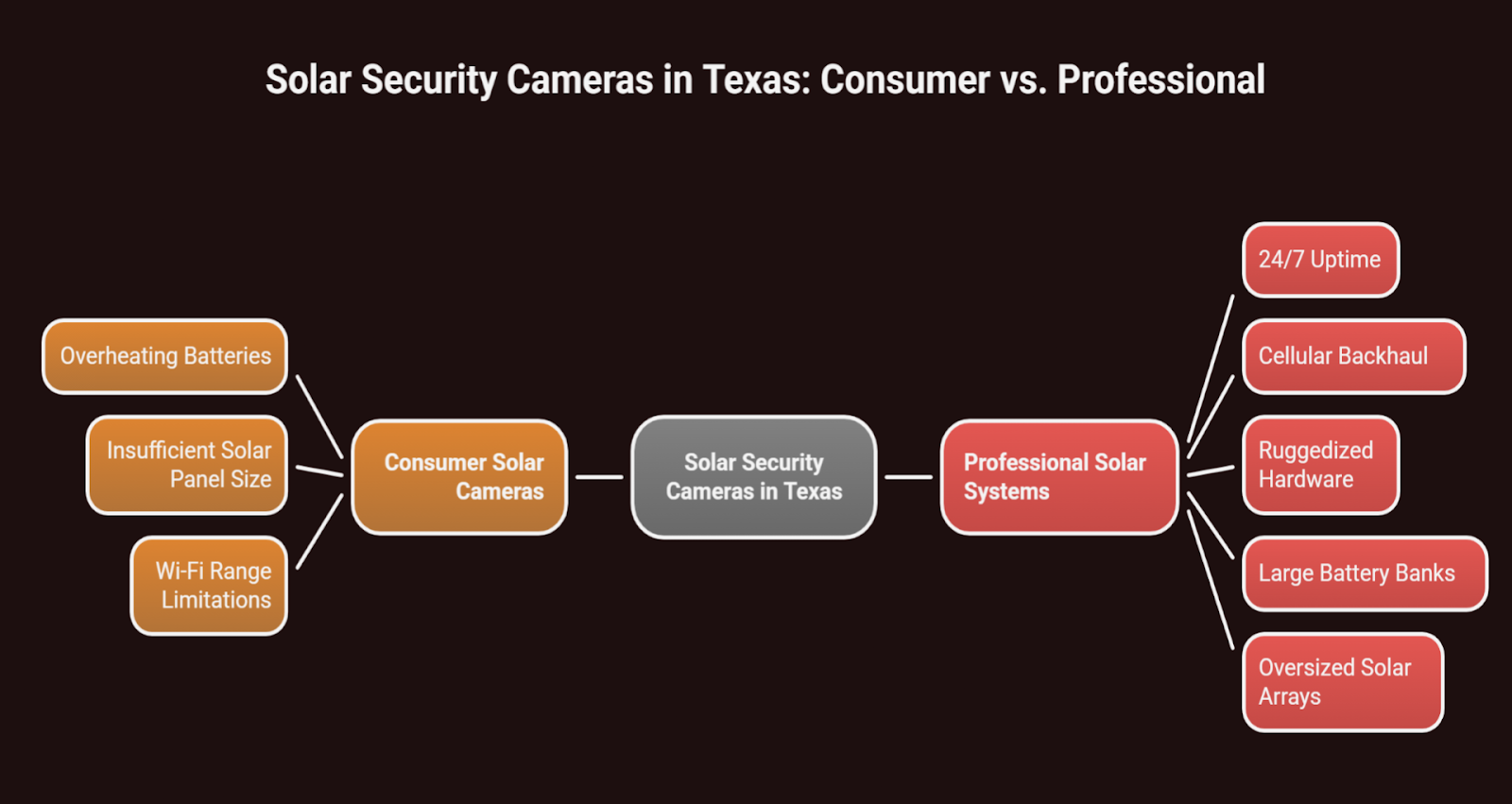
1. Overheating Batteries (Main Failure Point)
Lithium-ion batteries inside consumer solar cameras turn off to protect themselves due to overheating. According to UL standards, typical consumer Li-ion packs operate at:
- 32°F to 113°F operating range
- Ideal performance at 77°F
Source: UL Consumer Technology Safety Guidelines https://www.ul.com/services/battery-safety-testing
Texas summer temperatures frequently exceed these maximum temperature limits, including shaded areas.
2. Insufficient Solar Panel Size
Many "wire-free solar cameras" come equipped with:
- 3W–5W small solar panel
- 4,000–6,000 mAh battery
These are barely sufficient for 2-3 cloudy days and certainly not adequate for powering 24/7 recording. Commercial solar systems utilize:
- Large 30W-90W solar arrays
- Deep-cycle 20Ah–100Ah batteries
- Charge controllers designed for 140°F enclosures
There is a huge difference between consumer and commercial systems.
3. Wi-Fi Range Limitations
In Texas, the majority of ranch gates, barns, and perimeter zones are 500-1500 ft. away from the primary residence.
Consumer wire-free cameras rely on Wi-Fi—And Wi-Fi does not travel well over Texas terrain (trees, metal barns, rock walls).
Professional systems provide a solution to this limitation using point-to-point wireless bridges.
Why "Wire-Free" Solar Cameras Are Not Sufficient for Ranches & Construction Sites
It is important to note that wire-free solar cameras are suitable for backyard, shed, and small residential areas. However, for ranches, estates, MDUs, and construction sites, you require:
1. True 24/7 Uptime (Even After 4–5 Cloudy Days)
Texas weather patterns include:
- Dust storms
- Cloudy Weeks
- Extreme summer heat
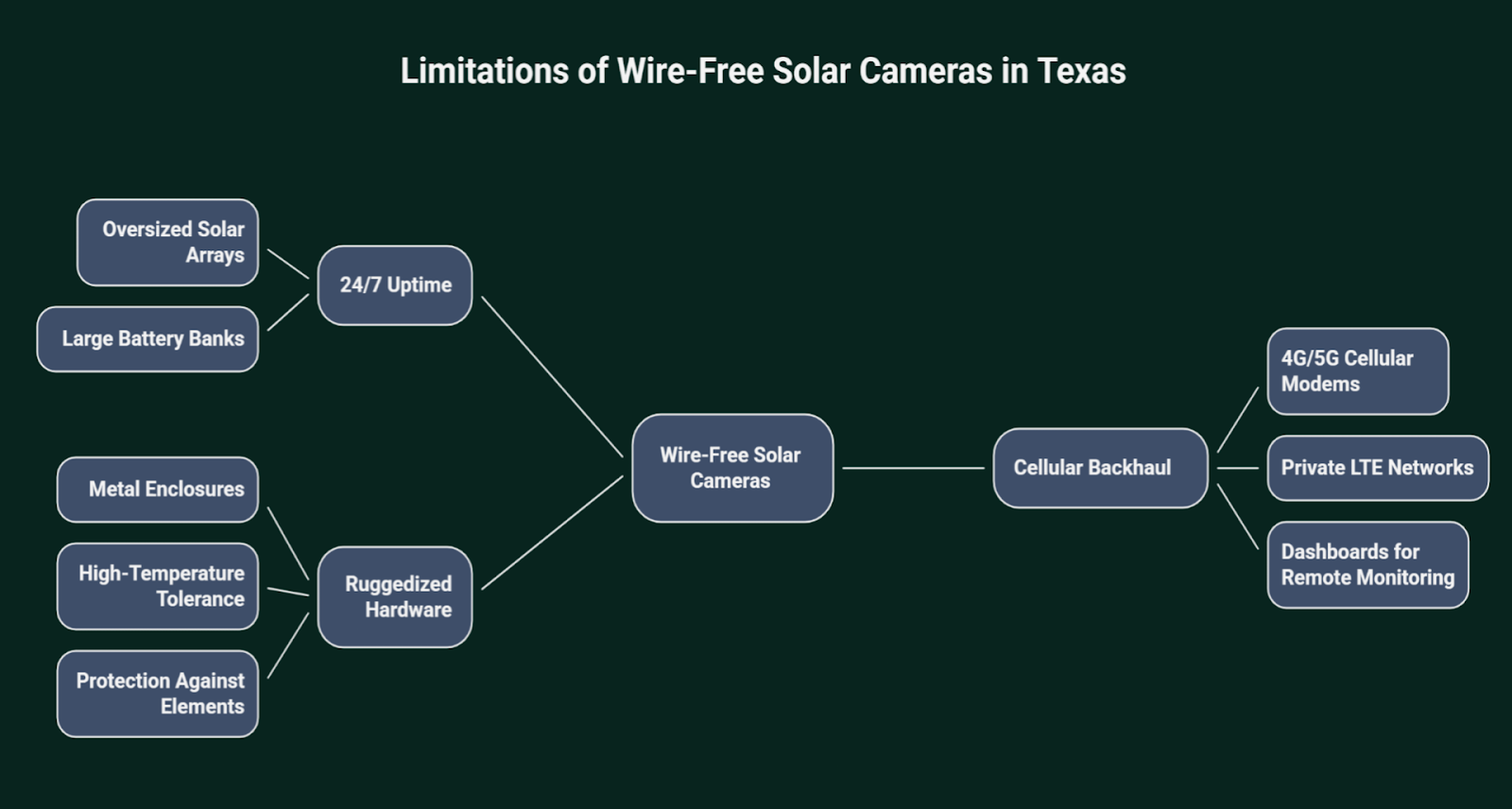
Professional units come with oversized solar arrays and large battery banks designed to provide continuous operation.
2. Cellular Backhaul (Not Wi-Fi)
A critical limitation: Wi-Fi-based cameras do not work far from the home.Professional systems use:
- 4G/5G cellular modems
- Private LTE networks
- Dashboards for Remote Monitoring
So even if the gate is 1 mile away, you get live video and alerts.
3. Ruggedized Hardware Built for Texas Conditions
Commercial solar cameras are built to perform under:
- 140°F internal temperatures
- Long standby cycles
- Wind, dust, rain, wildlife
- Metal enclosures that prevent overheating
Consumer-grade plastic housings can't compete.
Texas Applications Where Consumer Solar Cameras Will Fail
1. Ranch Gate Surveillance
Symptoms of failure:
- The camera goes offline by noon.
- No footage after storms
- Wi-Fi cannot reach the gate.
- Battery dies during the winter months
Solution:
Solar-powered gate surveillance units with cellular backhaul + P2P wireless.
2. Construction Sites
Wire-free cameras fail due to:
- High wind → tilt → offline
- Heat causes the battery to shut down.
- Theft → entire camera stolen
Professional units include:
- Anti-theft trailers
- Heavy steel poles
- Large solar batteries
- 360° PTZ cameras
- 24/7 remote monitoring
3. Large Estates & Barns
Large Estates and Barns employ hundreds of devices, such as:
- IoT Sensors
- Floodlights
- LPR cameras
- LoRaWAN gateways
Consumer solar cameras are unable to handle this complex ecosystem.
What is the best commercially available solar-powered security camera for Texas?
Here’s what matters most:
Q: What type of solar camera survives 110°F+ heat?
A commercial-grade pole-mounted unit with:
- Metal enclosure
- 20Ah+ battery
- 30W+ solar panel
- Active temperature management
Q: How do I get the internet to a gate 1 mile away?
Use a Point to Point Wireless Bridge like Ubiquiti airMAX or TP-Link Pharos.
Q: Do I need cellular service?
Yes – If your gate or jobsite is 1 mile away from your home, then you will be required to have a 4G/5G backhaul.
Professional vs. Consumer Comparison
Feature | Consumer Solar Cam | Commercial Solar Security System |
| Battery Size | 4,000–6,000 mAh | 20Ah–100Ah deep cycle |
| Solar Watts | 3W–5W | 30W–90W |
| Heat Tolerance | Limited | 140°F+ enclosure |
| Network | Wi-Fi only | Cellular / P2P wireless |
| Uptime | 2–3 days | 24/7 continuous |
| Best For | Home yards | Ranches, construction, estates |
When You Should Choose a Commercial Solar Camera Instead
You should choose a commercial-grade solar-powered security system if you need:
- 24/7 monitoring
- ½ mile to 1 mile coverage
- License Plate Recognition (LPR) cameras at entrance gates
- Construction site time-lapse
- Real-time alerts
- Tamper-proof enclosures
Choose a consumer if you need:
- Light residential use
- Occasional remote checks
Frequently Asked Questions
Q: Will solar security cameras work in Texas extreme heat?
Consumer ones usually fail; commercial-grade systems are designed for it.
Q: Do I need Wi-Fi at the gate?
No. Use cellular or point-to-point wireless.
Q: How many cloudy days can a commercial solar camera survive?
Typically, 3–5 days on battery alone.
Q: Are professional solar cameras expensive?
Yes, but they replace the need for trenching with thousands of dollars in cabling.
Q: Can I use a Ring or Reolink solar camera on my ranch?
Not reliably for security-critical applications.
Ready for a security system that actually survives Texas heat? Get a no-pressure consultation with us on seiits.com, and we’ll recommend the right solar, wireless, and camera setup for your ranch, estate, or construction site.
Comments ()