
Smart Home Integration Planning for Texas Architects: The 2026 Pre-Construction Guide
A pre-construction smart home integration guide for Texas architects covering when to involve a smart home integrator, Control4 vs Savant vs Crestron for luxury new construction, and phase-by-phase technology planning across Dallas, Austin, and Houston.
An architect I had been working with in Southlake called me during design development on a 9,400 square foot limestone estate. Her question was direct: 'Is it too late to bring you in properly?'
She had already locked the electrical plan. There was no network closet on the drawings. Her client had just confirmed they wanted a full Control4 system with distributed audio across eleven zones.
It was not too late. But the team spent two weeks reengineering decisions that should have taken two hours in schematic design. Nobody billed for it. Nobody forgot it either.
That scenario repeats on Texas job sites every month. Not because architects ignore technology. It happens because nobody gives them a clear, field-tested answer to the one question that matters: when do you involve a smart home integrator, and what do they actually need from you when they show up?
This guide answers that question. It is built from real pre-construction experience on luxury Texas custom builds by a team that has pulled Cat6A through Hill Country limestone, pre-wired Highland Park estates before framing started, and commissioned Control4 and Savant systems in homes where the owner expected perfection on move-in day.
What Is Pre-Construction Smart Home Planning?
Pre-construction smart home planning means designing a home's complete technology infrastructure before walls close. It covers structured wiring, AV zone mapping, lighting and shading integration, network architecture, equipment room sizing, and control platform specification.
When architects and integrators run this process together, technology disappears into the architecture. No surface conduit. No panels were placed wherever space allowed. Every speaker, shade motor, and access point sits exactly where the design intended.
When the process gets skipped, it costs real money. A BRAVAS industry survey found that 19 percent of architects encountered system incompatibility and coordination failures that forced project redesigns. Pre-construction planning prevents that outcome entirely.
Technology infrastructure is not a final selection. It is a structural decision. Plan it at the same time you plan your MEP systems.
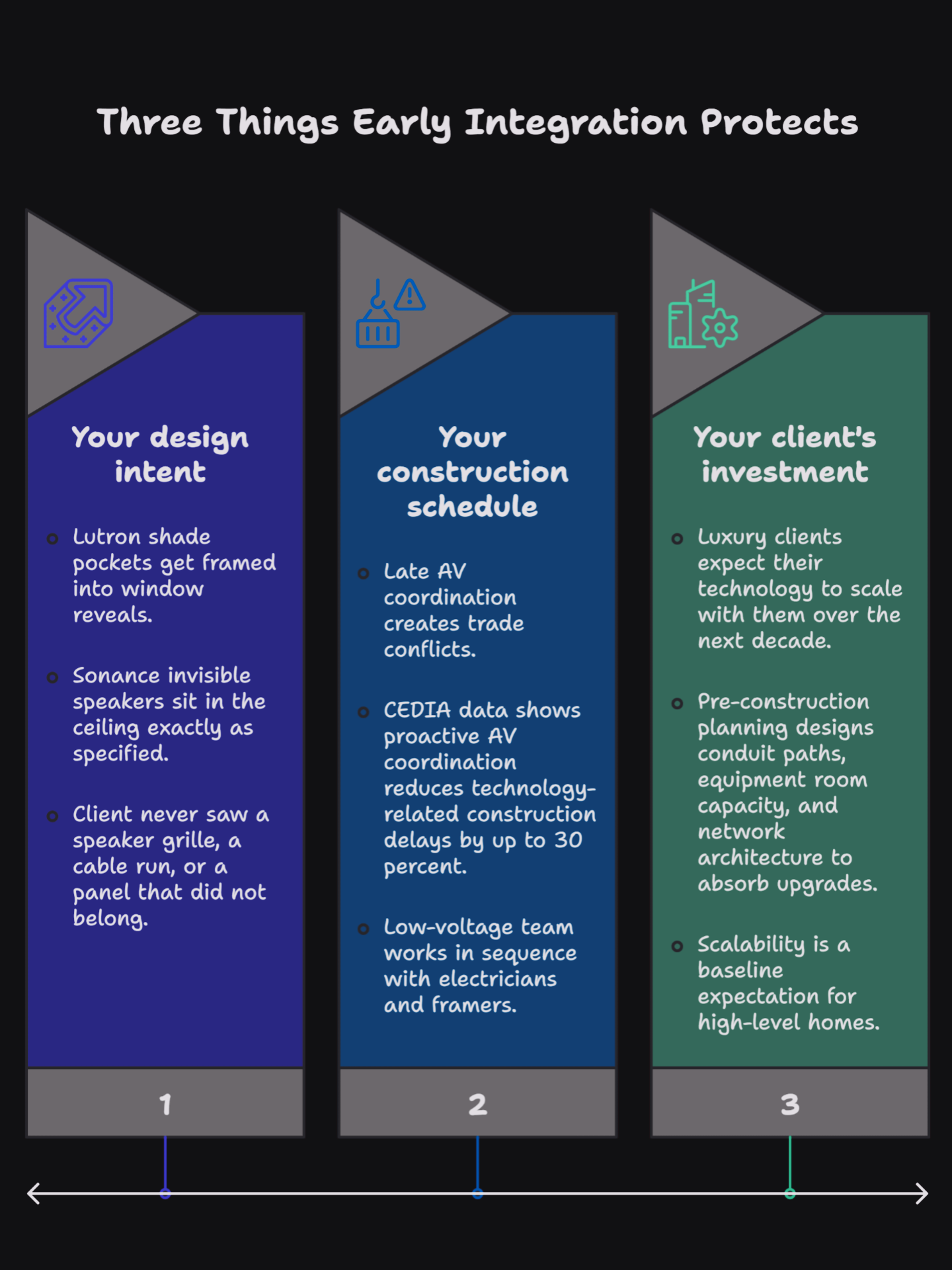
Three Things Early Integration Protects
Your design intent
When an integrator joins during schematic design, every technology component gets designed into the architecture rather than retrofitted onto it. Lutron shade pockets get framed into window reveals. Sonance invisible speakers sit in the ceiling exactly as specified. On a recent project in Dallas's Preston Hollow, early AV coordination meant the client never saw a speaker grille, a cable run, or a panel that did not belong. The technology was invisible. The design was intact.
Your construction schedule
Late AV coordination creates trade conflicts. When the low-voltage contractor arrives after drywall, every cable run demands a new hole, a patch, and a painter callback. CEDIA data shows proactive AV coordination reduces technology-related construction delays by up to 30 percent. Bring the integrator in early, and the low-voltage team works in sequence with the electricians and framers. Nobody doubles back. The schedule holds.
Your client's investment
A luxury Texas client spending $4 million on a custom home expects their Kaleidescape media server, Ubiquiti UniFi network, and Control4 automation to scale with them over the next decade. Pre-construction planning designs the conduit paths, equipment room capacity, and network architecture to absorb those upgrades without opening walls. That scalability is not a bonus. It is a baseline expectation for any home at this level.
Why Texas Builds Creates Challenges That National Guides Ignore
Limestone walls and radiant barrier insulation in Austin's Hill Country and Barton Creek absorb WiFi signal the way a sponge absorbs water. Thick masonry in Highland Park and Southlake does the same. A consumer mesh kit from any big-box store cannot overcome multi-wall signal loss in a 9,000 square foot estate. The correct solution is enterprise-grade Wi-Fi infrastructure from commercial-grade systems like Ubiquiti UniFi, positioned during design development and wired back to a managed switch. Consumer gear does not solve this problem, regardless of how many nodes you add.
Texas summers regularly push outdoor temperatures past 108 degrees Fahrenheit. Consumer smart locks and outdoor AV hardware fail in direct Texas sun within one to two seasons. Only commercial-grade, weather-rated equipment survives long-term outdoor installation in this climate. If you are deciding between smart locks and a full access control system for a luxury estate, the answer depends on more than just budget. Specify the right products before installation, not after the first summer proves the point.
Luxury custom homes in Frisco, Westlake, and The Woodlands regularly run between 7,000 and 16,000 square feet. Consumer WiFi designs for homes under 3,000 square feet. That gap does not close by adding more consumer nodes. It requires a complete rethinking of network architecture, and that rethinking needs to happen before the builder pours the slab.
The Phase-by-Phase Integration Framework
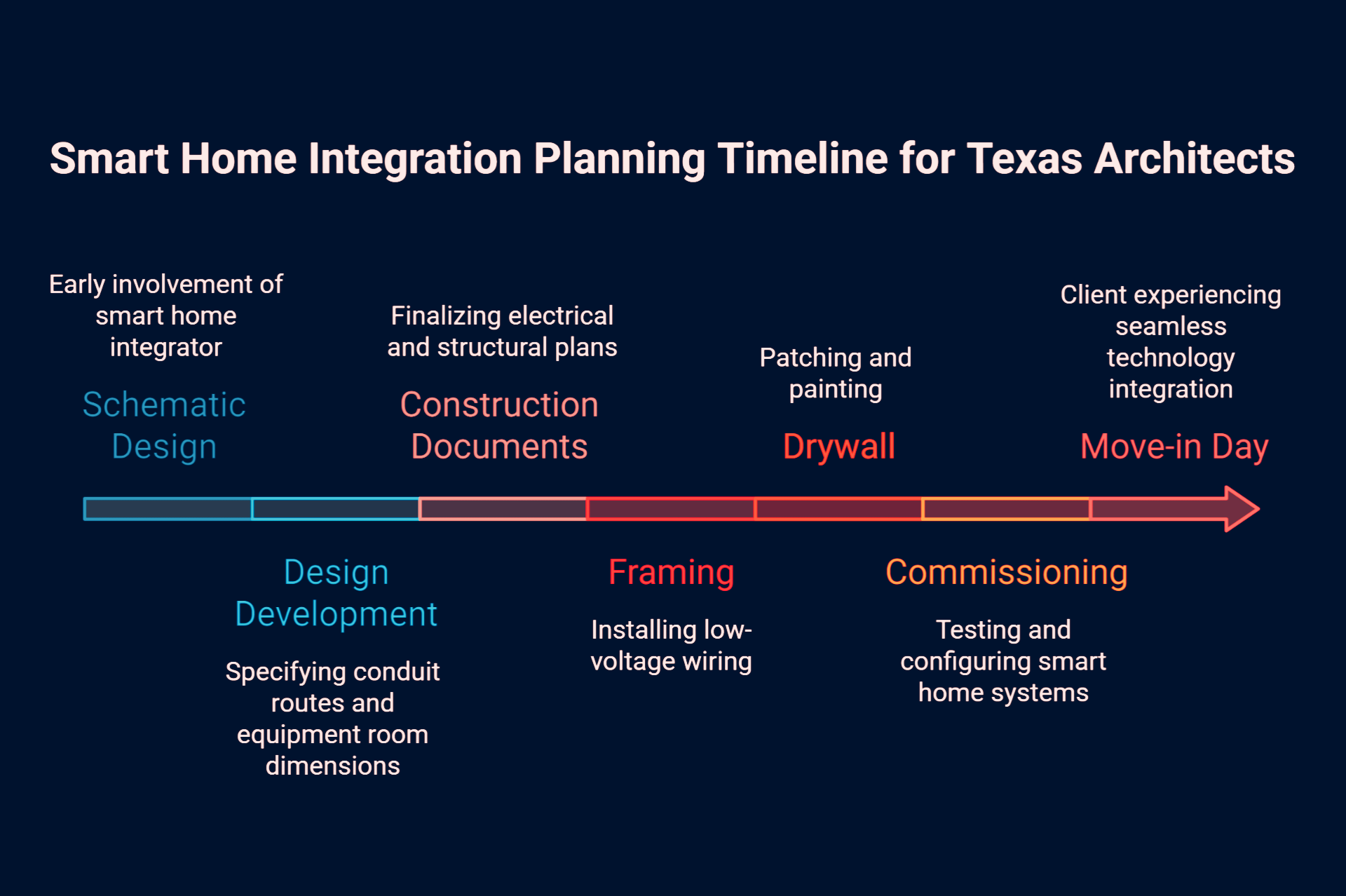
This is the exact sequence that protects your design vision and schedule on every luxury Texas new construction project. If your client is a builder working alongside you on the same site, share our guide on the 10 questions every builder must ask their integrator before construction begins. Between the two resources, every stakeholder on the project knows their role.
Every decision gets made at the right moment, by the right people, with enough time to get it right the first time.
Frequently Asked Questions
When should an architect involve a smart home integrator?
During schematic design, before any electrical or structural plans are finalized. Early involvement gives your integrator time to specify conduit routes, equipment room dimensions, and access point locations while changes cost nothing. Waiting until the construction documents phase adds cost and forces compromises that hurt the finished design.
Which control system works best for luxury Texas new construction?
Control4, Savant, and Crestron all perform well at the luxury level. For a detailed side-by-side comparison, read our Control4 vs Crestron architect's guide and the Crestron vs Savant breakdown for new luxury builds. The short answer: Control4 delivers strong value and a broad ecosystem. Savant suits Apple-centric households that prioritize UI quality. Crestron fits ultra-high-end builds where maximum customization matters most. Specify the platform during design development so pre-wiring and equipment room sizing align from day one.
How do architects prevent wall clutter from smart home hardware?
Specify centralized control systems with in-wall or in-ceiling hardware during design development. Lutron Homeworks keypads mount flush and match any paint color. Control4 touchscreens integrate into millwork. In-ceiling Sonance speakers disappear entirely. Rough-in dimensions and pocket depths need to appear in the construction documents, not get added during framing.
What is the biggest mistake architects make with smart home integration?
Waiting too long. When technology planning begins during construction documents or later, the team solves problems that early planning would have prevented. Equipment rooms end up undersized. Conduit paths conflict with the structure. The electrical plan does not support the lighting control system. Every one of those problems costs more to fix during construction than it would have cost to prevent in design.
What Your Client Gets When You Plan Technology Properly
Luxury homeowners in Dallas, Austin, and Houston do not buy technology. They buy the experience of living in a home that works the way they imagined it would. Lights that respond before they reach the switch. Audio that fills the right rooms without a button press. A network that performs flawlessly whether two people are home or twenty-two.
That experience comes from the right process, not the right products. And that process starts with an architect who treats pre-construction technology planning as a first-class design discipline from day one.
Every week you delay involving your technology partner is a week of design flexibility you spend permanently. The right time to start is always earlier than it feels necessary.
Seiits partners with luxury architects and custom builders across Dallas, Southlake, Highland Park, Austin, Barton Creek, Houston, Frisco, and The Woodlands. The team joins the schematic design phase, coordinates with every trade, and stays through commissioning, client training, and post-move-in support.
Book a Free Pre-Construction Technology Assessment at seiits.com
Comments ()