
Kaleidescape vs. Apple TV 4K: Is the Video Quality Noticeable?
Kaleidescape vs Apple TV 4K is not a 4K vs 4K debate. This guide explains how bitrate, compression, and lossless audio create visible differences in luxury home theaters, and when Apple TV is actually enough.
Why This Comparison Matters (Especially for Luxury Builds)
You may have asked yourself at some point while creating or installing a dedicated theater in a Texas luxury home:
“Is Kaleidescape really better than the Apple TV 4K—or is it just overpriced hype?”
Homeowners frequently assume that the Apple TV 4K already provides "optimal" 4K viewing, but once they comprehend the terms bitrate, compression, and lossless audio, the differences between the two systems cannot be ignored.
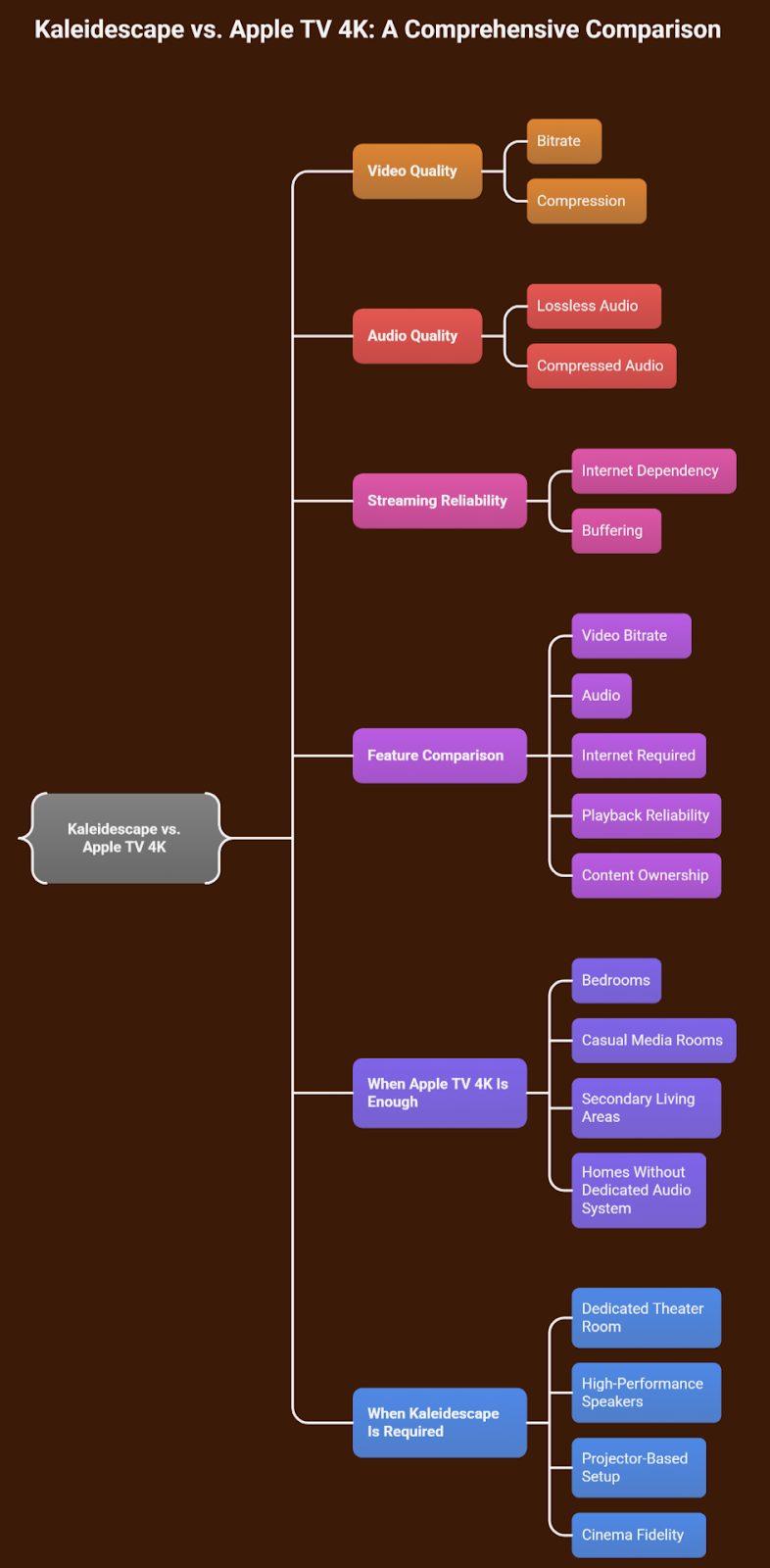
Clients installing $30K–$250K theater rooms are unknowingly bottlenecking their entire system with a $150 streaming box. That’s why this comparison, Kaleidescape vs Apple TV 4K, the decision regarding which product to use has become one of the most critical choices for both builders, integrators of luxury theater systems, and homeowners.We will provide the true differences through the utilization of factual data regarding the following topics:
- Bitrate
- Compression
- Audio formats
- Playback reliability
- Why Texas homes with unstable internet need local playback
- When Kaleidescape becomes mandatory (and when Apple TV is enough)
What’s the Real Difference Between Kaleidescape and Apple TV 4K?
Short Answer:
Yes, the quality differences are obviously noticeable. Not due to "4K vs 4K," but rather bitrate and lossless audio, the two elements that determine cinematic quality.
Let’s break it down.
Video Quality: Why Bitrate Matters More Than Resolution
The majority of homeowners inquire about:
"Why would Kaleidescape appear superior to Apple TV 4K since they both output 4K?"
Because Kaleidescape delivers up to 4–5x the video bitrate of streaming platforms.
Apple TV 4K (Streaming Services)
- Uses high-compression codecs (HEVC)
- Dynamically Adapts Depending on Internet Speed
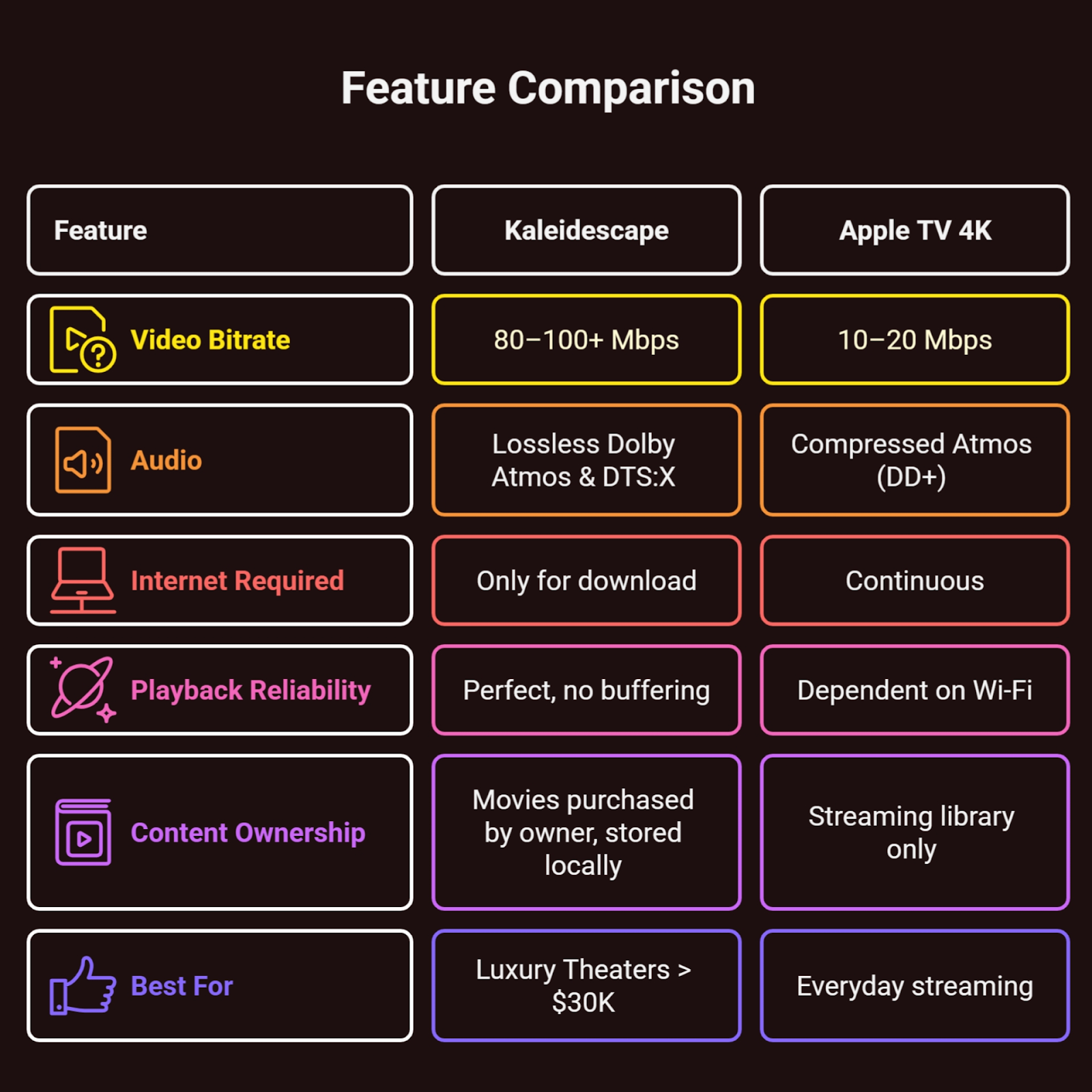
- Average Netflix 4K bitrate: 15–18 Mbps
- Disney+/Prime Video 4K bitrate: 10–20 Mbps
- Visible compression artifacts:
- Banding in dark scenes
- Smudging in fast motion
- Loss of texture in skin tones or fabrics
Kaleidescape (Downloaded Movie Files)
- Provides 80-100+ Mbps for video
- No adaptive compression
- Movie files are downloaded completely before playback.
- Picture quality closer to UHD Blu-ray
Result: Kaleidescape presents clearer details, smoother motion, darker shadows, and no streaming artifacts.
Personal Example (Texas Project)
Last year, during a theater calibration in a Westlake home, we played Top Gun: Maverick first on Apple TV and then on Kaleidescape Strato C. Even the homeowner, who claimed “I can’t see differences,” noticed:
- Sharper cockpit dials
- Clearer motion during aerial shots
- No flickering artifacts in the desert scenes
This is the actual difference in bitrate produced.
Audio Quality: The Biggest Gap Between the Two
If the video quality difference is apparent, the audio quality difference is unambiguous.
Output from Apple TV 4K:
- Dolby Atmos (compressed via Dolby Digital Plus)
- Reduced dynamic range
- Lower spatial precision
- Missing metadata, the mixer is included in the master track.
Output from Kaleidescape:
- Lossless Dolby Atmos (TrueHD)
- Lossless DTS:X
- Full dynamic range
- Reference-level audio identical to UHD Blu-ray
For clients investing in a high-end system (Triad, JBL Synthesis, Wisdom, McIntosh), the difference is drastic:
- Faster, Tighter Bass
- Cleaner dialogue clarity
- More immersive overhead channels
- No “muddiness” in complex scenes
If a client invests $20K–$150K in speakers and acoustics, sending compressed audio is like pouring cheap fuel into a Ferrari.
Streaming Reliability: Why Kaleidescape Wins in Texas Homes
In Texas, two primary factors affect the reliability of streaming quality:
- Inconsistencies with rural internet access (Hill Country, outskirts of Frisco, Dripping Springs)
Even with Starlink, weather can interrupt bitrate consistency.
- Large homes with complex Wi-Fi layouts
Estates of 5,000 – 15,000 sq. ft. may include:
- Thick stone walls
- Metal structures
- APs are placed at great distances from each other
- Occasional packet loss
The picture quality on an Apple TV 4K will immediately drop, as well as the audio compression, or start to buffer. Kaleidescape never buffers because the movie is stored locally.
This is why builders installing 120-inch screens, projectors, and full theaters should avoid relying solely on streaming.
Feature Comparison
When Apple TV 4K Is “Good Enough”
To create a believable representation of your content and the trustworthiness of what you see and hear:
Apple TV 4K is absolutely good enough for:
- Bedrooms
- Casual media rooms
- Secondary living areas
- Homes without a dedicated audio system
- Casual viewers who don’t care about compression
If you aren’t running a full Dolby Atmos theater, you won’t notice the biggest gap.
When Kaleidescape Becomes “Required Equipment”
Kaleidescape is the best option when the home includes:
1. A Dedicated Theater Room
Any system costing over $20,000 deserves a proper source.
2. High-performance speakers
TrueHD and DTS:X unlock capabilities of:
- JBL Synthesis
- Wisdom
- Triad
- Bowers & Wilkins CI
- Klipsch Pro Cinema
- McIntosh / Trinnov systems
3. A projector-based setup
Compression artifacts are far more visible on:
- 120–170" screens
- Ultra-short-throw laser projectors
- High-gain screens
4. Clients who want “cinema fidelity”.
This is the actual Hollywood-grade experience directors intend.
Want help choosing the right source for your theater or luxury home project? Book Your Service Call with seiits.com —we’ll specify the perfect system based on your room, your gear, and your goals.
FAQ
1. Is the video quality difference really noticeable?
Yes. Kaleidescape delivers 4–5x the video bitrate of Apple TV 4K, eliminating streaming artifacts.
2. Do I need good internet for Kaleidescape?
Only to download. Playback never depends on Wi-Fi or the internet.
3. Can Apple TV 4K do lossless audio?
No. It outputs compressed Dolby Atmos (DD+). Kaleidescape provides full lossless TrueHD Atmos.
4. Is Kaleidescape worth it for small rooms?
Only if high-end speakers or projectors are used. Otherwise, Apple TV is fine.
5. Does Kaleidescape work with Control4, Savant, or Crestron?
Yes. It integrates seamlessly with all major control systems.
Comments ()