
Invisible Speakers Explained: High-Fidelity Audio Without the Visual Clutter
Invisible speaker installation in Texas explained. Learn how Sonance Invisible Series delivers high-fidelity drywall-over audio without visible grilles for luxury homes and designers.

Introduction
When you're looking for an invisible speaker installation in Texas, you likely have a building design project where aesthetics will be just as important as performance (e.g., a luxury home, boutique hotel, or design-focused remodel). Architects I've worked with have told me over and over the same thing: "I need to have great audio, but I do not want to see one single grille."
Well, that is exactly what invisible speakers can do. The current drywall-over technology systems, such as the Sonance Invisible Series, can produce high-fidelity sound while being completely invisible in walls and ceilings. However, the first question designers always ask is: "Do they really sound good?" And, builders ask: "Who installs such speakers?" And, "How?"
This guide provides the answers to both questions, along with real-world examples, a side-by-side comparison, and the complete installation process that architects rely on when developing their plans.
What are "Invisible" Speakers, and How Do They Work?
Invisible speakers are flat-panel transducers installed behind drywall, plaster, or wallpaper. Unlike “in-ceiling” speakers with visible grilles, these systems appear as a blank surface, perfect for design-first projects.
What makes them “invisible”?
- They are placed completely behind drywall
- A thin layer of skim coat is applied over the speakers
- Finish with paint, plaster, or wallpaper
Most Common Uses
- Modern luxury homes
- Modern open-concept living rooms
- Media spaces or art walls
- Boutique hotels
- Minimalist architecture
Often referred to as "invisible wall speakers" or "invisible in-wall speakers", the overall idea is simply to provide quality sound without any visual distractions.
Do Invisible Speakers Actually Sound Good in 2025-2026? (Short Answer: Yes, as Proper Installation Occurs)
The majority of our search inquiries involve: "Do invisible speakers sound good?" Ten years ago, the truthful response would have been: "Good, but not Great." Today, that has changed because of two innovations:
1. Sonance Motion Flex Technology
The Sonance Invisible Series utilizes a dual-panel system for bass & mids/highs. This dual panel eliminates the muddy sound previously experienced with many other invisible speakers. Source: Sonance engineering overview
2. High-excursion transducers
These transducers produce a greater frequency range and therefore allow for clearer and more uniform coverage.
Actual Client Testimonial
We recently finished installing a 6,500 square foot Hill Country estate where the interior designer refused to use any visible grills. After fine-tuning the system, the owner told us:
“I do not understand how something I can’t see can sound this good.”
Pairing invisible speakers with invisible subwoofers gave them theater-quality warmth in the living room, without a single device showing.
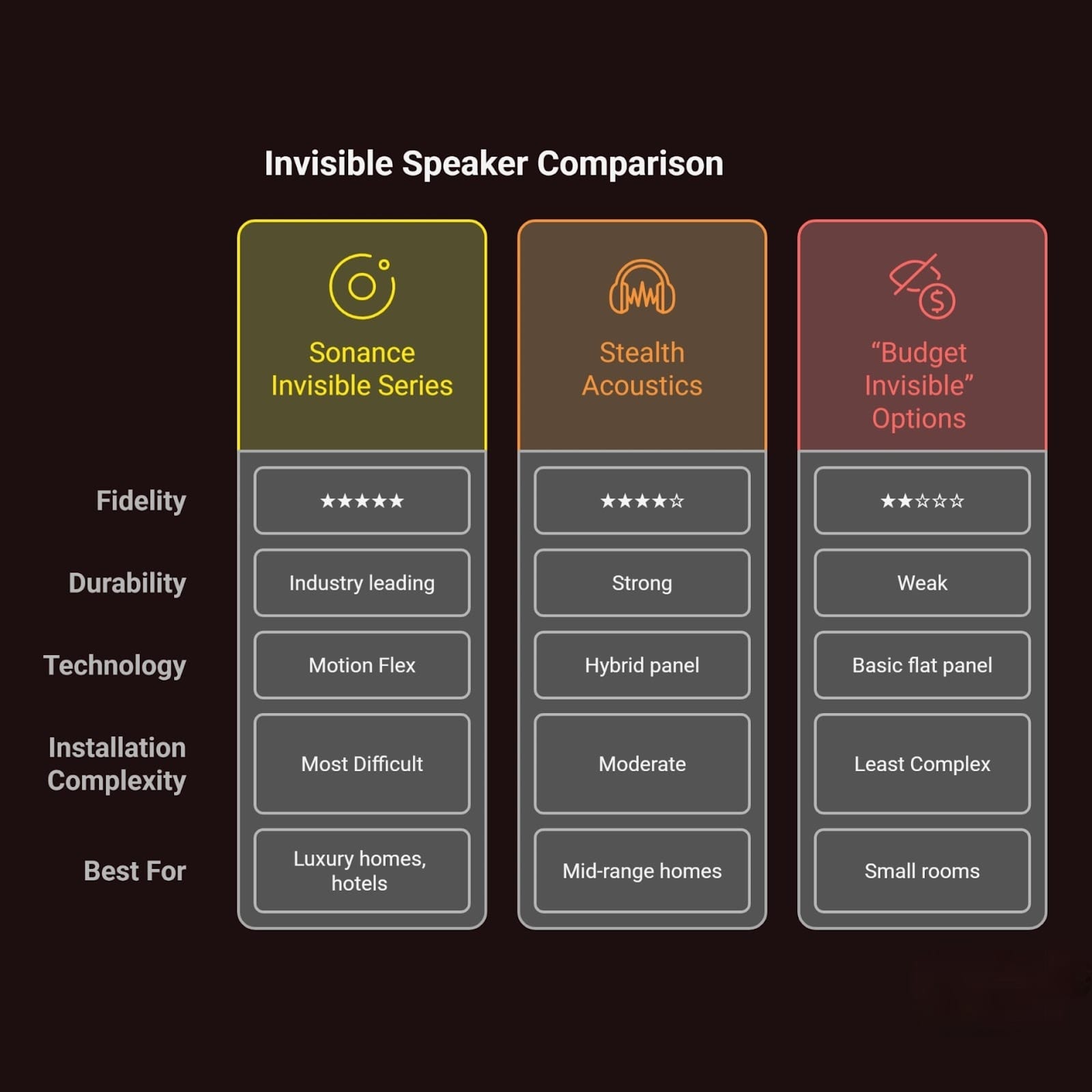
Sonance Invisible Speakers vs. The Field — Which Brand Wins?
In the real world, the following is a comparison of each brand:
What About “Bose Invisible Speakers”? (Important Clarification)
"Bose Invisible Speakers," "Bose 300 Invisible Speakers," and "Bose Virtually Invisible 791 Speakers" appear frequently within the consumer realm when searching for "invisible speakers". However, it is essential to note that none of these are actual invisible architectural speakers.
Bose's official documentation clearly states that their "Virtually Invisible 300" and "Virtually Invisible 791" speakers are surface-mount or in-ceiling speakers and should never be mounted in a wall cavity or behind drywall.
These products are excellent consumer audio solutions, but they do not disappear behind plaster, paint, or wallpaper, nor do they offer the performance or installation flexibility required for luxury design-driven homes or commercial projects.
For truly invisible, drywall-over applications, only brands like Sonance Invisible Series or Stealth Acoustics offer the technology designed for that level of aesthetic integration.
✔ Best for high-endLow-cost projects: Sonance
They deliver the most balanced frequency response and the best long-term reliability. This is why most high-end architects specify them.
✔ Solid mid-range option: Stealth Acoustics
Good for builders who need invisible audio on a budget but still want architectural audio solutions.
✔ Low-cost/no-name brands: Avoid them
They often crack under mud, distort at high volumes, and fail fast.
What Does the Installation Process Look Like? (and Why No Builder Should Try to DIY it)
All parties involved in the installation process of an invisible speaker work together to provide a complete end-to-end experience. These include:
- The integrator
- The drywaller
- The painter
- The designer
Below is a step-by-step explanation of the actual process:
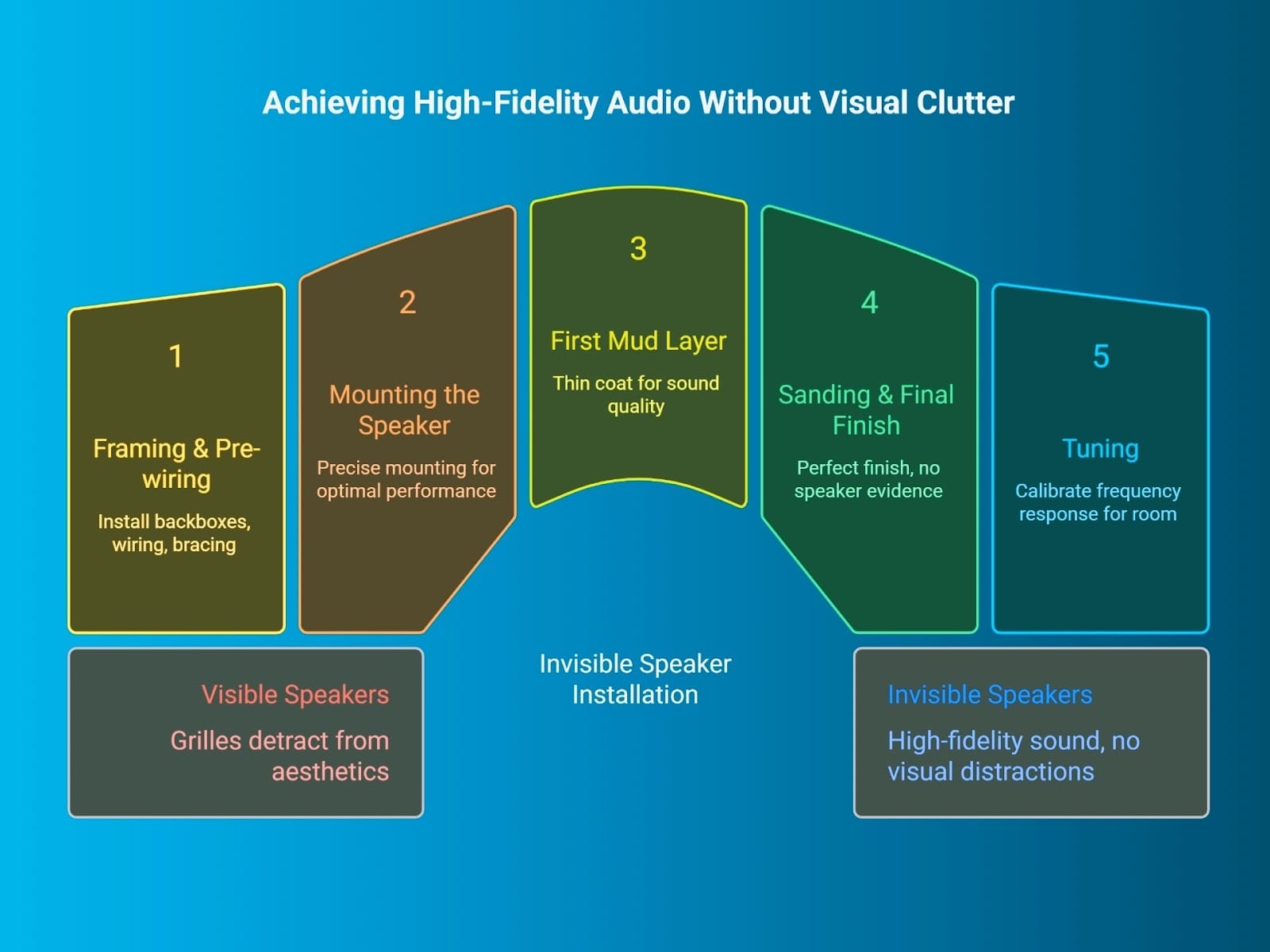
Step 1: Framing & Pre-wiring
We install backboxes, wiring, and bracing before drywall.
Step 2: Mounting the Speaker
Mounting the speaker is a very precise process. If the speaker is mounted incorrectly, even by 1/8 inch, it will affect how well it performs.
Step 3: First Mud Layer
A thin coat is applied. Applying too much mud can cause muddying of the highs. Not applying enough mud can lead to cracking.
Step 4: Sanding & Final Finish
The sanding process provides a perfect finish that leaves no evidence that the speaker is there.
Step 5: Tuning
We calibrate the frequency response for the room.
Why you should never let a standard drywall crew handle it
- Mud applied too thick ruins high-frequency detail
- Incorrectly bracing the area around the speaker can create vibrations that can cause damage to the surrounding structure.
- Over-sanding exposes the panel
- Incorrect drying times cause micro-cracks
Invisible speaker installation is not the same as installing a regular ceiling speaker. Treat it like a specialty trade.
How Much Do Invisible Speakers Cost in 2025?
You can expect prices to range as follows for invisible speakers in Texas:
Average total: $1,500–$3,500 per speaker zone. As invisible audio solutions are considered premium solutions, treat them as such – design upgrades, not commodities.
Conclusion
Invisible speakers have become high-performancedesign-driven and design driven solutions for modern architecture. If you're designing a project that requires both aesthetic and acoustic considerations, then invisible speaker installation services in Texas will provide unparalleled results if performed by a skilled integrator.
If you're building a luxury home, luxury hotel, or design-driven remodel then invisible audio offers the ultimate flexibility when it comes to design, without sacrificing the integrity of the audio system.
Frequently Asked Questions
Q1: What is the typical lifespan of an invisible speaker?
10-20 years, depending upon installation quality, climate-controlled, environment, and quality of materials used.
Q2: Can invisible speakers be installed behind wallpaper?
Yes. Many designers ask for this type of installation. This type of installation may require a thinner skim coat than normal and specialized adhesives.
Q3: Are invisible speakers suitable for bathroom and/or outdoor installations?
Yes, but only with moisture-rated models from brands like Sonance.
Q4: Do they need subwoofers?
For large rooms, yes. Invisible speakers excel at mids/highs; subwoofers fill the low frequencies.
Q5: Who should install invisible speakers in Texas?
high-performanceA certified integrator experienced with drywall-over audio systems—not a DIY installer.
Ready to simplify your next project? Book a free consultation with a Seiits.com integration specialist and get clear, expert guidance on design, wiring, product selection, and system planning—before costly mistakes happen.
Comments ()