
Control4 vs Crestron: The 2026 Architect's Integration Guide
Control4 vs Crestron integration guide for 2026. We compare installation speed, reliability, and design consistency to help architects and builders choose the right system.
Introduction:
For architects and builders prioritizing predictable timelines and standardized design, Control4 is the superior choice. Crestron remains the leader for ultra-custom estates requiring bespoke features, but it introduces higher integration complexity and reliance on specialized programmers.
An architect’s job isn’t just design. It is orchestration. From millwork to HVAC, all finishes, fixtures, and systems should work together. When clients ask for smart home integration, their point of great concern is not technology complexity, but predictability.
At this point, two names flood every pre-construction conversation: Control4 and Crestron.
These are two industry leaders with somewhat different focuses:
- Control4 is the standardized and predictable platform that offers the safest bet for easy coordination and client operability.
- Crestron leads the market in customization. It is unrivaled in flexibility but highly dependent on programming quality.
This guide breaks down which is truly easier for architects and builders to integrate. We focus not just on the user, but on the professionals managing risk, design intent, and client satisfaction.
Why Predictability is More Important than Features
Q: Why do architects and builders value “ease” in smart home systems?
Because “ease” means literally fewer surprises.
A smart system that is simple to install, behaves consistently, and looks the same on every project makes life easier for the entire design team. In fact, according to Statista’s 2025 Smart Home Market Report, three out of four new luxury homes are now designed with prewired automation infrastructure - and they require cross-trade coordination between the architect, builder, and integrator.
When technology is volatile, the effect is felt in all disciplines:
- Lighting layouts must adjust around keypad systems.
- Low-voltage runs delay drywall or finish carpentry.
- Design continuity is lost if user interfaces vary from room to room.
Predictability protects timelines, budgets, and reputations, which is why architects increasingly prefer Control4 for typical luxury builds.
Why Should I Care about Control4?
Q: Why do architects and builders call Control4 the “safe choice”?
Because Control4 is based on the ideas of consistency and simplicity.
Its operating system (now Control4 OS 3) has a standardized interface, which looks and works the same around the world. Whether it's a 4,000 square foot villa in Dallas or a 12,000 square foot mansion in Miami, the layout, icons, and user interface of the app are the same.
Advantages to Architects and Builders
- Predictable hardware - uniform keypad sizes and switch options simplify design drawings.
- Faster approval cycles - clients understand the UI immediately.
- Lower commissioning time - out-of-the-box templates and driver libraries reduce on-site labor.
- Lutron & HVAC integration - Less friction between other trades.
In one recent Seiits-managed project in Austin, the architect noted, “Control4’s wall stations matched our CAD layouts perfectly. No re-routing or re-cutting required - it just worked.”
The Risks of Crestron
Q: If Crestron is more powerful, why isn’t it the default choice?
Because power does not equal predictability.
Crestron Custom is legendary for flexibility. It can integrate everything from pool pumps to motorized skylights. However, it is coded from scratch by the integrator. The result relies strongly on the expertise of that specific dealer.
A great dealer can build a system that is magical. An average dealer can produce client frustration and endless service calls.
Key Strengths
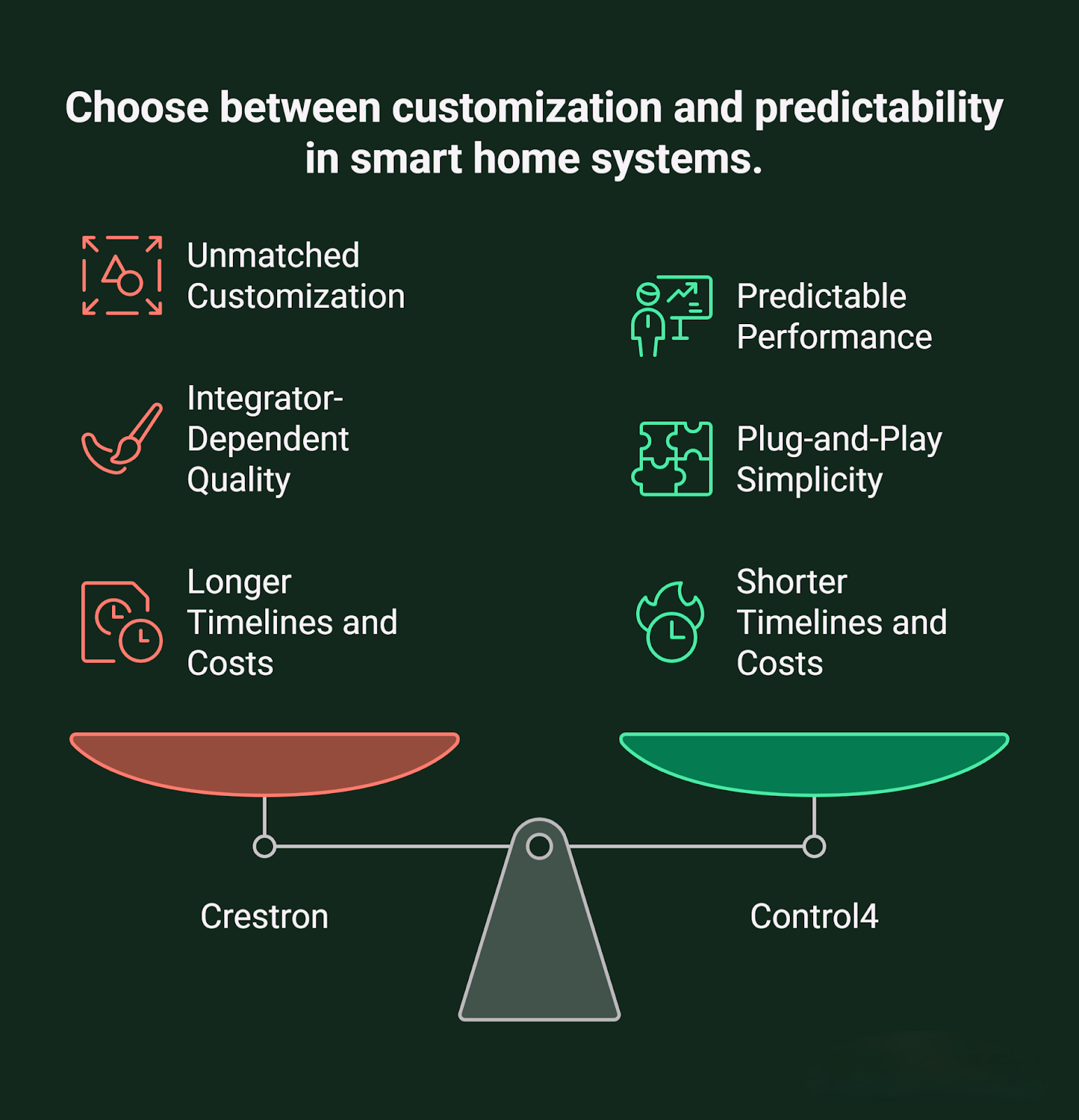
- Unmatched customization: Any automation logic can be programmed.
- Enterprise-grade reliability: Hard-wired and low-latency performance
- Freedom of design: totally customized touch-screen layout and hardware finishes.
Key Risks
- Integrator-dependent quality: Client experience depends on the dealer.
- Longer timelines: Custom code adds weeks to commissioning.
- Higher lifetime costs: Updates require reprogramming.
A Los Angeles architect told CE Pro that, "Our Crestron home was brilliant when we completed it, but it required re-tuning twice when we modified the lighting design." Control4 would have been plug-and-play.
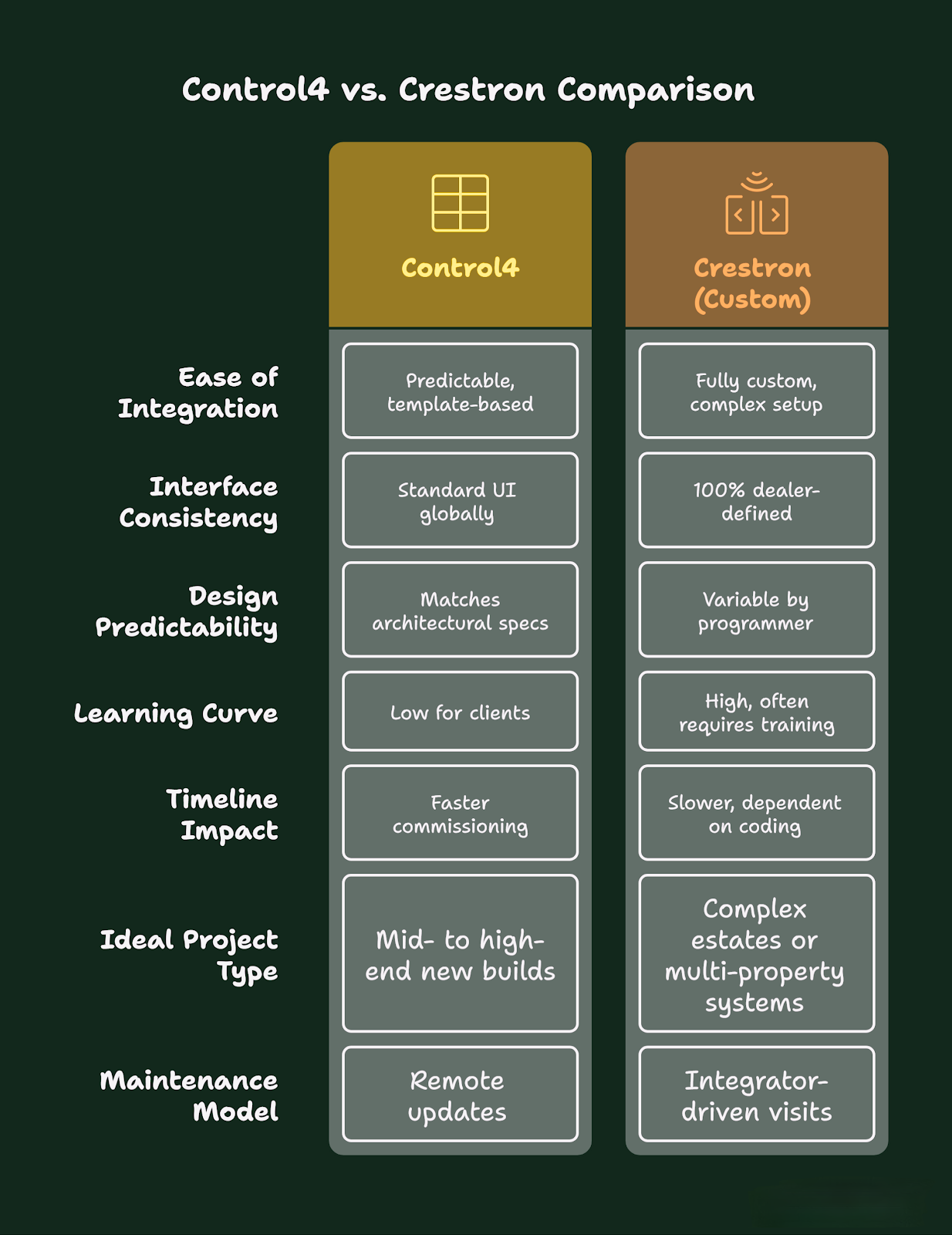
Control4 vs. Crestron - A Side-by-Side Comparison
Verdict: For architects and builders who value certainty, Control4 remains the practical, risk-managed option.
The Architect’s View - Integrating Without Compromising Design
Q: How does Control4 align better with architectural workflows?
Because the design process is like an architect's own. Control4 documentation includes keypad layouts, pre-wire schematics, device dimensions, and network requirements, especially important when designing high-performance Wi-Fi infrastructure for luxury homes.
This takes the guesswork out and provides the ability to coordinate easily with lighting, HVAC drawings, and cabinetry drawings before construction.
Crestron requires early integrator involvement to finalize programming logic and user interface layouts, which is why understanding when to hire a smart home integrator during pre-construction is critical for architects and builders
Builder's Perspective: Fewer Delays, Lower Risk
Q: Which system reduces construction friction?
Control4.
Builders appreciate its predictable installation schedule and consistent commissioning process. Because Control4 follows standardized wiring and programming workflows, electrical and low-voltage contractors know exactly what to expect.
Crestron offers flexibility but can complicate coordination with electricians, especially when custom relay modules or nonstandard power loads are involved.
In Seiits-led projects, we have tracked that Control4 installations typically finish 30 to 40% faster than equivalent Crestron deployments. This is a measurable advantage when carrying costs and strict timelines matter.
Expert Opinion: Which Is “Easier” in 2026?
“Easier” does not mean better or simpler. It implies a reduced risk for the professional in charge of delivery.
- For architects and builders, Control4 wins on:
- Predictability of installation and programming
- Design alignment and CAD compatibility
- Speed of commissioning and client onboarding
- Easy maintenance over its entire practical life by an operator
- For custom estate projects, Crestron is still the most flexible – but it needs a premium integrator and client budget to go with it.
Frequently asked questions
Q: Can Control4 and Crestron both integrate with Lutron lighting?
Yes, both pair beautifully with Lutron HomeWorks for lighting and shades.
Q: Which system offers faster installation?
Control4 - preconfigured templates minimize on-site time.
Q: Which requires more programming?
Crestron - every command and interface is custom-coded.
Q: Which platform’s UI is easier for clients?
Control4 - its mobile and wall interfaces look identical across homes.
Q: Which offers greater design freedom?
Crestron - full customization of hardware, finishes, and logic.
Conclusion:
For most new luxury builds, architects and builders need a system that enhances their workflow rather than complicates it.
Control4 is the predictable partner. It integrates seamlessly with design plans, reduces risk, and delivers consistent client satisfaction.
Crestron is the creative powerhouse. It is perfect for estates that demand total control, provided you have a top-tier integrator managing it.
In short: Control4 for confidence. Crestron for customization.
Building or designing a luxury smart home in Texas? Our experts at Seiits.com collaborate directly with architects and builders to design smart-ready infrastructure for Control4, Crestron, and Lutron systems.
Book Your Service Call Today
Comments ()