
Outdoor Speakers for a Pool and Backyard: How Many You Need and How to Lay Them Out
One loud pair of patio speakers blasts the people nearby and leaves the pool in silence. Here is how many outdoor speakers a Texas backyard really needs, where they go, and how to keep the neighbors on side.
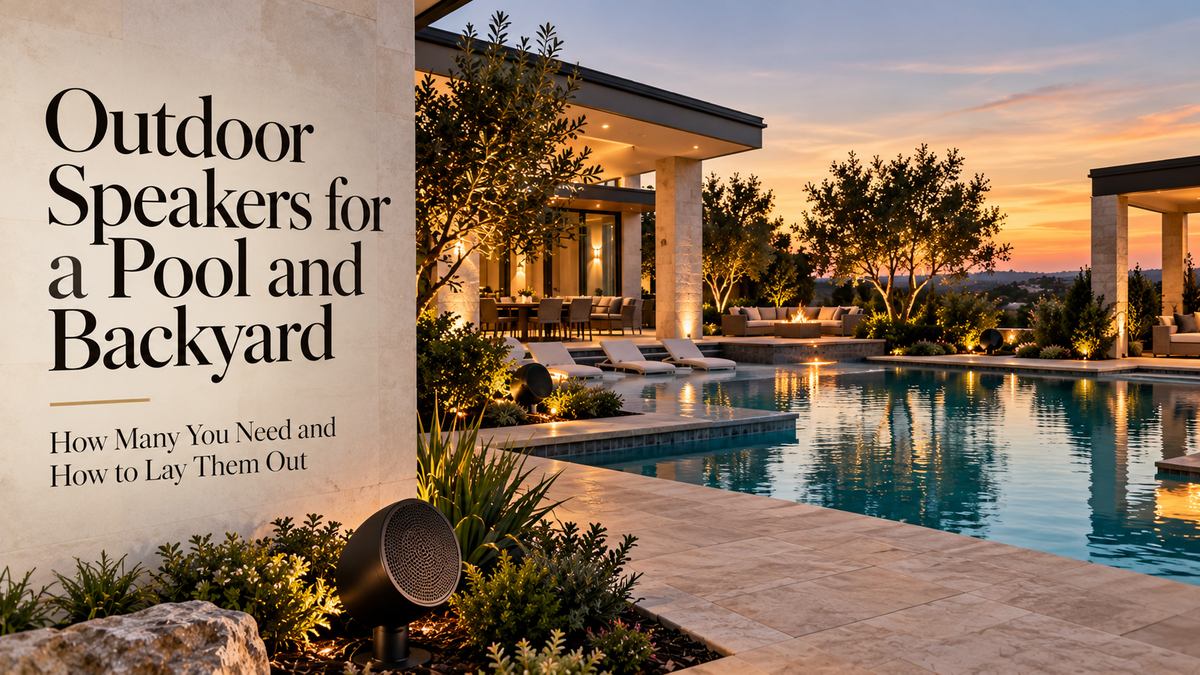
Saturday evening, forty guests, one pair of speakers bolted under the patio eave. The people nearest the house shout over the music. The ones by the pool can barely hear it. Someone turns it up, and the neighbor texts.
From a SEIITS planning perspective, the mistake we see most often is treating the backyard as one listening area. A pool deck, covered patio, spa, outdoor kitchen and lawn usually have different listening patterns, so they should not automatically share the same speaker placement or volume level.
When we plan outdoor audio for a Texas estate, we start with where people actually spend time, where the equipment can be protected from the weather, and where cable can be installed before landscaping and hardscape close access. The right outdoor speakers for a pool and backyard come down to how many you use, where you put them, and how the zones are split, not how loud any single speaker can play.
SEIITS's audio-visual service includes outdoor entertainment systems: landscape speakers hidden in planting beds, rock speakers, covered-patio ceiling speakers, marine-grade poolside speakers, outdoor subwoofers and commercial amplification in weatherproof enclosures, all synchronized with the indoor audio. Here is how to plan one.
How many outdoor speakers do you need for a pool and backyard?
As a starting point, plan one pair of outdoor speakers for every 200 to 400 square feet of space where people actually listen, a rule of thumb This Old House's outdoor speaker guide also uses. Measure the patio, pool deck, spa and lawn separately, because each becomes its own zone, then add a subwoofer for the areas where people gather.
Count listening areas, not the whole lot. An 800-square-foot pool deck works out to two to four pairs by that rule, while a lawn used twice a year may need none. The table below is a planning starting point; a site walk should adjust it for walls, trees and seating.
|
Outdoor area |
Typical approach |
Planning note |
|
Covered
patio or loggia |
Ceiling
or under-eave speakers |
Often
one or two pairs; the roof helps contain sound |
|
Pool
deck |
Distributed
landscape speakers around the edge, plus a subwoofer |
Spread
evenly so swimmers and loungers hear the same level |
|
Spa
or fire pit |
Its
own small zone |
Quiet
listening needs separate volume control |
|
Lawn
and garden |
Landscape
or rock speakers in the beds |
Only
where people actually spend time |
|
Outdoor
kitchen or bar |
Under-counter
or overhead speakers |
Group
with the patio for parties |
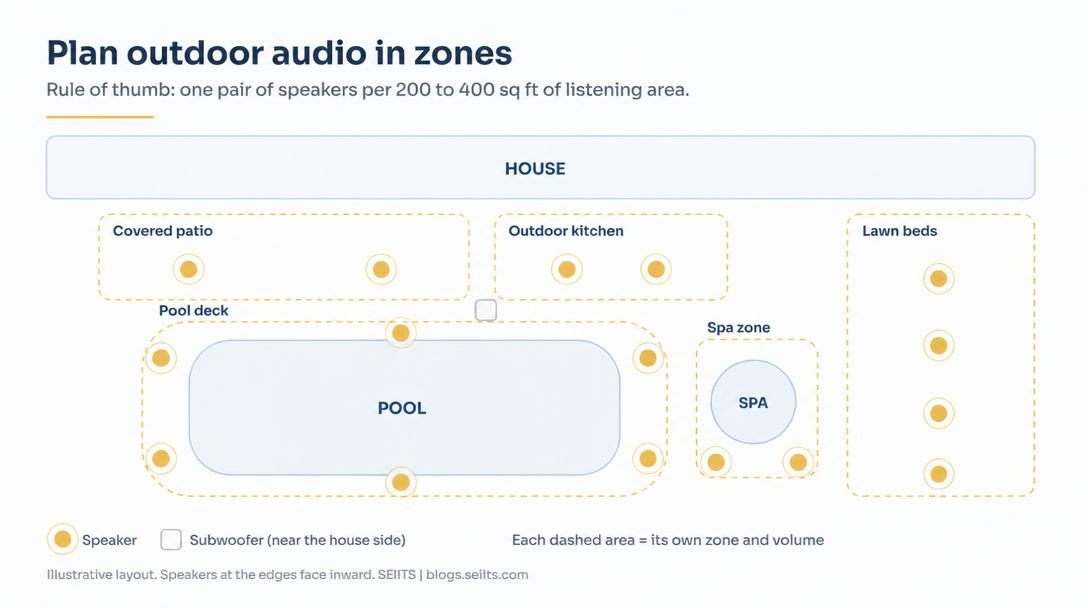
How SEIITS approaches an outdoor audio layout
For a Texas estate, speaker count is only the starting point. Before recommending equipment, the planning should account for:
- Listening zones: pool, patio, spa, outdoor kitchen and lawn
- Seating patterns: where people actually sit rather than the total property size
- Hardscape timing: whether cable can be installed before pavers, decking or planting
- Texas exposure: direct sun, humidity, rain and temperature swings
- Equipment location: where amplifiers can remain protected and ventilated
- Neighbor impact: speaker direction, subwoofer placement and evening volume
- Whole-home integration: whether outdoor audio needs to work with lighting, pool controls and indoor zones
Why do many small speakers beat one loud pair?
Many small speakers beat one loud pair because they spread sound evenly at a moderate volume, instead of making it very loud near one spot and faint everywhere else. Outdoors, there are no walls to reflect sound back, so level falls away quickly with distance from a single source.
A distributed layout keeps every seat at a comfortable level, which is what makes background music feel effortless at a dinner party. It also keeps the volume at the edge of the property lower, because no single speaker has to be pushed hard to reach the far side of the pool. A subwoofer, often hidden in a planting bed, supplies the low end that small satellite speakers cannot.
Which outdoor speakers survive Texas weather?
Outdoor speakers that survive Texas are those rated for outdoor use against water, sun and temperature swings, installed with weather-rated cable and with amplifiers kept out of direct heat. Summer sun, Gulf Coast humidity, pool chemicals and the occasional hard freeze all test cheaper speakers quickly.
1. Covered areas: ceiling or under-eave speakers, protected from direct rain and sun.
2. Planting beds: landscape satellite speakers on stakes, hidden among plants.
3. Open ground: rock-style speakers or in-ground subwoofers that blend into the hardscape.
4. Pool edge: marine-grade speakers built for splash and humidity.
5. Amplifiers: indoors, in the equipment room, or in a ventilated weatherproof enclosure. A sealed box in afternoon sun shortens their life.
6. Cable: outdoor or direct-burial rated, or run in conduit, and installed before pavers, decking and planting close the route.
Timing matters most. Cable runs to the pool edge and garden beds are easy while the hardscape is open and painful afterward, the same principle the new construction planning guide applies inside the house.
How do you keep outdoor music from bothering the neighbors?
You keep outdoor music neighbor-friendly by aiming speakers in toward the listening areas, using more speakers at lower volume, and setting volume limits by zone and time of day. Local noise rules are enforced at the neighbor's property line, so what matters is the level that reaches it, not the level on your deck.
Houston is a useful example. Its noise ordinance sets residential limits of 65 dB(A) during daytime hours and 58 dB(A) at night, according to a City of Houston committee presentation on Chapter 30. Other Texas cities and many HOAs have their own rules, so check yours before the party, not after the complaint.
Design handles most of it. Speakers along the property edge should face inward, subwoofers belong near the house rather than the back fence, and a late-evening scene can lower every outdoor zone automatically at a set time.
Should outdoor audio be wired or wireless?
Permanent outdoor audio should be wired: speakers connected by cable to amplifiers that stream music from the home network. Portable wireless speakers suit a picnic, but they run on batteries, cover one spot and rarely match a distributed system for even sound.
The streaming still depends on the network, so outdoor coverage matters. The mesh WiFi vs access points guide covers how to extend a strong signal outdoors, and the WiFi dead zones guide explains why far corners of a Texas property often drop out.
How should outdoor audio connect to the rest of the home?
Outdoor audio should be part of the whole-home system: the same app, the same music sources, and zones that can play together for a party or separately for a quiet swim. The SEIITS audio-visual page describes a "Pool Day" scene that turns on the outdoor speakers, adjusts pool equipment, opens patio shades and sets outdoor lighting in one step.
That only works when the systems are planned together. See why pool automation should not be a separate app, how smart lighting and whole-home automation tie in, and how indoor speakers disappear into walls in the invisible speakers guide. The broader picture is in the AV installation guide for Texas homes.
Frequently asked questions
How many outdoor speakers do I need?
A common rule of thumb is one pair of outdoor speakers for every 200 to 400 square feet of listening area. Measure each area separately, such as the patio, pool deck, spa and lawn, and treat each as its own zone. Add a subwoofer where people gather, then adjust for walls, trees and seating.
What are the best speakers to put around a pool?
The best speakers around a pool are outdoor-rated models built for splash, humidity and sun, often described as marine grade, placed around the pool edge so everyone hears the same level. Keep the amplifiers indoors or in a ventilated enclosure, and run weather-rated cable before the decking goes in.
Do I need a subwoofer for outdoor speakers?
For most pool and patio systems, yes. Small outdoor satellite speakers cannot reproduce deep bass, and outdoors there are no walls to reinforce it. A subwoofer hidden in a planting bed or buried in the ground fills in the low end, and placing it near the house helps keep bass away from neighbors.
Are rock speakers any good?
Rock speakers can sound good and hide well in open ground, especially as part of a distributed system with several speakers and a subwoofer. On their own, a single pair rarely covers a large area evenly. Choose outdoor-rated models and place them where the sound aims toward the listening area, not the fence.
How loud can outdoor music be in Houston?
Houston's noise ordinance sets residential limits of 65 dB(A) during daytime hours and 58 dB(A) at night, measured at the property receiving the sound. Other Texas cities and HOAs set their own rules. Aiming speakers inward and using more speakers at lower volume helps stay within limits.
Music that sounds the same by the spa as it does on the patio is a design decision. Book your free Home Technology Assessment at seiits.com/assessment to plan your outdoor audio properly.

Comments ()